
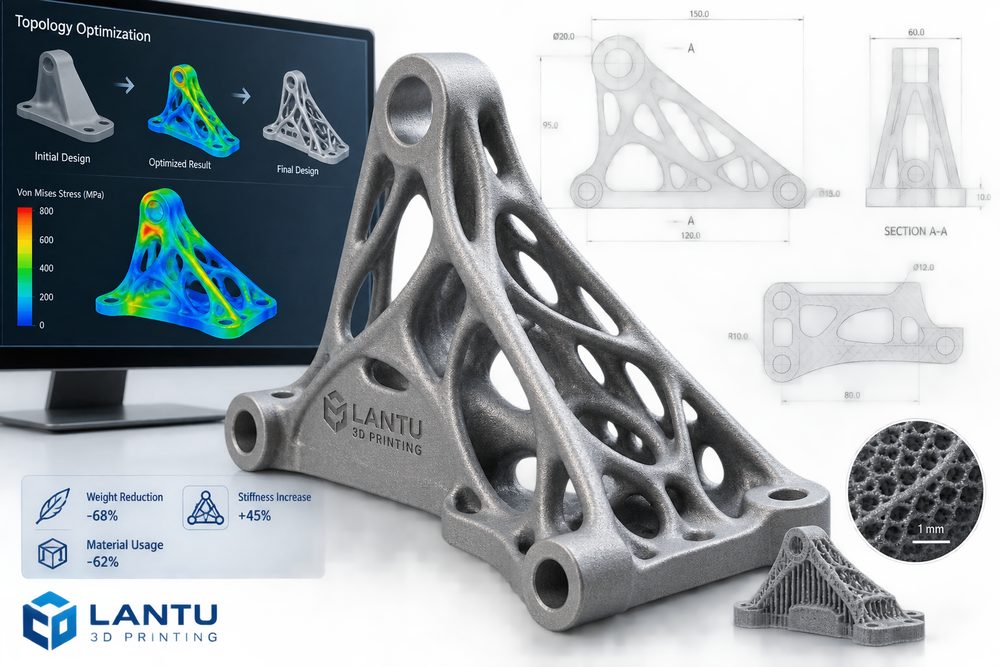
Introduction: Complex Shapes Do Not Equal Good Design
Topology optimization is often seen as the most representative design capability of 3D printing: parts take on organic curves, internal lattice structures appear, weight drops significantly, and everything looks very “advanced.” But in real projects, whether lightweight design succeeds does not depend on how complex the model looks; it depends on whether it satisfies requirements for load, stiffness, fatigue, assembly, manufacturing, and inspection. A bracket that is 40% lighter but has stress concentration around bolt holes, trapped powder that cannot be removed after processing, or no room for assembly tools is not a good engineering design.
When handling lightweight projects, lantu3D typically places topology optimization in a closed loop of “design - simulation - process - verification,” rather than sending software output directly to the printer. Only by considering boundary conditions, material performance, print orientation, and post-processing constraints together can topology optimization evolve from a visual highlight into a deliverable capability.
1. Define the Goal First: Weight, Stiffness, and Cost Cannot All Be Optimized Indefinitely
The first step in lightweight design is to clarify the objective function. Common goals include reducing weight by 20% to 50% without lowering stiffness, increasing the first natural frequency at a fixed weight, or reducing material usage and print time while maintaining a safety factor. The clearer the goal, the easier the optimization result is to verify. Conversely, if the only instruction is “make it as light as possible,” the algorithm may sacrifice mounting surfaces, maintenance space, or fatigue life.
Engineers need to specify load directions, load magnitudes, operating frequencies, fixed regions, non-changeable regions, and safety factors. For example, fixture parts may focus on static-load stiffness, robot end effectors must also consider inertia and vibration, and aerospace brackets may need to account for both fatigue and temperature conditions. Different goals lead to completely different structural forms.
2. Topology Optimization Results Must Be Rebuilt for Manufacturability
The topology result produced by software is usually a density map or an irregular mesh and cannot be used directly as a production model. In the implementation stage, geometric reconstruction is required: preserve the main load paths, smooth sharp edges, add transition fillets, standardize hole locations and mounting surfaces, and provide necessary powder-drain holes, support-contact zones, and machining allowances. For metal SLM parts, overhang angle, heat accumulation, and support removability all affect part quality; for SLS nylon parts, lattice openings that are too small may make it difficult to remove residual powder.
Lightweighting does not always require complex lattices. Shell thinning, rib layouts, hollow structures, part splitting and assembly, and material substitution can be just as effective. lantu3D often recommends first using a low-risk方案 to achieve 70% of the weight-reduction target, then evaluating whether a high-complexity lattice structure is truly needed. This lowers print failure rates and post-processing costs.
3. Materials and Processes Set the Limits of Lightweight Design
The same topology can perform very differently when printed with different materials and processes. PA12 nylon is suitable for complex structures, lightly loaded functional parts, and small-batch fixtures, offering good toughness and design freedom; photopolymer resins provide fine detail but have limited long-term load-bearing and temperature resistance; aluminum and titanium alloys are suitable for high-strength lightweight applications, but they also require higher cost, heat treatment, and machining effort.
Layer thickness, print orientation, and support strategy also affect strength. Thin rod structures loaded in the Z direction may be more brittle than those oriented in the XY plane, and thin walls and sharp corners are prone to defects. In the design stage, engineers should combine material data, machine experience, and sample testing instead of directly applying idealized material parameters from CAD software. For critical parts, it is advisable to print tensile coupons or localized structural samples to verify performance under real process conditions.
4. Verification: Prove with Data That Weight Reduction Has Not Sacrificed Reliability
Lightweight design must pass through a verification loop. Common checks include finite element stress and displacement analysis, modal analysis, real assembly testing, static-load or fatigue testing, critical dimension inspection, and environmental simulation. For batch delivery, first-article approval and sampling inspection rules are also needed to ensure that variations caused by different material lots, machines, and post-processing remain within acceptable limits.
Verification results should also feed back into design revisions. For example, if a bracket appears safe in simulation but cracks around a hole during bolt tightening, that means local contact stress or post-processing notch effects were not fully considered. Increasing thickness around the hole, adjusting fillets, changing the print orientation, or using metal inserts is often more effective than simply increasing the overall wall thickness.
Conclusion: The Core of Topology Optimization Is the Engineering Loop
The value of lightweight design in 3D printing lies not in complex appearance, but in enabling material to work along the real load path. When companies advance topology optimization projects, they should first define goals and constraints, then perform manufacturability reconstruction, and then iterate based on material, process, and verification data. As a lifecycle management platform from blueprint to physical part, lantu3D emphasizes unified management of design optimization, printing processes, post-processing, and inspection, helping customers achieve lightweight results that are explainable, repeatable, and deliverable.
Submit a model, drawing, image or written notes. Engineers will review material, process, finishing and delivery based on actual use.