Introduction: SLS stability comes from detail management
SLS nylon printing is widely used in consumer electronics, automotive interiors, jigs and fixtures, and medical aids because it does not require conventional support structures and is well suited to complex geometries and low-volume functional parts. However, many project risks do not come from whether a part can be printed, but from whether dimensions remain consistent within the same batch, whether the surface finish is uniform, and whether strength is reproducible. To achieve stable delivery, powder, equipment, nesting, cooling, and post-processing must all be managed as one system.
1. Powder condition sets the lower limit of part quality
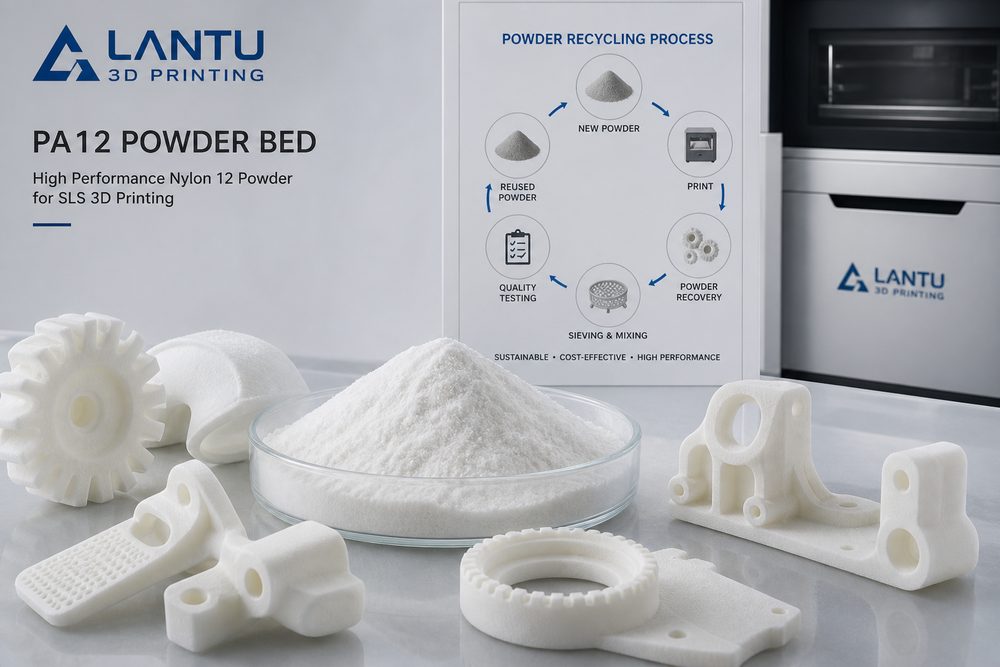
The particle-size distribution, moisture content, flowability, and refresh ratio of PA12 powder directly affect powder spreading quality. Once powder absorbs moisture, it can easily cause uneven sintering, yellowing on the surface, or reduced strength; too high a ratio of used powder may also increase part brittleness. In practice, teams should record the refresh ratio, lot usage, powder-drying time, and ambient humidity, and establish a powder turnover log. For higher-requirement functional parts, batch variation can be reduced by fixing the blend ratio of fresh and used powder and performing sampled tensile testing.
2. Nesting strategy affects both dimensions and cost
SLS may seem able to be packed densely, but the spacing between parts, placement orientation, and heat distribution will affect warpage and dimensional deviation. Long, slender parts should not all be packed tightly in the same orientation, and thin-walled structures need sufficient heat-dissipation space. Nesting also affects cost: increasing build density helps spread machine time across more parts, but excessive stacking raises the risk of depowdering difficulty and scrap. The right strategy is to balance lead time, strength orientation, post-processing efficiency, and build risk.
3. Temperature profile and cooling cadence cannot be ignored
The core of SLS is keeping the powder bed in a stable temperature window close to the melting point. Insufficient preheating leads to weak interlayer bonding, while overheating can easily cause caking or deformation. Cooling after the build is equally critical; forcing the chamber open and removing parts may shorten waiting time, but it can also introduce warpage and internal stress. For dimension-sensitive parts, a standard cooling time should be defined, and chamber-opening temperature should be included in production records.
4. Post-processing and inspection improve delivery confidence
Depowdering, sandblasting, dyeing, impregnation, and assembly inspection all shape the customer’s final perception of the part. Batch orders should include first-article approval, sampled dimensional inspection, and appearance-grade standards. For functional parts such as snap-fits, hinges, and thin-wall housings, assembly trials or cyclic testing can be added to avoid a situation where a part “looks acceptable” but fails in use.
Conclusion
The competitiveness of SLS nylon printing is not about the speed of a single machine, but about the combination of powder management, process parameters, nesting experience, post-processing, and inspection standards. If manufacturers can digitize, standardize, and trace these steps, they can maintain stable quality and predictable delivery times in low-volume, high-mix orders.
Submit a model, drawing, image or written notes. Engineers will review material, process, finishing and delivery based on actual use.