Introduction: Why 3D Printing Delivery Is More Than Just a Successful Print
In 3D printing projects, many teams focus on dimensional accuracy, material performance, and post-processing results, while underestimating the impact of packaging and shipping on final acceptance. A resin appearance part with a 1.2 mm wall thickness may be dimensionally correct and have an intact painted surface inside the printer, but if it is squeezed or rubbed during transit, it can still arrive with chipped edges, broken clips, or scratched locating surfaces. For the R&D validation, small-batch pilot production, and display model projects served by Blueprint3D, packaging is not an administrative step; it is part of the engineering delivery chain.
The core goal of packaging and shipping management is not simply to “pack it thicker,” but to strike a balance among cost, volume, lead time, and protection. Overpackaging increases freight costs, unpacking time, and environmental pressure; insufficient protection leads to rework, reshipment, and customer complaints. A more mature approach is to establish packaging rules based on part risk: structural strength, surface grade, dimensional tolerance, material brittleness, production quantity, and end-use scenario all determine the packaging plan.
1. Build Packaging Tiers Based on Part Risk
The first category is low-risk structural parts, such as PA12 nylon SLS parts, mounting brackets with wall thickness above 2.5 mm, and tooling fixtures that do not require a high-gloss surface. These parts typically have good impact resistance and are suitable for a combination of individual bagging, dust-proof packaging, and standard cartons. One thing to note is that nylon surfaces may have a slight powdery feel; if they are packed together with dark painted parts, surface contamination may occur, so material segregation is still necessary.
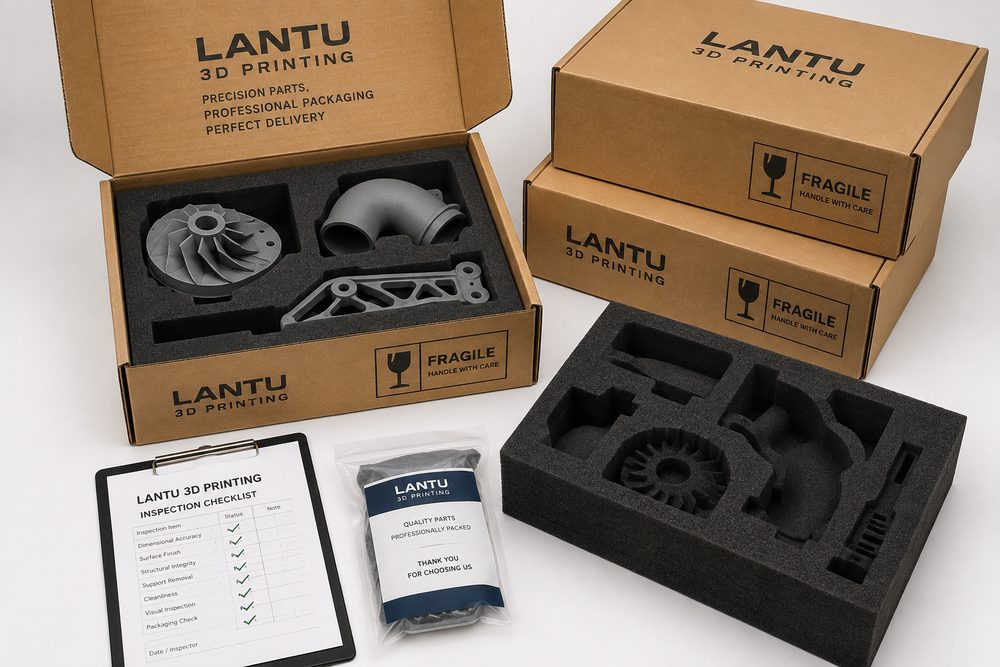
The second category is medium-risk functional prototypes, such as parts with threaded posts, thin-wall clips, cantilever beams, or locally machined surfaces. These parts should use single-piece compartments, EPE foam slots, or honeycomb cardboard positioning, and critical surfaces should avoid direct contact with rigid carton walls. For mating surfaces and sealing surfaces, removable protective film or soft spacers can be added. When Blueprint3D handles this type of order, it typically performs a “shipping orientation” assessment before packaging to confirm that load-bearing directions will not concentrate on clips, sharp corners, or slender posts.
The third category is high-risk appearance parts and transparent resin parts, including painted models, display prototypes, transparent housings, and thin-wall complex curved surfaces. In addition to impact resistance, these parts must also be protected against friction, dust, humidity, and light exposure. It is recommended to wrap them in nonwoven fabric or soft film, then use custom foam to limit movement on the outside. Transparent parts should not be taped directly to avoid adhesive residue. For parts with higher unit value or longer lead times, box-in photos should be taken and the packaging level recorded.
2. Packaging Design Must Match the Characteristics of the 3D Printing Process
Shipping risks differ by process. SLA photopolymer parts have fine details but limited toughness in some materials, so thin posts, thin edges, and sharp corners are more likely to fail under drop impact. SLS nylon parts are tougher, but uncolored or light-colored parts can easily absorb dust, so contamination prevention is especially important. SLM metal parts are strong, but their sharp edges may scratch other parts or packaging materials, so chamfer protection and individual isolation are required. Large FDM parts have visible layer lines; if bending occurs along the layer direction, the risk of interlayer cracking increases locally.
Packaging engineering should be involved early at the CAD stage. If a part must be shipped over long distances, temporary ribs, shipping support bridges, or removable protective frames can be added in areas that do not affect function, and removed by the customer or service provider after arrival. For thin-wall shells, temporary support blocks can be designed inside the model to reduce shell deformation during shipping. For multi-part assembly prototypes, moving components should be fixed at the center position to prevent shaft-pin wear caused by transport vibration.
3. Shipping Validation: Reduce Batch Risk at Low Cost
When order quantities exceed 20 pieces, unit value is high, or the destination is far away, simplified shipping validation should be performed. Common methods include 30 cm corner drop tests, horizontal vibration simulation, carton load testing, and unpacking re-inspection. Not every project requires laboratory-level ISTA testing, but internal validation should at least confirm that the packaging will not fail during normal courier sorting.
During validation, three indicators should be recorded: whether the parts are damaged, whether the surfaces are scratched, and whether the positioning is loose. If a part moves noticeably inside the box, positioning structures should be added rather than simply increasing the amount of filler. Filler can cushion impact, but it cannot replace proper positioning. For small-batch deliveries, it is recommended to test-pack and ship 1-3 parts first, then apply the results to the full order.
4. Labels, Checklists, and Traceability Make Incoming Inspection More Efficient
Packaging and shipping should not only protect the parts, but also help customers quickly verify the delivery contents. Each outer carton should include the project number, quantity, fragile warning, opening direction, and contact information; inner packaging should correspond to the packing list so customers do not need to compare model files one by one. For parts in the same project that look similar but differ in size, QR codes or numbered labels are recommended to link material, process, post-processing, and inspection records.
Blueprint3D pays more attention to end-to-end management from blueprint to physical delivery, so packaging labels should be integrated with production data. After customers receive the parts, they can trace the printing batch, post-processing method, and quality inspection records by number. If shipping damage occurs, it is also possible to quickly determine whether the issue came from packaging design, the carrier, or the part structure itself, rather than relying on fragmented communication.
5. Cost Control: More Protection Is Not Always Better
Packaging cost is usually composed of material cost, labor cost, volumetric weight, and management time. For a single sample, custom foam may be reasonable; for 100 low-risk nylon parts, excessive customization may push packaging cost above the necessary level. It is recommended to keep packaging cost within 2%-8% of the order value, with a moderate increase allowed for high-value display pieces or cross-border shipments.
Reusable packaging is also worth considering. For recurring customers, turnover boxes, replaceable foam inserts, and standard label positions can be designed to reduce long-term costs and save the time required to redesign packaging each time. For enterprise customers, stable packaging specifications can reduce warehouse receiving pressure and improve internal circulation efficiency.
Conclusion
Packaging and shipping for 3D printed parts are not an afterthought to delivery, but an engineering step in product realization. By using risk-based tiers, process matching, shipping validation, label traceability, and cost control, companies can significantly reduce breakage, misdelivery, and rework. Blueprint3D recommends incorporating packaging and shipping requirements at the project review stage so that every physical part transformed from a digital model can reach the customer site in a traceable, inspectable, and reusable way.
Submit a model, drawing, image or written notes. Engineers will review material, process, finishing and delivery based on actual use.