Introduction: Why functional prototypes should be judged on more than whether they can be printed
In new product development, functional prototypes are often used for structural verification, assembly checks, fixture trials, and small-batch market testing. Many projects focus only on whether the model can be formed at the beginning, while overlooking the impact of material modulus, heat deflection temperature, moisture absorption, surface roughness, and post-processing on the actual validation result. A sample that looks acceptable may still fail to support engineering decisions if it breaks after repeated snap-fit assembly and disassembly, or warps significantly in a 60°C environment. Blueprint3D treats 3D printing as a lifecycle management process from blueprint design to physical delivery, which means material selection must be evaluated together with structure, process, inspection, and delivery timing.
1. The core value of PA12 nylon: stable, balanced, and ideal for iteration
PA12 nylon is one of the most widely used materials in SLS selective laser sintering. Its advantage is not a single extreme metric, but stable overall performance: common layer thickness can be controlled at 0.10-0.15 mm, thin walls are generally recommended to be no less than 1.2 mm, snap-fit areas are usually advised to remain above 1.5-2.0 mm, and rounded corners should be used to reduce stress concentration. For functional prototypes such as handheld device housings, air ducts, clips, and light-load brackets, PA12 offers a good balance of toughness, dimensional stability, and the ability to form complex geometries without support structures.
In real projects, PA12 is also suitable for multiple rounds of iteration. The design team can verify appearance and assembly in the first round, adjust ribs, hole positions, and tolerances in the second, and then move closer to small-batch trial-fit conditions in the third. Blueprint3D usually reminds customers during quotation and manufacturability review to distinguish between display samples, functional samples, and test samples, because each has different requirements for surface finish, strength, and inspection, which directly affects cost and lead time.
2. Modified composite materials: moving from “good enough” to “closer to real operating conditions”
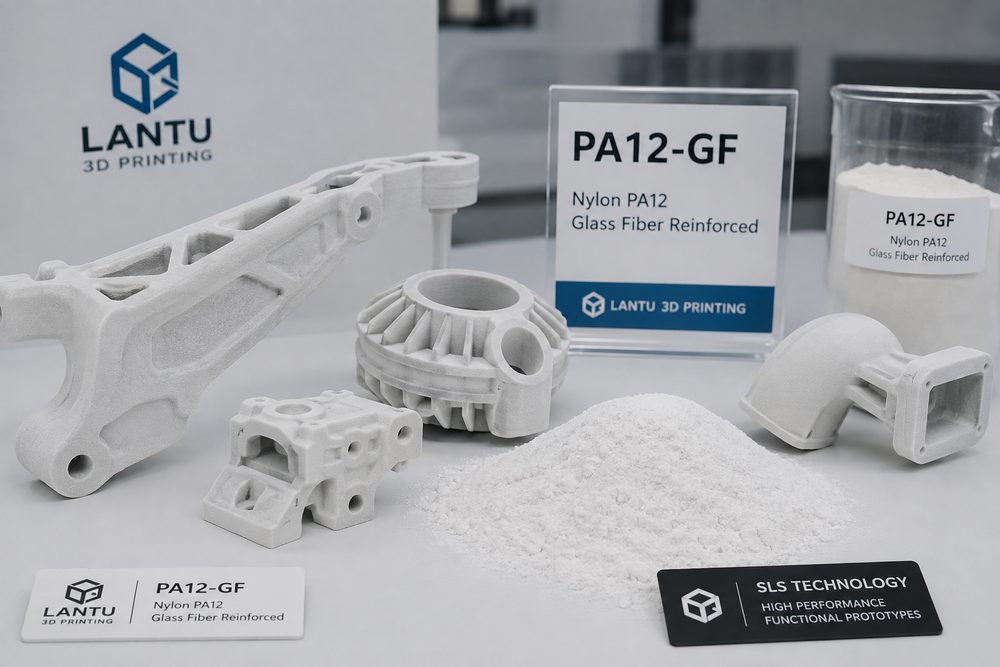
When a prototype needs higher stiffness, better heat resistance, or flame-retardant performance, glass-fiber-reinforced nylon, carbon-fiber-reinforced nylon, or flame-retardant modified materials enter the evaluation scope. Glass-fiber-reinforced materials can improve flexural modulus and are suitable for thin-wall brackets, mounting bases, and load-bearing housings. Carbon-fiber-reinforced materials have an advantage in lightweighting and stiffness, but their surface feel, anisotropy, and post-processing method must be confirmed in advance. Flame-retardant materials are commonly used for validating electronic and electrical enclosures, but the target standard, test conditions, and final production material must be clearly defined so that sample results are not misread as certification conclusions.
Modified materials are not always better just because they are more advanced. Reinforcing fillers may reduce local toughness, making small snap-fits more prone to brittle failure under repeated bending. The batch consistency of powder materials, the recycling ratio, and the sintering window can also affect surface quality and dimensional performance. Therefore, in material-innovation projects, Blueprint3D emphasizes “operating-condition mapping”: first define temperature, load, assembly cycles, contact media, and appearance grade, and only then decide whether a material upgrade is necessary.
3. Structural design must be adjusted in sync with material properties
After changing the material, the structure should not be copied over unchanged. Nylon parts are well suited to using fillets, ribs, and gradual wall-thickness transitions to distribute stress. Reinforced materials, by contrast, should minimize sharp corners and locally weak cross-sections. The outer diameter of screw bosses should usually be determined by the screw specification, insert method, and assembly torque, and holes can be left with 0.15-0.30 mm of machining allowance. For sliding tracks, hinges, and snap-fits, it is recommended to define three clearance levels in the CAD stage: display grade, assembly grade, and motion grade, each corresponding to different post-processing and inspection standards.
If the final part will eventually move from 3D printing to injection molding or CNC machining, the prototype stage becomes even more important for preserving transferable design logic. For example, rib thickness should not be increased without restraint to avoid future injection-shrinkage issues. Load-bearing areas can be achieved through local thickening combined with rib plates rather than simply adding material. Blueprint3D’s role is not merely to print files, but to help customers turn every sample into data that informs the next engineering decision.
4. Inspection and delivery: making material selection verifiable
The outcome of material selection must be validated through a closed-loop inspection process. In terms of dimensions, key hole spacing, snap-fit width, and mating-surface flatness can be set as sampling points. In terms of performance, tests may include assembly cycles, drop simulation, screw retention, and thermal exposure. For small-batch functional parts, it is recommended to specify the material grade, process, layer thickness, post-processing, and inspection items in the delivery list so that future reviews can clearly identify whether a problem came from the design, the material, or the manufacturing process.
In project management, Blueprint3D writes material, process, and delivery risks into review recommendations in advance. For example, nylon parts with high appearance requirements may need sandblasting, dyeing, or coating. Structures requiring tight fits may need localized CNC reaming. Parts intended for long-term loading must be conservatively evaluated for creep and fatigue. This allows customers to make transparent trade-offs among cost, speed, and reliability.
Conclusion: The essence of material innovation is engineering fit
Nylon and modified composite materials offer a rich set of options for functional prototypes, but their real value comes from matching the actual operating conditions. PA12 is ideal for frequent iteration and balanced validation, reinforced materials are suitable for stiffness and heat-resistance needs, and flame-retardant materials are well suited for early-stage evaluation in electronics and electrical applications. Through design review, process selection, post-processing, and inspection closure, Blueprint3D turns material innovation into engineering results that are deliverable, reviewable, and ready for further optimization.
Submit a model, drawing, image or written notes. Engineers will review material, process, finishing and delivery based on actual use.