
Introduction: One Misaddressed File Reveals a Permission Problem, Not an Employee Problem
An additive manufacturing workshop received a customer complaint: a model file that should have been sent only to the person responsible for the project had been forwarded to an external industry peer through a personal email account by an employee who had already changed positions. During the review, the company found that three conditions existed at the same time—the employee's access to the old project had never been revoked after the transfer; file downloads required no approval; and the system had no record of who downloaded which file and when. Together, these three failures turned an operation that could have been intercepted into a data leak that could not be substantiated with evidence.
Such incidents are not uncommon in 3D printing companies. The industry tends to focus on encryption, nondisclosure agreements, and watermarks, but what truly determines data boundaries is the account permission system: who can see what, who approved access, and what trace access leaves behind. Turning these rules into an executable engineering solution is more effective than signing ten more nondisclosure agreements.
1. Why Permission Management Is More Difficult for 3D Printing Companies Than for General Manufacturing
The data forms used by 3D printing companies differ from those of mass manufacturing companies, creating additional complexity in permission design. First, the data granularity is fine. A single part may simultaneously have six types of assets: the original 3D model, the repaired mesh file, the slicing file, the process parameter package, the inspection report, and physical-part photographs. Their sensitivity levels are not the same. Customers often authorize the use of a model for production only, not its secondary modification or forwarding to third parties.
Second, there are many participants. In addition to internal roles in design, process engineering, printing, post-processing, quality inspection, and delivery, there are subcontractors, remote maintenance personnel from equipment manufacturers, customer-side drawing reviewers, and even third-party inspection agencies temporarily involved in a project. Each type of external role requires different data scopes, validity periods, and permitted actions. Attempting to cover them with a single internal account system will inevitably lead to loss of control.
Third, systems are fragmented. Model files are stored on file servers or in object storage; slicing parameters are in equipment vendors' local software; inspection data is on standalone workstations for measuring instruments or CT equipment; and order information is in business systems. Permissions are managed separately across four systems. When an employee changes positions, permissions must be modified in four places, and missing any one of them leaves an exposure.
2. Role Definition: First Translate the Organizational Structure into Data Objects
The most common mistake in a permission system is to directly copy the organizational chart. Job positions are organizational concepts, while permissions are data concepts, and a translation layer is required between them. A practical approach is to first establish a data object inventory, then define roles, and finally map positions to roles.
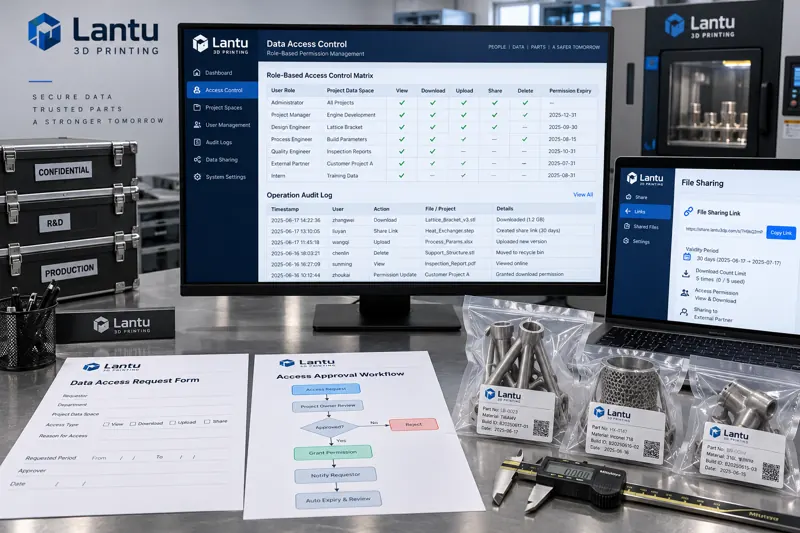
Data objects should be organized by project rather than by department. A project directory contains four subspaces: model, process, inspection, and delivery. Each subspace further distinguishes four actions: read-only, editable, downloadable, and externally shareable. Permissions defined this way naturally include project boundaries, preventing employees working on Project A from casually viewing Project B files.
The number of roles should be restrained. As a rule of thumb, internal roles should be limited to six to eight: project manager, design engineer, process engineer, production operator, quality inspector, delivery specialist, system administrator, and auditor. Too many roles make it impossible for anyone to remember what each role can do, ultimately leading everyone to request administrator privileges. Auditors must be an independent role and must not have any data modification permissions; otherwise, they could delete logs themselves.
3. The Principle of Least Privilege: Deny by Default, Grant Temporary Access as Needed
Least privilege is not a slogan; it requires three verifiable rules. The first is deny by default: before explicit authorization, a newly created account must not be able to see any project. Many systems default to "read access for all employees," which in a 3D printing environment is equivalent to making customer models semi-public.
The second is that authorization must have an expiration period. Regular position permissions should be reviewed quarterly, project-based permissions should be tied to the project end date, and temporary external access should be precise to the day. After permissions expire, the system should automatically revoke them and notify the project manager for confirmation, rather than relying on someone to remember to disable them. The third is separation of actions: downloading and external sharing are two different permissions. Being allowed to download a file for production does not mean being allowed to send it externally; external sharing must be separately approved and recorded.
For highly sensitive data, dual authorization is recommended. Three types of actions require review by a second person before execution: exporting original customer models, exporting complete process parameter packages, and bulk downloads exceeding a defined threshold. The value of the two-person rule is not merely to prevent malicious insiders, but to reduce the likelihood of individual operational errors and leave a second witness afterward.
4. Account Lifecycle: Three-Stage Control for Onboarding, Transfer, and Offboarding
Personnel changes are where permission failures occur most frequently. During onboarding, permission requests should be formalized into tickets: the project manager specifies the required data spaces and action list, an administrator configures access after approval, and the configuration results are written back to the ticket as evidence. Verbal permission requests must be prohibited.
The transfer stage is the most critical and the most easily overlooked. The correct sequence is to revoke old-position permissions first and then grant new-position permissions, rather than layering them. In practice, a more reliable approach is to freeze all project permissions for the account on the transfer date, have the new manager submit new authorization requests, and make all unrequested spaces inaccessible. If the employee still needs to participate in historical projects, access should be requested separately as a project member and assigned an end date.
During offboarding, three tasks must be completed on the same day: disable rather than delete the account, in order to retain log associations; remove project membership in bulk; and invalidate all external-sharing permissions and shared links. Deleting an account breaks the association between actions and users in logs, making later tracing impossible—a pitfall many companies have encountered.
5. Operational Audit Trails: Logs Must Answer Five Questions
Audit trails are not created merely to store logs, but to reconstruct facts afterward. A qualified access log must at least answer: who, at what time, acted on which data object, performed what action, and with what result. In addition to user identity, timestamp, object identifier, action type, and result status, the field design should also record the source endpoint and network location, making it possible to distinguish workshop workstation access from anomalous remote access.
The logs themselves must be tamper-proof. Once written, they must not be modified or deleted, and even administrator accounts must not have deletion privileges. The retention period must be no shorter than the dispute limitation period specified in customer contracts; retention of at least twelve months is generally recommended. Log files must also have access auditing—who reviewed the logs must itself be recorded.
Logs without review are equivalent to having no logs. Three types of automated alerts are recommended: large-volume downloads outside working hours, daily downloads by a single account exceeding three times its historical baseline, and external accounts accessing unauthorized project spaces. An alert does not need to be immediately classified as a violation, but someone must handle it within a business day and leave a disposition record.
6. Boundaries for External Accounts and Shared Links
Customer drawing reviewers, subcontractors, and equipment manufacturer maintenance personnel should all use external accounts with separate namespaces and must not be mixed with the internal account system. By default, external accounts should access only explicitly shared objects, should not see the project directory structure, and should not be able to guess paths to other files through links. Shared links should use non-enumerable random identifiers and be bound to expiration dates and maximum access counts.
Remote maintenance by equipment manufacturers is the channel most easily overlooked. Maintenance accounts typically have high privileges in equipment control systems. If they are connected to the file system on the production network, this effectively opens an external bypass around the permission system. The proper approach is to use a separate network channel for maintenance access, and to include file export actions during maintenance within the same approval and audit-trail process.
7. Implementation Checklist
Companies can conduct a self-assessment using the following items: whether newly created accounts can see no projects by default; whether all permissions currently held by an employee can be listed within five minutes; whether all permissions have expiration dates; whether transfer workflows include layering permissions by granting access before revoking old access; whether downloading and external sharing are two separate permissions; whether logs include source endpoint fields and cannot be deleted; whether external accounts are isolated from internal accounts; whether shared links are bound to expiration dates and access-count limits; whether external-sharing links are invalidated on the day of departure; and whether a permission review was actually conducted in the previous quarter. If three or more of these ten questions cannot be answered, the permission system needs to be rebuilt.
Conclusion
The boundaries of data assets in 3D printing companies are ultimately defined by the account permission system, not by encryption strength or nondisclosure agreements. Translate positions into roles, bind roles to time-limited data objects, set the default policy to deny, and preserve every access event as an auditable record. When these four steps are properly implemented, most data leakage incidents can be intercepted before they occur or clearly substantiated afterward. Permission management is not a one-time policy release, but an engineering mechanism that requires quarterly review and continuous refinement as projects change.
Submit a model, drawing, image or written notes. Engineers will review material, process, finishing and delivery based on actual use.