
Introduction: Disputes Often Arise in the Line Item Missing from the Quotation
In on-demand manufacturing, when customers compare two quotations, the most common concern is not the unit price but an apparently unexplained “engineering fee” on one of them: one supplier quotes CNY 260 per part, while another quotes CNY 320 per part plus a separate one-time charge of CNY 18,000. What truly determines whether a project can be reordered smoothly is not whether this fee should be charged, but whether it has defined cost categories and evidence, whether it will be charged again on the next order, and who owns the fixtures and gauges created for it. As a lifecycle management and implementation platform spanning design blueprints through physical delivery, lantu3D converts such one-time investments—Non-Recurring Engineering (NRE)—from “miscellaneous charges” into verifiable engineering objects within its delivery system. It first breaks down cost categories, then defines amortization rules, establishes tooling ownership and service life, and finally incorporates change, scrap, and reorder decisions into the technical agreement. This article presents a method that can be applied directly to quotations and cost-review sheets.
1. NRE Is Not a Miscellaneous Fee: Break One-Time Investment into Six Verifiable Categories
NRE refers to engineering investment incurred for the first time for a specific project and not required to recur for every delivery. It must be managed separately from variable per-part cost; otherwise, neither pricing verification nor customer substantiation is possible. It is recommended to consistently divide NRE into six categories: 1) data preparation and geometry repair, including freezing units and coordinate systems, non-manifold repair, wall-thickness checks, support generation, and build layout; typically 2–8 labor hours, with a deliverable consisting of a model handover package carrying a SHA-256 hash; 2) process development and parameter-window qualification, progressing through single-track, bulk, and feature-coupon levels, with no fewer than 12 test coupons at each level and records of laser power, scan speed, layer thickness, and volumetric energy density; for Ti6Al4V, a typical volumetric energy-density window is 50–80 J/mm³, with oxygen content verified at ≤1,000 ppm and build-chamber dew point at ≤−40 °C; 3) dedicated tooling, fixtures, and inspection gauges, including locating and clamping design, manufacturing, and CMM calibration; 4) first-article qualification and validation, including FAI, full CTQ dimensional inspection, witness coupons, and necessary non-destructive testing; 5) controlled programs and documents, including parameter packages, work instructions, inspection procedures, and revision numbers; and 6) project coordination and the initial trial-and-error allowance, including records of failure reviews. Every category must be linked to three elements—labor hours or quantity, deliverable ID, and revision number. Any item missing one of these elements must not enter the quotation. This is essential to preventing NRE from becoming an unsupported lump-sum charge.
2. From Cost Category to Quotation: Field Structure, Measurement Basis, and Three-State Decisions
The minimum fields in an NRE detail sheet should include: category ID, category name, measurement basis (labor hour/part/event), quantity, unit price, amount, deliverable ID, evidence link, whether it is charged to the customer, and whether it is reusable. Cost categories and the cost-review sheet must be presented as two separate sections. Change-order additions must not be mixed into the NRE section: change additions are quantified records of scope expansion under an executed contract, while NRE is capability-building investment made before contract formation, so their start points differ. A three-state decision should be used for whether an item is charged: customer-specific items that cannot be reused by the platform are charged at actual incurred cost; general platform capability investments, such as common parameter libraries and standard work templates, are not listed separately and are absorbed into unit cost; customer-specific but reusable items, such as dedicated gauges and frozen parameter packages, are charged once on the initial order and not charged again on reorders. The three-state decision must be jointly signed off by process engineering, quality, and commercial teams, preventing a sales representative from verbally promising “it will not be charged next time” without a corresponding system status.
3. Amortization Quantity: Incorporate One-Time Cost into Unit Price Without Double Charging
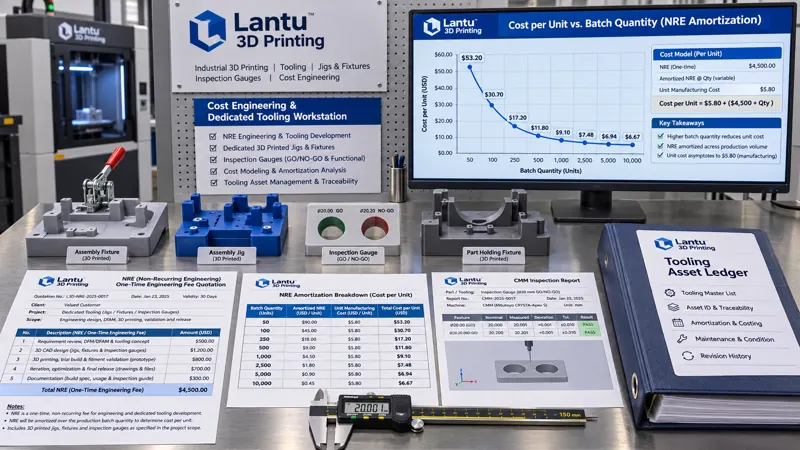
The allocated amount per part is A = recoverable NRE ÷ committed baseline volume N0. N0 must be included in the technical agreement, together with the permitted tolerance band, recommended at ±20%; it must not appear only in a sales email. For example, if recoverable NRE for a project is CNY 18,000 and N0 = 300 parts, then A = CNY 60 per part. With a variable unit cost of CNY 260, the initial-order price including allocation is CNY 320 per part. If actual cumulative volume over 12 months reaches only 180 parts, it should be handled under a “no retroactive shortfall recovery” clause: the shortfall is not charged back to the customer, and N0 is recalculated during review of the second order. If cumulative volume reaches 300 parts and reorders continue, the system should automatically switch the quotation to a “reorder price excluding NRE: CNY 260 plus the agreed annual tooling maintenance fee,” and print an “NRE fully amortized” status on the quotation. For projects with uncertain demand, a three-tier amortization structure may be used: 0–100 parts at CNY 180 per part, 101–300 parts at CNY 60 per part, and above 300 parts at zero; cumulative allocation across all tiers must not exceed total NRE, and the year-end reconciliation variance should be ≤3%. The most common dispute is charging the full amount on the first order and amortizing it again on reorders. This will inevitably occur if N0 and the status field are absent; these two items are therefore mandatory release conditions.
4. Ownership, Service Life, and Custodial Responsibility for Dedicated Tooling
Four categories of objects should be included in the tooling register: printing and post-processing fixtures, inspection gauges, witness-coupon carriers, and dedicated packaging inserts. Three ownership structures may be used: full customer buyout, under which a tooling list, drawings, and CMM report are provided at delivery and the physical tooling is transferred or placed in storage with its storage location identified; shared ownership, under which usage and disposal rights are defined according to payment proportions; and platform ownership, under which only a usage fee is charged and the tooling must not be repurposed for third-party projects. Regardless of the selected structure, the following register fields cannot be omitted: tooling ID, associated project and part numbers, material and manufacturing method, initial calibration date, measured values for positioning accuracy of ≤0.05 mm and repeat positioning of ≤0.02 mm, life in cycles—recommended as 500 clamping cycles or 24 months, whichever comes first—periodic inspection interval, recommended every 100 clamping cycles or six months, and storage conditions, including light protection for resin parts, corrosion prevention for metal parts, and relative humidity ≤60%. Expiration or an out-of-tolerance periodic inspection triggers a scrap-and-remanufacture decision. Cost is allocated in three directions according to cause: normal wear is borne by the owner, customer ECN-driven redesign is borne by the customer, and errors in our custody or calibration are borne by us. Defining service life as a countable quantity rather than simply stating “valid long term” is the prerequisite for turning tooling from an asset into a manageable object.
5. Decision Rules for Changes, Exceptions, and Second Orders
It is recommended that five types of triggers be included in an appendix to the technical agreement: 1) ECN drawing or design changes, linked to the change-order number, with assessment of whether tooling is in one of three states—reuse, modify, or remake—and issuance of an incremental NRE quotation and new N0; 2) scrap and remanufacture caused by the customer, where reprinting is priced per part and NRE is not charged again, while the scrap lot number and responsible party are recorded; 3) project suspension or termination, where incurred and substantiated NRE is settled based on actual labor hours, unincurred portions are refunded, and tooling is handled under the ownership clause with destruction or transfer records retained; 4) second orders and production-site transfers, where transferable tooling incurs only transfer and recalibration fees, while non-transferable tooling is requoted with the reason explicitly stated on the quotation; and 5) volume escalation, where the reorder price applies after N0 is exceeded, but a process-route change—for example, from resin parts to metal parts—requires renewed parameter-window qualification and a separate NRE item. Every rule should correspond to a fillable field rather than a general statement of principle, ensuring that a reviewable object exists when a dispute occurs.
6. A 30-Day Implementation Plan and Eight-Point Self-Check
A four-week implementation schedule is recommended. In week one, establish the category dictionary and labor-hour baselines by extracting and back-calculating at least 20 completed projects from the previous 12 months. In week two, connect the NRE detail sheet to two separate sections in the quotation and cost-review sheet, and add an “NRE fully amortized” status in the system. In week three, establish the tooling register and periodic inspection plan, completing measured positioning-accuracy values and life-cycle counts for every active tool. In week four, conduct end-to-end back-calculation using two historical projects to verify allocation reconciliation variance and consistency of reorder status. The eight-point self-check list is: Are all categories linked to deliverable IDs? Is the measurement basis standardized as labor hour/part/event? Are N0 and its tolerance band included in the technical agreement? Is there a printable “NRE fully amortized” status? Is tooling ownership signed by both parties? Are service-life and periodic inspections current? Does the ECN trigger an incremental NRE quotation? Does the reorder quotation incorrectly charge NRE a second time? Only when all eight checks pass may the project quotation template be reused.
Conclusion
The value of engineering NRE is not to charge customers an additional fee, but to turn the questions of “which investments have already been made, whether they can still be reused, and whether they should be paid again next time” into reviewable data. When the four chains of cost categories, amortization, ownership, and change control are closed, one-time investment is no longer the most ambiguous line on a quotation. Pricing shifts from experience-based judgment to an auditable, reproducible part of the full lifecycle from blueprint to physical delivery. For additive manufacturing services characterized by low volumes and high product variety, this approach protects customers from duplicate charges while also preventing suppliers from silently absorbing capability-building costs into unit prices.
Invia un modello, un disegno, un'immagine o note scritte. Gli ingegneri valuteranno materiale, processo, finitura e consegna in base all'uso effettivo.