Introduction: Late Delivery Is Usually Not Because Printers Are Too Slow
In 3D printing services, one of the customers' biggest concerns is delivery timing. Many projects appear to consist of only a few model files, but the actual workflow may include file checks, process evaluation, nesting, printing, powder removal, support removal, curing, sanding, painting, machining, inspection, and packaging. Any one stage getting backed up can turn an order that could have been printed in 24 hours into a five-day delivery.
The goal of production scheduling optimization is to turn uncertain project flow into a predictable resource plan. Blueprint3D does not position itself as a single printing factory, but as a lifecycle management platform from design blueprints to physical delivery. Therefore, the scheduling system needs to manage equipment, staff, materials, post-processing capacity, and customer priority at the same time, instead of relying on experience and guesswork for commitments.
1. Build a Multi-Process Capacity Model
The first step in scheduling is to convert capacity from machine count into available labor hours and bottleneck capacity. For example, a single SLA machine may have a print time of 6-10 hours, but pre-processing nesting, resin changes, cleaning and curing, and support removal also consume staff and equipment time. SLS nylon machines are suited to stacked nesting, and a single build cycle may reach 18-24 hours; what really determines lead time is build frequency, cooling time, and powder removal capacity. Metal printing must also account for build plate preparation, heat treatment, wire cutting, and nondestructive testing.
It is recommended to break each process into standard steps and record the average time, variation range, and resource constraints. For example, an SLA appearance part can be set as printing 8 hours, cleaning 0.5 hour, curing 0.5 hour, support removal 1 hour, and sanding and painting 1-2 days; an SLS batch part can be set as nesting 0.5 hour, printing 20 hours, cooling 12 hours, powder removal 2 hours, and dyeing 1 day. These data give sales quotations and customer commitments a calculable basis.
2. The Bottleneck Is Not Always in Printing
When many teams expand capacity, the first instinct is to buy more printers, but the real bottleneck may be in post-processing and quality inspection. For example, if 10 SLA machines finish appearance parts at the same time but only 2 post-processing staff are responsible for support removal and sanding, orders will still pile up. Spray booths, drying racks, CMM inspection equipment, and packaging stations can all become key constraints on delivery.
Blueprint3D recommends identifying bottlenecks by work-in-progress volume and waiting time. If the queue before a process remains above 1.5 times the average daily processing volume, a scheduling alert should be triggered. The solution is not necessarily to add more equipment; it may also mean changing batch strategy, preparing fixtures in advance, separating low-requirement surface parts from high-requirement appearance parts, or grading inspection items by risk.
3. Rush-Order Rules Must Be Transparent, Otherwise Overall Lead Time Will Suffer
3D printing services often face urgent orders: trade show prototypes, R&D review samples, replacement parts for a production line shutdown, or last-minute customer changes. Without clear rush-order rules, urgent jobs will repeatedly interrupt normal scheduling and cause many ordinary orders to be delayed. A sensible approach is to create a rush-order evaluation sheet that includes at least customer tier, business impact, process occupancy, post-processing complexity, and whether existing committed orders will be affected.
Urgent jobs should not be judged by how loud the customer is, but by the system impact. A small SLA part that can be completed in 2 hours can be inserted into an overnight machine gap; a batch order that occupies an entire SLS build may push back multiple projects. Dispatch staff should quantify the impact of a rush order, such as the number of orders affected, the expected delay in hours, and the recovery plan, before deciding whether to accept the expedite request.
4. From Lead Time Commitments to Dynamic Feedback
Lead time commitments should be divided into internal planned delivery dates and external committed delivery dates. Internal plans can be tighter to drive coordination; external commitments should include reasonable buffers, especially for projects with post-processing, logistics, and inspection fluctuations. For standard materials and mature processes, the buffer can be controlled at 10%-15%; for new material validation, complex painting, or cross-process combination projects, the buffer should be increased to 20%-30%.
Dynamic feedback is equally important. When a print fails, materials are delayed, or customer files change, the system should automatically update the estimated delivery date and synchronize the reason with sales and customer service. Compared with notifying the customer of a delay only near delivery, explaining the risk 24-48 hours in advance and offering alternatives is far more likely to earn understanding.
5. Digital Dashboards Make Cross-Department Collaboration Visible
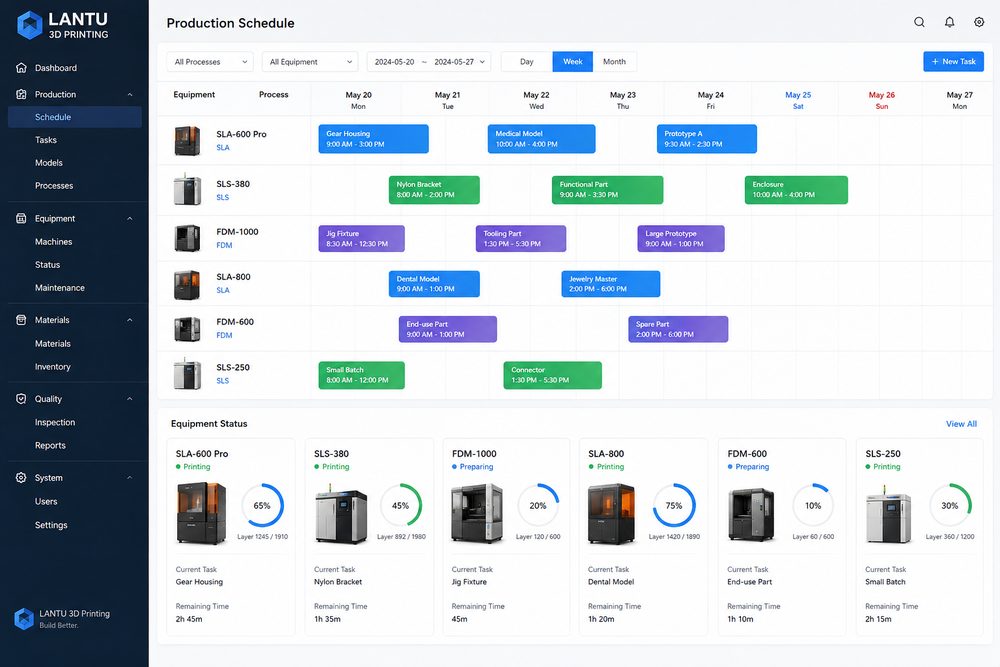
Production scheduling is not the work of the scheduler alone. Sales needs to know which orders can be promised with short lead times; engineers need to know which files must be fixed first; post-processing needs to prepare colors, sandpaper, fixtures, and packaging materials in advance; quality inspection needs to arrange sampling or full-inspection resources. Digital dashboards should display order status, process location, owner, estimated completion time, and exception flags.
The dashboard should not have too many fields, but it must answer three questions: where is the bottleneck now, who is responsible for the next step, and will customer commitments be affected? For a service platform like Blueprint3D, scheduling data can also be fed back into the quotation knowledge base, helping similar future projects produce reliable timelines more quickly.
Conclusion
The key to optimizing 3D printing production scheduling is not to keep every machine fully loaded, but to establish a predictable rhythm across multi-process, multi-person, and multi-post-processing stages. Through capacity modeling, bottleneck identification, transparent rush-order handling, dynamic lead times, and digital dashboards, companies can reduce firefighting and improve the credibility of their customer commitments. Ultimately, lead time management becomes a core capability that helps 3D printing services move from able to make it to reliably deliver it.
Submit a model, drawing, image or written notes. Engineers will review material, process, finishing and delivery based on actual use.