Introduction: A real quality accident
In 2023, a batch of titanium alloy structural parts manufactured by an aerospace company using the SLM (selective laser melting) process suffered early fatigue failure during bench testing. After tracing, it was found that 6 of the 24 parts in the same batch had varying degrees of pore defects, with the defect rate as high as 25%. Due to the lack of complete process parameter records, the source of the problem could not be accurately located, which ultimately led to the scrapping of the entire batch of parts and a direct economic loss of more than 800,000 yuan.
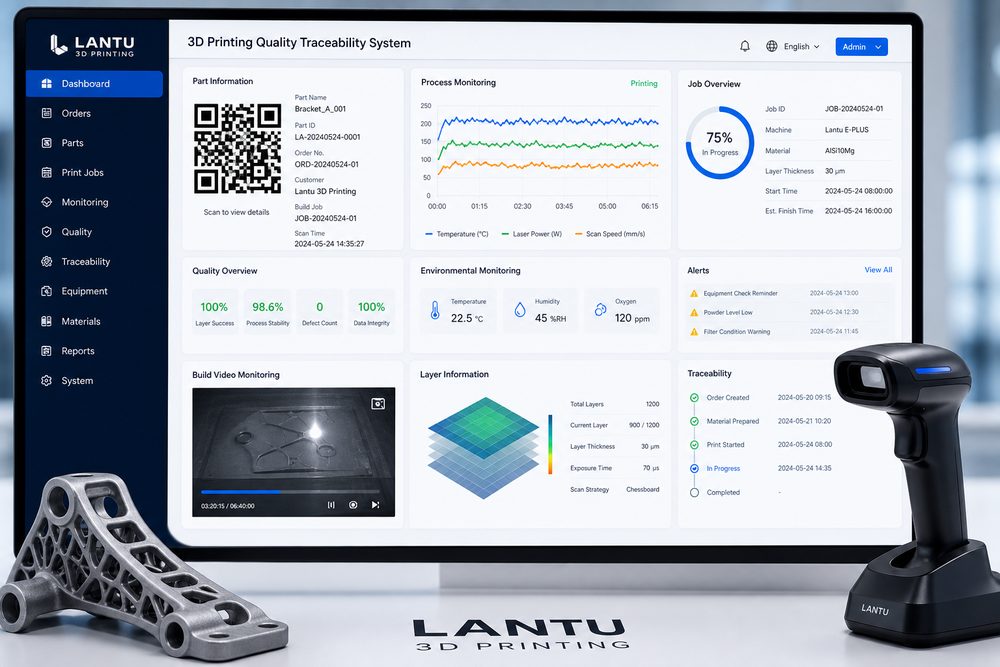
This case reveals the core pain points in 3D printing manufacturing: The complexity of process parameters and the lack of quality traceability. Different from traditional cutting processing, the 3D printing process involves the coupling of dozens of process parameters such as laser power, scanning speed, layer thickness, powder coating parameters, forming temperature, etc. Small deviations in any parameter may lead to internal defects. According to industry statistics, in 3D printing workshops that lack a systematic traceability system, the first-time pass rate of products is usually only 85%-90%, which is far lower than the 95%-plus level of traditional manufacturing.
1. Special challenges of 3D printing quality traceability
To build a 3D printing quality traceability system, we must first understand its essential differences from traditional manufacturing. Taking the two mainstream metal printing processes of SLS (selective laser sintering) and SLM as examples, their quality influencing factors show significant features of multi-parameter coupling and non-linear correlation.
1. Complexity of process parameters
Key parameters of the SLM process include:
- Laser parameters: power 150-400W (titanium alloy typical value), scanning speed 600-1200mm/s, spot diameter 50-100μm
- Scanning strategy: scanning spacing 0.1-0.14mm, layer thickness 30-50μm, scanning angle rotation 67°
- Environmental parameters: oxygen content in the forming chamber Next Step Is this close to what you need?
Submit a model, drawing, image or written notes. Engineers will review material, process, finishing and delivery based on actual use.