Introduction: Temperature Sensitivity Cannot Be Solved Simply by Saying “Keep Away from Heat”
In lantu3D’s lifecycle management from blueprint/design through physical delivery, completing printing, cleaning, and inspection does not mean that the delivery loop is closed. Photopolymer resin prototypes, incompletely post-cured polymer parts, thin-wall parts with temporary supports, functional parts with bonding or coatings, and accompanying resin consumables and calibration coupons are often far more sensitive to transport temperature and humidity than dense metal components. In practice, the problem is usually not that “nobody added ice packs,” but that no temperature window was defined before shipment, that data loggers were placed outside the box or directly against a cold source, and that a temperature curve is available upon receipt but cannot establish whether the batch may proceed to assembly, reinspection, or customer acceptance. A short period of high temperature in an enclosed vehicle during summer may cause dimensional drift, surface tackiness, or changes in post-cure condition; winter freeze-thaw exposure may turn residual cleaning moisture, adhesive layers, or condensation inside the packaging into new quality risks. The goal of a temperature-sensitive delivery chain is not to keep temperature permanently at its lowest level, but to convert “permitted exposure” into engineering criteria that can be measured, calculated, and approved by signature.
1. Define Temperature-Sensitive Items and Temperature Windows First
Temperature-sensitive controls should begin by classifying materials and part conditions, rather than applying a single “fragile/keep away from heat” label to an entire order. Delivery items should be divided into four categories: ① photopolymer resins, engineering resins, and incompletely post-cured parts, with primary control of high-temperature and UV exposure; ② bonded, potted, coated, laminated, and internal-channel parts with cleaning residue, with primary control of freeze-thaw, condensation, and temperature cycling; ③ coupons, furnace test specimens, and standard specimens used for customer reinspection, with primary control of temperature effects on measurement references and material condition; and ④ accompanying consumables such as resins, additives, and adhesives, controlled according to supplier SDS requirements and labeled temperature ranges. For each category, three fields must be frozen in the technical agreement or shipping card: permitted lower temperature limit T_min, permitted upper temperature limit T_max, and permitted short-term excursion rules. For example, a resin prototype category may have a normal window of 5–30 °C, allow 30–35 °C for no more than 30 minutes and no more than 2 cumulative hours, and require quarantine and reinspection upon exposure below 5 °C. Such values must be confirmed through sample validation or supplier data and must not be copied from generic cold-chain thresholds.
2. Packaging Validation: From “A Cold Source Was Added” to a Reproducible Internal Temperature Field
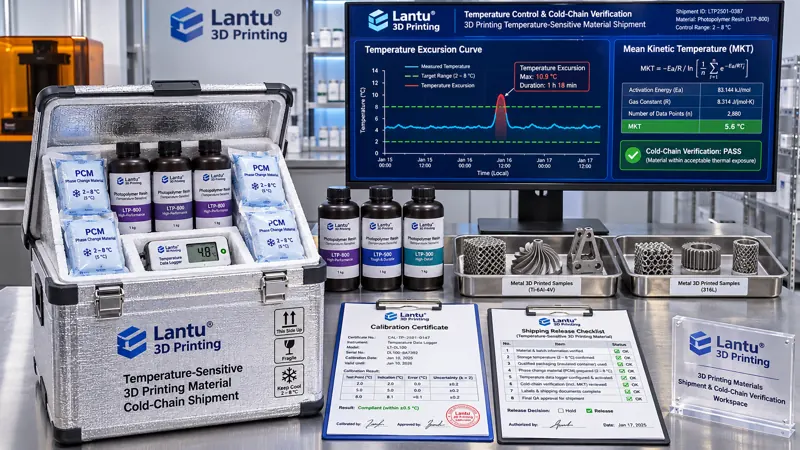
An insulated shipper, phase-change material (PCM), ice pack, or gel pack becomes an engineering solution only after temperature-distribution validation. At least three measurement points should be used during validation: the geometric center of the box, a hot spot near the box wall, and a cold spot near the cold source. One empty-load or simulated-load profile should be run for both summer and winter conditions, with an additional extreme-route trial where necessary. The PCM phase-change temperature must match T_min/T_max. Cold sources must not directly contact parts; partitions, cushioning liners, and breathable isolation layers should be used to create a uniform temperature field. A sampling interval of 1–5 minutes is recommended. Calibration certificates must remain valid, and the logger ID, sensor locations, packing photographs, sealing time, and shipment number must be linked. The validation report should include heating/cooling rates, recovery time after opening, worst-case locations, and temperature margin over a representative transport duration. If the center point passes but a hot spot exceeds the upper limit, the solution cannot be accepted. For parts containing liquids or incompletely dried internal cavities, dew-point margin must also be included in the criteria to prevent condensation immediately after opening upon receipt.
3. Quantifying Excursions: MKT, Cumulative Thermal Exposure, and Three-State Disposition
Reviewing only the “maximum temperature” upon receipt can lead to incorrect decisions. Engineering evaluation should consider three metrics simultaneously: individual limit excursions, cumulative exposure duration, and mean kinetic temperature (MKT). MKT uses an Arrhenius-type relationship to convert different temperature intervals into an equivalent temperature and is suitable for evaluating material changes that are sensitive to temperature-dependent reaction rates. It does not replace every material failure model, but it is more auditable than either automatic rejection based on peak temperature or acceptance based on an average temperature. The activation-energy constant, sampling interval, valid data segment, and units must be fixed for calculation. The original curve, algorithm version, missing-data treatment, and calculation-sheet hash must be retained as evidence. Disposition is recommended in three states: State A indicates that the entire shipment remained within the window and data are complete, allowing routine release; State B indicates a short-term excursion, but MKT, cumulative duration, and appearance/dimensional reinspection all meet predefined thresholds, allowing concessionary release with quality engineer co-signature and documented applicability limits; State C indicates exposure below T_min, prolonged exposure above the upper limit, logger failure, seal anomalies, or inability to verify sensor location, and requires quarantine. Such material may not enter use without reinspection and customer approval. The disposition form must state who signed according to which revision of the criteria; verbal confirmation by logistics personnel is not acceptable.
4. Evidence-Chain Gates for Shipment and Receipt
The recommended minimum record set for a temperature-sensitive delivery chain contains nine fields: part number/batch number, temperature-sensitivity category, temperature-window revision, packaging-solution revision and validation-report number, logger ID and calibration validity, sensor-layout diagram, box-sealing and handover timestamps, transport route and carrier, and hash of the original receipt temperature-curve file. Shipment gates D1–D4 are: D1, the temperature-sensitivity category and window are frozen; D2, the packaging solution has been validated for the applicable season and duration; D3, logger status, battery level, sampling interval, and sensor-location photographs are acceptable; and D4, tamper seals, packing list, exception contacts, and return requirements are complete. Receipt gates D5–D7 are: read the curve before opening, or open in a controlled environment according to the contingency plan; verify tamper seals, shock/tilt indicators, and logger serial number; download original data and generate an A/B/C disposition form. For State B or C events, retain photographs of in-box sensor positions, part appearance and critical-dimension reinspection records, and, where necessary, sampling related to resin viscosity or glass-transition behavior, as well as the customer’s disposition decision. Records must comply with ALCOA+: attributable, legible, contemporaneous, original, accurate, and complete, consistent, enduring, and available. The full temperature evidence package should be traceable from a part serial number within 30 minutes, with a target first-pass traceability success rate of at least 95%.
5. Implementation Roadmap and Common Failure Modes
Implementation can proceed over four weeks. In week one, establish a temperature-sensitivity classification dictionary, temperature-window master data, and a prohibited mixed-packing list. In week two, complete summer and winter packaging temperature-distribution validation and determine worst-case locations and PCM configurations. In week three, embed loggers, sensor maps, tamper seals, curve hashes, and A/B/C disposition forms into shipping and receipt processes, with D1–D7 system blocks configured. In week four, conduct one real-route exercise and one intentional chain-break exercise to verify that data retransmission, quarantine, reinspection, and customer notification are fully closed-loop. Common failures include placing a logger against a cold source so that its curve does not represent the parts; reviewing only maximum temperature while ignoring low-temperature freeze-thaw; selecting PCM without accounting for season and route duration; failing to link curve files to batch numbers, making it impossible to prove which box they represent afterward; allowing State B concessions without reinspection and customer approval; and treating “temperature sensitive” only as a warehouse-storage requirement while excluding transport, transfers, temporary storage, and waiting time before customer receipt from the same temperature account. lantu3D treats these records as part of the design-to-physical-delivery chain: temperature evidence is not a logistics attachment, but a release condition for confirming a part and allowing it to enter the next process or customer assembly.
Conclusion
Controllable delivery of temperature-sensitive parts depends on three things: define the window first, validate the packaging first, and make excursions assessable. Only by linking T_min/T_max, PCM temperature distribution, MKT and cumulative exposure, A/B/C disposition states, D1–D7 gates, the nine-field evidence package, and the ALCOA+ traceability mechanism can “ice packs were included” be upgraded into “was this batch exposed to permissible temperatures, on what basis was it released, and can the decision be recalculated in the event of a dispute?” For high-mix, low-volume 3D-printing deliveries, this method is more valuable than simply increasing packaging cost: it turns temperature variation from a delivery black box into engineering data that can be verified, improved, and jointly confirmed with customers.
Invia un modello, un disegno, un'immagine o note scritte. Gli ingegneri valuteranno materiale, processo, finitura e consegna in base all'uso effettivo.