
Introduction: What Customers Need Is Not a “Green Manufacturing” Claim, but a Verifiable Carbon Figure per Part
More and more customers request a “product carbon footprint per part” from 3D printing service providers during quotation reviews or annual supplier audits, expressed in kgCO2e/part, along with the functional unit, system boundary, and data sources. Many factories already have submetering data, powder issue records, machine parameter packages, and scrap logs, yet the resulting figure cannot withstand scrutiny: How should the electricity used by one part be allocated against the dozen or more other parts on the same build plate? Should emissions from witness coupons, supports, scrap, and rework be included? Which year and version of the grid emission factor was used? What is missing is not data, but accounting rules that organize data into an auditable chain of evidence. lantu3D treats the entire process from design documentation and engineering through physical delivery as a lifecycle management object. Carbon accounting should likewise be embedded in the same traceable engineering language rather than remaining a marketing statement.
1. Define the Functional Unit and System Boundary First: Why “One Part” Is Not a Natural Unit
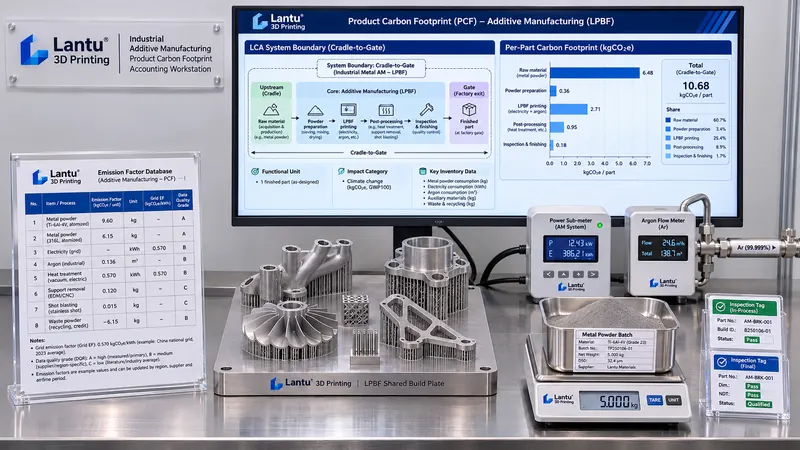
The first step in accounting is not finding emission factors, but defining “one part” as a determinable functional unit. A recommended formulation is: one inspected and accepted part of a specified model, completed with required post-processing and packaging, and delivered at the factory gate. The same declaration should specify the material grade, condition (as-built or heat-treated), CTQ list, and applicable technical agreement revision. The functional unit must be tied to “accepted delivery”; otherwise, allocating scrap to accepted parts or excluding it will produce two fundamentally different results.
A cradle-to-gate boundary is recommended as the starting point, with four segments recorded: (1) raw materials (cradle emissions of metal powder or resin, packaging, and transportation); (2) build operations (machine electricity, shielding gas, auxiliary equipment and standby consumption, build plates, and support material); (3) post-processing (support removal, heat treatment, machining, surface finishing, cleaning, and wastewater/waste-gas/waste-residue treatment); and (4) inspection and delivery (inspection equipment, witness coupons, packaging materials, and internal logistics). For every segment within the boundary, state “included / excluded + reason,” rather than merely drawing a flowchart without explanatory text. The use phase and end-of-life phase may be excluded in an initial version, but their exclusion must be explicitly declared to prevent customers from mistaking a factory-gate figure for a full lifecycle result.
2. How to Collect Activity Data: From Submetering to Shared-Build Allocation
Activity data fall into three categories. The first is measurable direct data: for the build stage, use machine-level submeters to record total kWh; meter auxiliary equipment separately, including chillers, compressors, dust extraction, and powder sieving systems, or estimate consumption from rated power multiplied by operating time. Use cumulative flowmeters to record shielding-gas consumption in m³ per build. Determine powder consumption by subtracting recovered and sieved powder from issued powder, while recording batch number and reuse cycles. The second category is geometry and process data: export scan time, layer count, layer thickness, part volume, support volume, and occupied plate area from the parameter package; these are the numerators used for allocation. The third category is quality outcome data: the number of accepted, scrapped, and reworked parts, as well as witness coupon quantities, from inspection batch records.
The most common source of error in 3D printing accounting is shared-build allocation. Equal allocation by part count is the crudest approach: a single plate may contain large thin-walled parts and small solid parts, whose scan times and occupied volumes can differ by several multiples. A weighted allocation factor is recommended, for example: w = 0.5 × occupied plate area ratio + 0.3 × (volume × layer count) ratio + 0.2 × scan-time ratio. The weighting coefficients should be written into the accounting procedure and, once established, must not be adjusted on a job-by-job basis. Shared consumption—including preheating, empty powder-spreading passes, atmosphere purging, build plates, and witness coupons—should first be assigned to a common build pool and then allocated to individual parts according to w. Consumption attributable to a specific part, such as additional remelting or a second machine run, should be assigned directly to that part. Allocation rules have a greater effect on results than emission-factor precision; rules must be frozen before discussing factors.
3. Emission Factors and Data Quality Ratings: Primary Data Must Not Be Reported Together with Defaults Without Distinction
Emissions are calculated by multiplying activity data by emission factors. Use regional grid factors for electricity consumption (an illustrative range is approximately 0.5–0.6 kgCO2e/kWh, but the actual factor must come from a customer-approved database, with the version year and geographic basis stated). Use upstream factors or supplier product carbon declarations for shielding gas, powder, resin, and packaging materials. Use t·km factors for transportation. Each factor must include five metadata fields: source organization, database version and year, geographic applicability, technological representativeness, and unit conversion coefficient.
More importantly, assign a Data Quality Indicator (DQI) to every data item. It is recommended to score five dimensions—technological representativeness, geographic representativeness, temporal representativeness, completeness, and verifiability—on a scale of 1 to 5, then use either an average or weighted score. Direct measurements from machine submeters with calibration certificates and matching timestamps may be rated Level 1–2; industry averages or database default values may be rated Level 4–5. The declaration must disclose the proportion of high-emission-contribution items with DQI ≥4. Using default factors is not shameful; presenting default factors as measured data is. This is among the first items a verifier will examine.
4. Four Additive-Manufacturing-Specific Amplification Factors That Cause Systematic Underestimation If Omitted
The first is supports and build plates: support material is included in the raw-material stage, and removed support waste must also be included if it is not recovered. Reductions in support volume achieved through overhang-angle optimization should be reflected as lower values under the same functional unit. The second is witness coupons and test specimens: they consume material and machine time but are not delivered as accepted parts. They must be allocated from the shared pool to accepted parts or reported separately as “quality-verification emissions per batch.” The third is scrap and rework: use a yield amplification factor, meaning carbon intensity of accepted parts = total emissions within the boundary ÷ number of accepted delivered parts, rather than dividing by the number of parts initially loaded. Reprints caused by first-build failures can materially increase the per-part figure for that batch; batch variation should be retained in results rather than erased through annual averaging. The fourth is post-processing and three-waste treatment: heat-treatment furnaces, CNC machining, blasting, cleaning, dust collection, and hazardous-waste disposal all have separate energy and material flows that are often broadly classified as “manufacturing overhead” and omitted.
These four factors share one characteristic: they are all “nonconforming or auxiliary” elements, precisely the fields missing from general manufacturing carbon-accounting templates. The accounting procedure should reserve a mandatory field for each of them; even a zero value must be accompanied by a stated reason.
5. Uncertainty, Evidence Chains, and Declaration Boundaries
A single-point value is insufficient for external disclosure. At a minimum, provide an uncertainty range: assign relative uncertainty separately to activity data and factors—for example, ±2% for meters and ±5%–15% for factors—and use error propagation or Monte Carlo sampling for major contributors to report P50 and P95 values, while declaring whether a conservative upper bound or median value is used. Sensitivity analysis should identify the top three carbon hotspots, typically electricity during the build stage, upstream powder production, shielding gas, or heat treatment.
Organize the evidence chain according to ALCOA+ principles, with at least eight items: submeter calibration certificate number and validity period; emission-factor database version screenshot or citation; parameter package revision and build report number; powder batch number and weighing records; scrap and rework log; allocation-rule revision number and weighting coefficients; inspection-batch list of accepted parts; and timestamps for the preparer and reviewer. A carbon figure is verifiable only when a third party can trace it from a spreadsheet back to an original record. The declaration boundary must also state that the result covers the factory-gate scope, excludes the use phase and capital equipment manufacturing, and requires reissuance with retained historical versions whenever allocation rules or factor versions change.
6. Feed Carbon Results Back into Process Decisions Instead of Producing Only a Report
The value of accounting lies in the closed loop. Under the same functional unit, four types of quantitative comparisons can be made: differences in support volume and scan time resulting from alternative orientations and placements; shared-build combination optimization, such as nesting parts with similar scan times to reduce common-pool allocation; substitution of post-processing routes, such as using heat-treatment-free materials or near-net-shape production to reduce machining; and the carbon cost of powder reuse-cycle limits and scrap reprints. Each decision should be evaluated against three indicators simultaneously: carbon intensity per accepted delivered part + yield + lead time, avoiding carbon reductions achieved at the expense of reliability or on-time delivery. When a customer sets a carbon-reduction target, presenting the difference between a baseline and improved version under the same functional unit is far more persuasive than supplying an isolated green label.
Conclusion: An Eight-Item Minimum Checklist
(1) The functional unit is tied to accepted delivery and states the condition and technical agreement revision; (2) the system boundary is segmented and provides inclusion/exclusion reasons for each segment; (3) activity data are divided into direct measurements, geometry/process data, and quality outcomes; (4) shared-build allocation rules are frozen and version-controlled; (5) every factor includes five metadata items: source, version, geography, representativeness, and conversion coefficient; (6) every data item has a DQI rating, and the proportion of high-contribution default values is disclosed; (7) supports, witness coupons, scrap/rework, and post-processing/three-waste treatment are all mandatory entries; and (8) uncertainty ranges, carbon hotspots, and indexes to eight types of original records are provided. Only carbon accounting that can be traced to “one functional unit, one allocation rule, one emission-factor version number, and one certificate number” is fit for inclusion in delivery documentation. This is also the natural extension of linking design documentation, process parameters, and physical delivery into a single verifiable data chain.
Submit a model, drawing, image or written notes. Engineers will review material, process, finishing and delivery based on actual use.