Introduction: The hard part of small-batch production is not 'printing' but 'stable replication'
When many companies first encounter 3D printing small-batch production, they understand it as 'printing dozens more after the sample passes.' In real projects, the real challenges usually appear in repeatability, batch consistency, delivery pace, and change control. A sample succeeding does not mean that 50, 200, or 500 units can be completed with the same quality. Material lot, build orientation, post-processing labor time, inspection sampling ratio, and packaging method all affect the final delivery result.
lantu3D pays more attention to full lifecycle management from blueprint, design, and process to physical delivery. For small-batch orders, the platform needs to answer three questions at the same time: what version the customer confirmed, who is responsible for each step during production, and how to prove before delivery that every product meets requirements. Only by addressing these questions in advance can small-batch production avoid becoming temporary firefighting based on experience.
1. First freeze the requirements: turn 'printable' into 'batch-deliverable'
Before launching small-batch production, three types of freeze should be completed: model version freeze, process parameter freeze, and acceptance criteria freeze. Model files should retain version numbers, such as V1.3 and V1.4, and record the reason for any modification to avoid confusion if the customer sends a new file in the middle of production. Process parameters should at minimum include material, forming process, layer thickness, build orientation, support strategy, post-processing method, and color requirements.
Using SLS nylon parts as an example, if the sample stage uses 0.12 mm layer thickness, natural white, and sandblasted delivery, the batch stage should not casually switch to 0.10 mm layer thickness or a dyeing process. Seemingly minor changes may affect dimensions, surface feel, and assembly clearance. For assembled parts, it is recommended to complete 3 to 5 sets of first-article confirmation before mass production, and to include key dimensions, snap-fit force, and hole fit in the acceptance checklist.
2. Schedule by batch: balance equipment efficiency and consistency
Equipment utilization in 3D printing is often related to nesting density, but small-batch production should not pursue full build volume alone. For parts sensitive to dimensional accuracy, avoid mixing parts with different orientations, different wall thicknesses, and different post-processing requirements in the same batch. A reasonable batch should have the same material, a similar process window, and consistent delivery requirements.
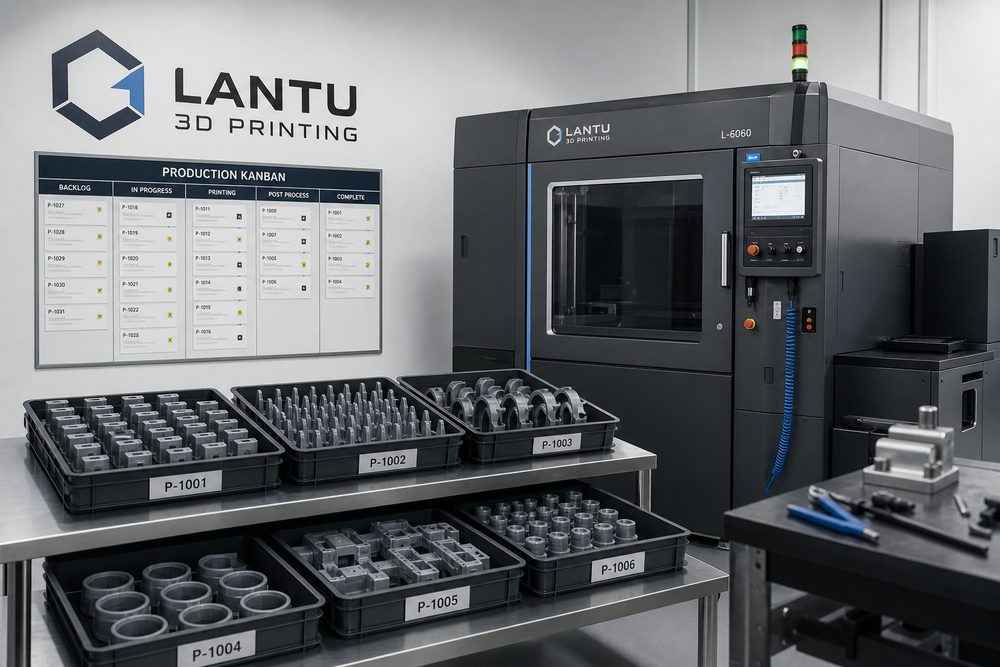
Production scheduling can adopt a three-level numbering system of 'order batch number + equipment task number + post-processing task number.' The order batch number is used for customer delivery traceability, the equipment task number records the printer, material lot, start time, and end time, and the post-processing task number records depowdering, curing, sanding, dyeing, coating, or assembly steps. In this way, even if an individual part is abnormal, it can be quickly traced to a forming issue, a post-processing issue, or a packaging and transportation issue.
3. Quality control should not rely only on final inspection: process records matter too
Common risks in small-batch orders include warping, hole diameter deviation, thin-wall breakage, surface color variation, and assembly interference. It is recommended to divide quality inspection into first-article inspection, in-process sampling, and pre-shipment final inspection. First-article inspection focuses on whether the model version and process are correct; in-process sampling focuses on batch stability; and final inspection focuses on appearance, quantity, labels, and packaging.
For orders under 50 pieces, key dimensions can be inspected 100%; for orders above 100 pieces, a combination of full inspection for key dimensions and sampling inspection for general appearance can be used. If the parts are used for functional verification, it is recommended to record the test load, assembly cycles, or temperature environment. Quality records do not need to be overly complex, but they must be able to answer: which material lot, which machine, which parameter, who inspected, and what the result was.
4. Delivery management: reduce communication costs with checklists
Before delivery, prepare the packing list, quantity verification, fragile area protection, and customer confirmation documents. Thin-wall parts, slender parts, transparent resin parts, and painted parts should use partitioned packaging to avoid scratches caused by transport friction. For multi-part products, it is recommended to bag by set and mark the part number on the packaging so that it corresponds to the BOM list.
At the same time, the project manager should write key production changes into the delivery notes. For example, the customer accepted an adjustment to a reinforcing rib, a slight batch difference in a certain color, or an assembly position that has been corrected based on first-article feedback. These notes can reduce after-sales disputes and provide a clear basis for the next repeat order.
Conclusion: The core of small-batch management is turning experience into process
The value of 3D printing small-batch production lies in speed, flexibility, and low tooling cost, but to truly support commercial delivery, a closed loop must be established from requirement freeze, batch scheduling, in-process quality inspection, to packaging and delivery. lantu3D turns design blueprints into stable physical delivery through platform-based management, so that small-batch orders no longer rely on isolated experience, but on a production system that is reproducible, traceable, and optimizable.
Submit a model, drawing, image or written notes. Engineers will review material, process, finishing and delivery based on actual use.