Introduction: Small-batch orders usually have many SKUs, low quantities, and frequent changes. If they are still managed like single-piece prototyping, version confusion and rework can easily occur
From prototypes to small batches: how 3D printing production management can avoid “the more you make, the messier it gets” is not a single technical issue, but a systems engineering challenge spanning customer requirements, model data, process selection, scheduling and delivery, and after-sales review. For a full-lifecycle management platform like lantu3D, which connects blueprint/design to physical delivery, the key is not whether something can be printed, but whether uncertain demand can be turned into a manufacturing process that is plannable, traceable, and deliverable. A common mistake in the industry is focusing only on machine parameters while ignoring order batches, validation checkpoints, quality records, and cross-department information flow, which ultimately leads to rework, delays, or runaway costs. This article focuses on small-batch 3D printing production management and offers an actionable framework based on small-batch manufacturing scenarios.
1. Define a “production-ready version” before entering batch production
After the sample is approved, the model version, material grade, layer thickness, build orientation, post-processing method, and acceptance criteria must be locked. It is recommended to manage STL/STEP files with version numbers and write key dimensions, tolerance grades, and surface requirements into the production card. For SLS nylon parts, layer thickness, packing direction, powder refresh ratio, and dye batch should be mandatory fields; for SLA resin parts, support positions, cleaning duration, and secondary curing parameters should be recorded. Only when this information is stable can an order move from sample status to small-batch status.
2. Replace verbal scheduling with batch work orders
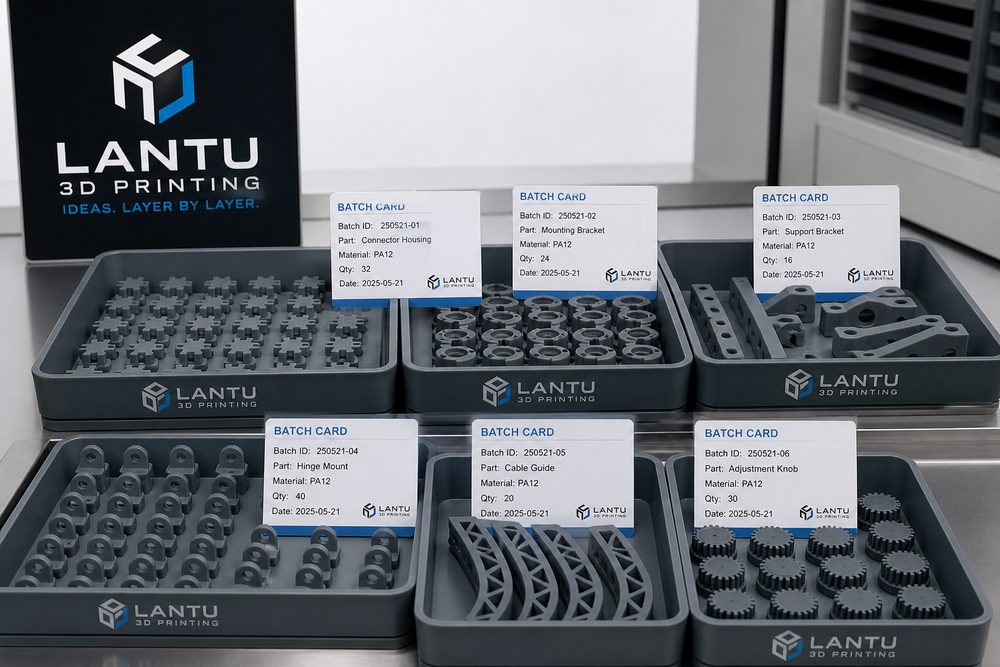
Small batch does not mean making items as they arrive. If a 20-piece order is split into five print runs, differences in color, dimensions, and surface finish may become obvious. A more reliable approach is to create batch work orders based on material, machine, delivery time, and post-processing method, clearly defining the quantity per batch, spare-part ratio, and inspection ratio. In practice, functional parts can have a process spare-part ratio of 3% to 8%, while appearance parts may need to be raised to 5% to 10% depending on post-processing losses.
3. Quality control must cover the first article, the process, and the final piece
First-article confirmation solves orientation issues, in-process spot checks solve variation issues, and final-piece verification solves delivery issues. For dimensional parts, calipers, plug gauges, or a CMM should be used to record key dimensions; assembly parts should retain assembly photos and notes on interference points; and appearance parts should have reference samples for color difference, layer lines, scratches, and sanding boundaries. The lighter the quality record, the easier it is to execute, but it must still be traceable to the machine, material batch number, and operator.
4. Delivery pacing must leave room for post-processing
Many delays do not occur during printing, but during part removal, depowdering, cleaning, curing, sanding, painting, packaging, and other post-processing steps. When managing small-batch orders, post-processing time should be built into the plan rather than treating print completion as production completion. For parts that require painting or dyeing, it is recommended to combine same-color batches and reserve a drying and re-inspection window of at least 24 hours.
Conclusion: Turn experience into repeatable delivery capability
The core of how 3D printing production management can avoid “the more you make, the messier it gets” is to distill scattered experience into standard actions: demands have an intake point, decisions have a basis, processes have records, exceptions have a closed loop, and results can be reviewed. Companies are advised to start with one high-frequency product category or one typical customer project, establish the minimum viable process first, and then gradually expand into a material library, process library, pricing rules, and quality traceability system. What lantu3D focuses on is exactly this kind of continuous capability building from design blueprints to physical delivery, making 3D printing not just a prototyping tool, but a reliable node for rapid validation, small-batch production, and on-demand manufacturing.
Submit a model, drawing, image or written notes. Engineers will review material, process, finishing and delivery based on actual use.