
Introduction: Equipment maintenance is part of delivery capability
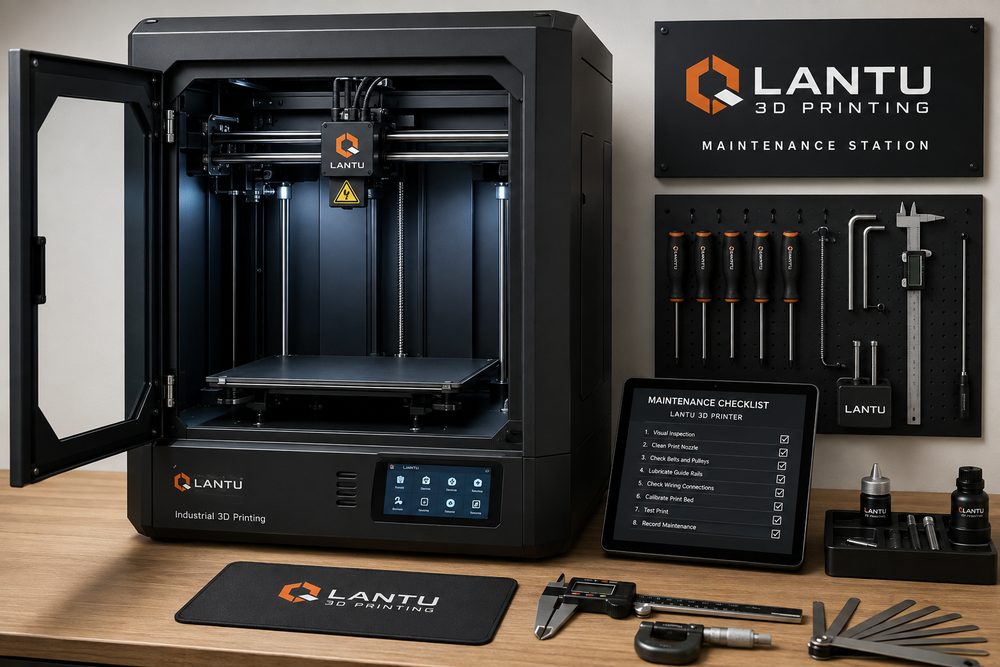
In 3D printing services, equipment is not just a production tool; it is a core resource for delivery stability. Many project delays do not come from model design, but from sudden equipment failures, abnormal material conditions, build platform calibration deviations, or queues at post-processing equipment. During low-traffic night production, if there is no standard inspection routine, problems often surface only during quality inspection the next day, causing entire batches to be reworked. lantu3D integrates equipment maintenance into project lifecycle management and reduces downtime risk through checks, records, and preventive care.
The goal of equipment maintenance is not to make every machine never fail, but to make failures predictable, isolatable, and recoverable. Different equipment such as SLA, SLS, MJF, FDM, and metal printers have different maintenance priorities, but the management logic is the same: confirm status before printing, monitor key indicators during printing, record deviations after printing, and feed exceptions back into scheduling and quoting systems.
1. Pre-print inspection: from the environment to platform status
Pre-print checks should be standardized into a checklist. Temperature and humidity are the first items. Resin and nylon powders are both sensitive to temperature and humidity, so it is recommended to keep the production area at 20-26°C, with relative humidity controlled between 40% and 60% depending on material requirements. If the material absorbs moisture, nylon parts may show rough surfaces, dimensional variation, or reduced mechanical performance, while resin parts may experience abnormal curing.
The second item is the platform and motion system. For photopolymerization equipment, check the cleanliness of the build platform, the condition of the release film, impurities in the vat, and whether the Z-axis runs smoothly. For FDM equipment, check nozzle clogging, extruder gears, heated bed flatness, and first-layer adhesion. For powder-bed equipment, check the recoating blade, powder recovery system, heating zone, and filtration system. Metal equipment also requires checks of the atmosphere, oxygen content, shielding gas, and powder safety management. Each check should be recorded with one of three statuses: normal, observe, or stop for handling.
2. Key component care: replace temporary firefighting with cycle-based management
Equipment maintenance should assign cycles by component. Release films, nozzles, filters, recoating blades, laser windows, guide rails, lead screws, fans, and sensors are all high-impact parts. In SLA equipment, even a slight scratch on the release film may cause local delamination, and residue in the vat may damage the next print. In SLS equipment, uneven powder spreading directly affects surface quality and dimensional stability. If you wait until a finished part fails before investigating, the time cost is much higher than regular replacement.
It is recommended to divide maintenance into daily, weekly, monthly, and quarterly checks. Daily checks focus on cleaning, material condition, and platform reset. Weekly checks focus on motion mechanisms, consumable levels, and filtration systems. Monthly checks focus on calibration, light source energy, temperature stability, and critical spare parts inventory. Quarterly checks are suitable for verifying equipment accuracy, confirming software versions, and conducting safety training. Maintenance records should be linked to the equipment ID, operator, material batch, and order batch.
3. Night inspection: low-traffic production needs stronger anomaly alerts
The advantage of night production is higher equipment utilization and fewer external interruptions, but the risk is delayed detection of anomalies. Therefore, night inspections should place greater emphasis on visual status and interruption strategies. When scheduling, avoid placing first-time validation of new materials, new structures, and extra-long jobs entirely in unattended time slots. For print jobs longer than 8 hours, it is recommended to set stage checkpoints, such as first-layer confirmation, support stability confirmation, temperature curve confirmation, and remaining material confirmation.
Inspection records should include equipment operating status, estimated completion time, anomaly screenshots or photos, pause/resume decisions, and the person responsible. If the equipment supports remote monitoring, save images at key time points. If not, use a unified format for shift handovers. If the same type of defect appears twice in a row on one machine, suspend new orders and perform root cause analysis to prevent equipment issues from becoming customer delivery problems.
4. Exception review: turn one failure into process improvement
Equipment anomalies should not be recorded simply as “machine failure.” An effective review should include at least the symptom, scope of impact, possible causes, verification methods, corrective actions, and preventive actions. For example, if a batch of nylon parts shows local surface particle anomalies, the cause may be powder moisture content, recoating blade wear, temperature zone fluctuations, or an overly high proportion of reclaimed powder. Engineers need to investigate step by step using material records, equipment logs, and part placement positions instead of simply reprinting.
The review results should also affect future quoting and scheduling. If a high-risk part type requires longer cooling time or additional inspection, the system should add these requirements to the process route. If one machine is less stable with a specific material, equipment allocation should be adjusted. lantu3D emphasizes delivery transparency and, when necessary, will explain risks, mitigation plans, and a revised acceptance date to the customer.
Conclusion: A maintenance plan makes delivery proactive instead of reactive
3D printing equipment maintenance is not a back-office task; it is part of quality management and customer service. Through pre-print inspections, periodic maintenance of key components, night-time anomaly alerts, and failure reviews, companies can significantly reduce downtime, rework, and lead-time fluctuations. For customers who need stable small-batch delivery, choosing a platform with equipment status management capabilities is more important than comparing unit prices alone.
Submit a model, drawing, image or written notes. Engineers will review material, process, finishing and delivery based on actual use.