Introduction: The Key Step from Single Prototypes to Deliverable Projects
3D printing defect analysis is not something to consider only after a model has been sent to the machine. It is a systematic effort that runs through requirement clarification, structural design, process planning, quality validation, and delivery review. In its project practice, lantu3D focuses more on a closed loop across the entire lifecycle from blueprint and design to physical delivery: the front end clearly defines the use case, load, appearance, assembly, and budget; the middle stage quantifies risk through materials and processes; and the back end makes results traceable through inspection, post-processing, and file archiving. For enterprise customers, a sample that looks good does not mean the project is successful. Only when dimensions, surface quality, strength, lead time, and cost are all under control does 3D printing truly become a reliable manufacturing capability.
1. Core Issue: Troubleshooting Must Distinguish Design, Process, and Post-Processing Defects
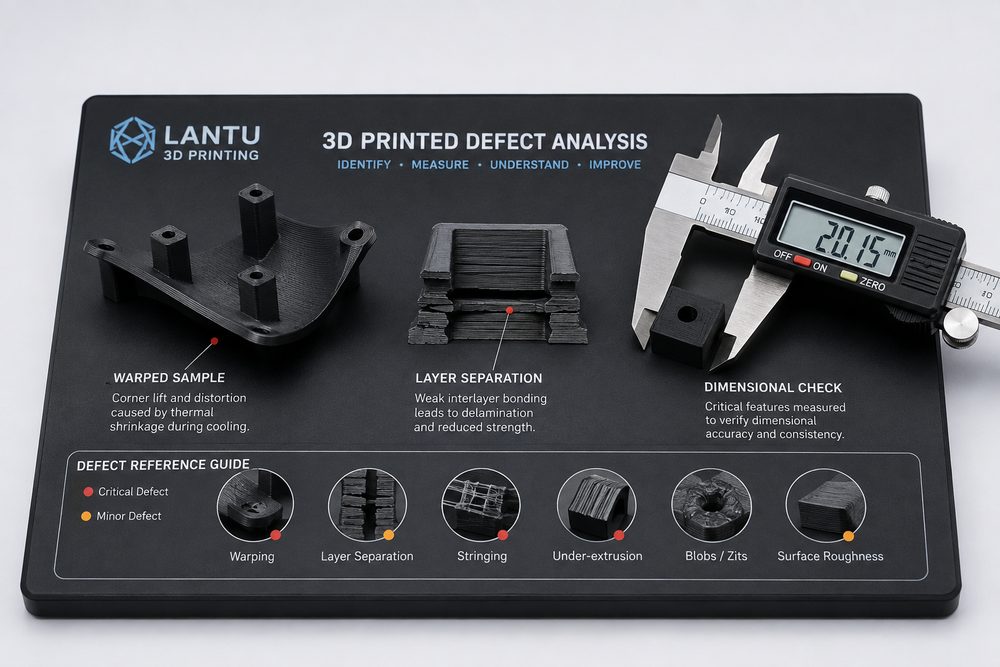
In scenarios where SLA, SLS, MJF, SLM, and FDM processes coexist, the same 3D data can produce completely different results because of differences in material shrinkage, layer height, support strategy, and post-processing path. Taking common engineering parts as an example, SLA resin parts typically use a layer height of 0.05-0.1 mm to achieve a fine surface, but long-term load-bearing and heat resistance must be evaluated carefully; SLS PA12 parts are suitable for complex internal cavities and small-batch functional validation, and common dimensional tolerances should be reserved at about ±0.2 mm or ±0.3% depending on part size; metal SLM parts also require consideration of thermal stress, support removal, heat treatment, and machining datums. Warping is usually related to thermal gradients, large flat thin walls, and insufficient support; delamination may come from poor interlayer bonding, material moisture content, scanning energy, or an unreasonable print orientation; hole position deviations may result from printing shrinkage, but they may also come from depowdering, sanding, or secondary machining fixture errors.
2. Engineering Analysis: Moving Uncertainty Upstream to the Design Review Stage
Many failures do not come from insufficient equipment capability, but from requirements that were never expressed in engineering terms. For example, saying that an appearance part should simply have a 'good surface' is far from enough. It is necessary to define the acceptable texture, paint color variation, sanding area, and visible assembly surfaces. Likewise, saying that a functional part 'needs high strength' is not enough. The main load direction, peak load, operating temperature, fatigue frequency, and safety factor should be specified. lantu3D usually recommends creating a project risk table before quoting, and listing wall thickness, hole diameter, overhangs, slender rods, threads, inserts, post-processing, and inspection methods item by item. The benefit of doing this is that the customer can make clear trade-offs among price, lead time, and performance instead of discovering after delivery that the model needs to be redone.
3. Solution: Layered Control of Parameters, Prototypes, and Batch Delivery
For a reliable 3D printing project, a 'three-layer validation' method is recommended. The first layer is digital validation: check whether the STL/STEP file contains broken faces, non-manifold edges, overly thin walls, or undefined assembly clearances. The second layer is process validation: confirm the material grade, print orientation, layer height, infill or scan strategy, support contact surfaces, and expected shrinkage compensation. The third layer is physical validation: verify the solution through first-article measurement, fit testing, surface samples, and, when necessary, mechanical testing. If the project is expected to scale from 1 sample to 20-200 pieces in a small batch, version numbers, process cards, inspection sheets, and packaging requirements should be fixed in advance to avoid unexplained differences between batches.
4. Implementation Checklist: Actionable Steps from Communication to Acceptance
A troubleshooting path is recommended: first check whether the model has overly thin walls or isolated sharp corners, then check the material lot and drying condition; next review the machine maintenance records, build chamber temperature, layer height, and placement orientation; finally confirm whether post-processing has changed the datum surfaces. At the same time, customers are advised to attach a 2D drawing of key dimensions or annotated screenshots when submitting the model, because a 3D model can express shape, but it does not always express functional priority. For parts that require painting, electroplating, dyeing, polishing, or CNC finishing, design-stage machining allowance of about 0.05-0.3 mm should be reserved, and it should be clearly stated which surfaces are assembly surfaces, appearance surfaces, and non-critical surfaces. For projects with batch delivery plans, first-article reports, material lot numbers, equipment IDs, and post-processing records should also be retained to create a reviewable quality chain.
5. lantu3D's Role: Delivering Not Only Parts, but Also a Manageable Manufacturing Process
lantu3D's value lies not only in turning drawings into samples, but also in organizing scattered information about design, manufacturing, post-processing, inspection, and delivery into an executable workflow. For R&D teams, this means faster concept validation; for procurement and project managers, it means clearer quotation boundaries and more transparent change records; for the final user department, it means the parts received are closer to actual application needs. Especially as product iteration speeds up, 3D printing should not be viewed as a temporary fix, but as a standardized module within the R&D and small-batch manufacturing system.
Conclusion
High-quality 3D printing insights and project experience ultimately point to the same principle: the earlier the goals, constraints, and risks are clarified, the more stable the manufacturing process will be. Whether the topic is post-processing, design optimization, defect analysis, or industry trends, truly practical methods depend on data, workflow, and validation. When choosing a 3D printing service, companies should focus on whether the supplier can provide material recommendations, structural feedback, process records, post-processing plans, and acceptance criteria, rather than comparing only the unit price. This is the only way each prototype can build greater certainty for the next delivery.
Submit a model, drawing, image or written notes. Engineers will review material, process, finishing and delivery based on actual use.