
Introduction: One Build, Two Systems, Two Different Curves
During a delivery review of a metal LPBF part, the customer requested layer-by-layer curves for build-chamber oxygen content and laser power. The MES-exported curve contained 4,217 points, while the equipment’s local log contained 4,239 points; power values for the same layer differed by 6%. It took the engineering team two days to confirm that this was not an equipment fault. After an 11-minute overnight disconnection, the edge gateway mixed the “equipment timestamp” and “storage timestamp” into a single field during data backfill and also lost the sequence numbers for 22 points. The part itself was conforming, but the data link was not trustworthy, so the report could not be released. lantu3D categorizes such issues within lifecycle management from digital blueprint to physical delivery: the data chain is not an ancillary equipment function, but a controlled object on the same level as the model, parameter package, and powder lot number. This article provides an implementable controlled-acquisition specification: a point semantic dictionary, four timestamps, quality flags, an offline persistent queue, four transactional backfill checks, and A/B/C link release states.
1. Point Semantic Dictionary: Define What a “Point” Means First
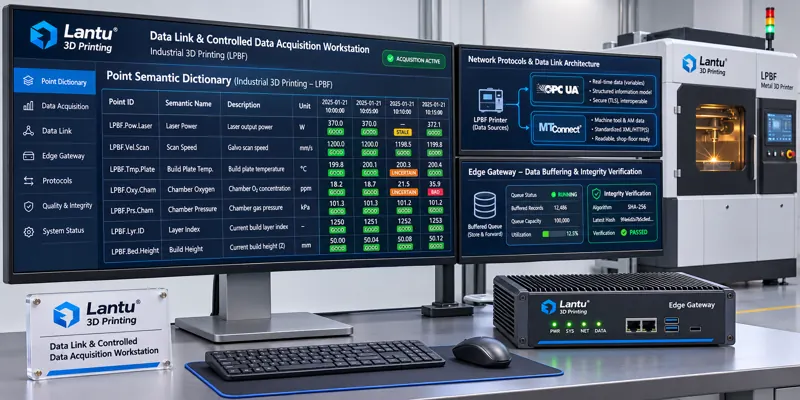
Most shop-floor acquisition tables contain only three columns: variable name, value, and time. This is insufficient to support decisions. An 11-field semantic dictionary should be established for every data point: ① unique equipment identifier, including model and factory serial number; ② point code, such as LPBF-03.CHAMBER.O2_PPM; ③ physical quantity name and engineering unit, such as ppm, W, mm/s, or °C; ④ data-source type, such as PLC register, equipment API, or external sensor; ⑤ sampling interval and trigger method, such as periodic 1 Hz / 10 Hz sampling or layer-event triggering; ⑥ measurement range and resolution, such as 0–2,000 ppm and 0.1 ppm; ⑦ filtering and aggregation rules, such as retaining raw values unsmoothed while storing a 1-minute average as a separate derived point; ⑧ source of accuracy or uncertainty; ⑨ applicable process stage, such as preheating, building, cooling, or post-processing; ⑩ associated primary key, consisting of work order number + build number + layer number; and ⑪ version number and effective date.
The dictionary must be version-controlled: adding a point, changing a range, or changing a sampling rate must follow a change order, while historical points must continue to be interpreted according to their original definitions. Without a semantic dictionary, neither cross-machine comparison nor allocation across a shared build is possible. Two machines may both have a point called “Power,” but one may represent the setpoint and the other the measured feedback value; merging them directly will inevitably lead to incorrect conclusions.
2. Four Timestamps and Clock References: Make Every Point Locatable and Replayable
Each record should carry four timestamps: T_dev (time generated by the equipment), T_gw (time received by the gateway), T_store (time stored in the database), and T_backfill (time when backfill was completed; blank during normal online operation). Each serves a distinct purpose: T_dev is used for process reconstruction and layer alignment; the difference between T_gw and T_dev reflects link latency; T_store supports database auditing; and T_backfill identifies records that underwent recovery after an interruption.
The clock reference must also be specified: equipment and gateways should use a unified PTP/NTP source, with a target deviation of ≤10 ms and daily drift records. For sampling above 10 Hz or multi-layer parallel events, timestamp resolution, in ms or μs, must be stated in the point dictionary. A common misinterpretation is to plot curves using T_store as T_dev. Points in a backfill window are then compressed into the same moment, creating false power steps. The engineering rule is: when |T_gw − T_dev| exceeds three times the sampling interval, mark the record as STALE; when it exceeds 30 s for 10 consecutive points from the same equipment, trigger a link alarm.
3. Quality Flags: The Four States of GOOD / STALE / UNCERTAIN / BAD
A value does not inherently indicate its reliability and must therefore carry a quality flag. GOOD means the point arrived within the periodic window, is within range, has continuous sequence numbers, and meets clock-deviation requirements. STALE means it arrived late or repeats the previous value; it may be displayed on dashboards but must not enter release calculations. UNCERTAIN means the value is near a range limit, the sensor calibration has expired, the backfill digest has not been verified, or conflicting values exist for the same layer number. BAD means out of range, non-numeric, broken sequence, or hash mismatch. Only GOOD points may be included in conforming-data denominators and in metrics such as energy consumption per part, gas consumption, and layer power. UNCERTAIN points must undergo manual review before being converted to GOOD or BAD; the system must not automatically downgrade release requirements.
The four states should be stored with each record rather than calculated afterward, because backfill, replay, and cross-system export can change context. Quality flags must be stored together with the point-dictionary version number so that the decision conditions applicable at the time can be reproduced during historical recalculation.
4. Offline Persistent Queues: Size Capacity for the Worst-Case Window, Not Average Bandwidth
Edge-gateway disconnections are routine rather than exceptional. Gateways require a local persistent queue using a composite primary key of equipment code + point code + T_dev + layer number, with each record carrying a sequence number and SHA-256 digest. Capacity must be calculated as “maximum tolerable outage duration × peak point frequency × record size.” For example, 12 machines with 40 points each, sampled at an average of 1 Hz and approximately 200 B per record, require about 69 MB for 8 hours. Considering 10 Hz points, retransmission copies, and indexing overhead, reserve at least 256 MB and no less than 24 hours of capacity, with an 80% utilization alarm and a pre-overflow degradation strategy that retains critical CTQ points first and pauses derived points.
The queue must use write-ahead logging (WAL) and power-loss protection. After recovery, it must not be cleared immediately; records may be deleted only after all four backfill checks pass and the transaction is committed. “Overwrite on reconnection” is prohibited—it is precisely the root cause of the 22 lost points described in the introduction.
5. Four Transactional Backfill Checks: Sequence Number, Count, Digest, and Primary-Key Conflict
Backfill should be handled as one transaction for each “equipment + outage interval,” with four checks performed in sequence: ① sequence continuity: no missing or duplicate sequence numbers in the interval; ② count consistency: the difference between the gateway queue count and equipment-local export count must be ≤0.1%; if exceeded, mark the entire segment UNCERTAIN and compare manually; ③ digest match: concatenate records in sequence, calculate SHA-256, and compare it with the equipment-side interval digest; ④ primary-key conflicts: check the composite primary key before storage; conflicting records must not be silently overwritten and must be written to an isolation table for disposition.
Only when all four checks pass may the transaction be committed, T_backfill written, and the quality flag changed from “pending backfill” to GOOD. If any check fails, the entire segment must be rolled back to the queue; partial submission is prohibited. A 30-minute trace-back drill is recommended monthly: randomly select one build and require reconstruction of the same curve from equipment logs, gateway queues, and the database within 30 minutes. The link is considered controlled only when the consistency rate is at least 95%.
6. A/B/C Link Release States: Whether Data Can Be Used for Sign-Off
Link status should be directly tied to engineering release. State A (releasable) means the CTQ point-dictionary version is valid, all four timestamps are present, the GOOD rate is ≥99.5%, no backfill remains open, and clock drift is acceptable; witness coupons and inspection reports may be linked to the build’s process curves. State B (conditionally usable) means non-CTQ points contain STALE records or backfill has been closed, with a GOOD rate of 98%–99.5%; the data may be used for internal process analysis but not as customer delivery evidence or as a basis for concession release. State C (frozen) means critical CTQ points contain BAD records, digests do not match, an open outage exceeds 24 h, or the dictionary version differs from that used in production; process data for that build must not be released and must undergo a deviation report and data review.
The three states require dashboards and assigned owners. Five indicators should be reviewed weekly: link health, measured as GOOD rate; backfill closure duration; clock drift; point-dictionary version consistency rate; and trace-back drill pass rate. In this way, “data reliability” is no longer a verbal assurance, but a determinable, traceable, and reproducible engineering criterion.
7. Implementation Checklist and Common Misinterpretations
Implementation follows six steps: inventory points and freeze Dictionary V1.0 → unify clocks and timestamp fields → configure gateway queue capacity and utilization alarms → implement the four backfill checks and isolation table → store quality flags with records → write A/B/C release rules into the inspection procedure. Three common misinterpretations are: treating “data was collected” as “data can be released,” despite missing quality flags and release states; treating “averages” as “raw evidence,” although derived points cannot replace raw points; and treating “backfill succeeded” as “data is complete,” without count and digest verification.
Boundary conditions must also be recognized: the point dictionary and quality flags do not replace equipment metrology calibration, which belongs to geometric accuracy and measurement traceability; nor do they replace account permissions and audit logs, which belong to the access-control layer. Only the combination of all three forms a complete evidence chain from design blueprint and process parameters to physical delivery.
Conclusion
The value of an equipment data link is not how many points it collects, but whether every point can be defined, located, assessed, and reproduced. An 11-field dictionary eliminates semantic ambiguity; four timestamps eliminate timing misalignment; four-state quality flags distinguish reliability; persistent queues and four transactional backfill checks eliminate data loss during interruptions; and A/B/C states translate link status into an engineering conclusion on whether release is permitted. For additive manufacturing, where small batches, high mix, and stringent traceability are standard, this method makes process data a truly deliverable asset rather than a collection of logs that cannot substantiate themselves after the fact.
Submit a model, drawing, image or written notes. Engineers will review material, process, finishing and delivery based on actual use.