
Why Requirements Must First Become Determinable Specifications
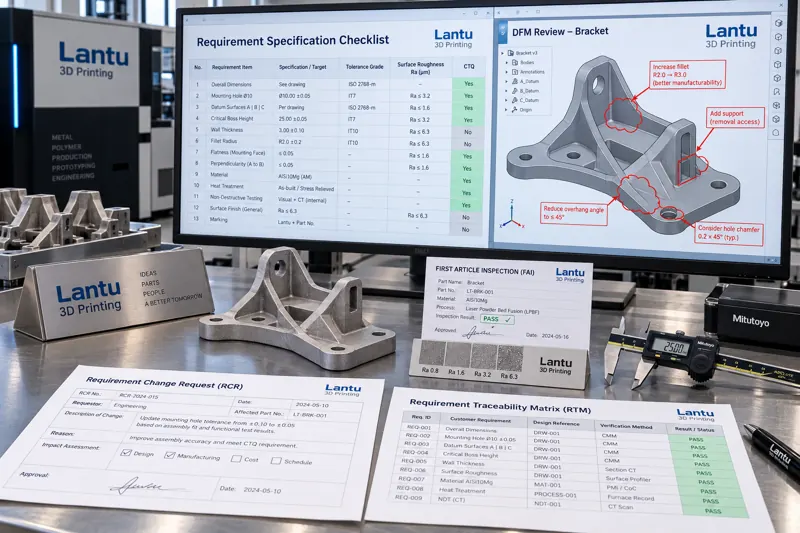
In additive manufacturing projects, the most common source of rework is not the printing process but the interpretation of requirements. Statements such as “higher strength,” “smoother surfaces,” or “better dimensional accuracy” are not directly actionable engineering instructions: without a material grade, heat-treatment condition, and sampling orientation, there can be no acceptance criteria. lantu3D defines requirements engineering as the first checkpoint in lifecycle management from drawings to physical parts—translating vague descriptions into numbered requirements with thresholds and verification methods, so that quotation, production scheduling, and inspection all use a common language.
A usable requirements specification generally includes four categories of information: geometry and tolerances (critical dimensions, GD&T, and datum systems); materials and condition (material grades, powder-batch requirements, heat treatment, and densification requirements); surface quality and performance (roughness grades, mechanical-property sampling locations and orientations); and delivery and traceability (batch identification, required inspection reports, and packaging methods). If any category is missing, it will eventually need to be added through a change order.
CTQ Identification: Reducing Dozens of Dimensions to a Small Set of Critical Items
A printed part may have hundreds of dimension callouts, but only 5 to 12 typically determine assembly and functional performance. These are CTQs, or Critical-to-Quality characteristics. They should be identified by working backward from the functional chain: dimensions affecting assembly fit, surfaces affecting sealing or load bearing, and fillets and surface conditions affecting fatigue life should all be classified as CTQs; non-mating dimensions that affect appearance only may be classified as general items.
Once characteristics are classified, inspection resources can be allocated accordingly. CTQs should generally receive 100% inspection with retained actual measurement records; important items should be sampled by batch; and general items require only visual and shipping-damage checks. For metal LPBF parts, sampling orientation must also be specified separately—elongation can differ by 20% to 40% between vertical and horizontal orientations. A performance requirement that does not specify sampling orientation is inherently invalid.
Sample Approval and First Articles: Turning “Looks Right” into “Measures Right”
Conducting sample approval before a production order is the most effective way to converge requirements. The sample stage should validate not appearance, but three key factors: whether the selected material and process-parameter combination meets performance requirements; whether print distortion remains within the compensation range; and whether the post-processing chain can consistently reproduce the required surface condition.
First article inspection (FAI) should cover all CTQs and include material certificates, heat-treatment curves, and inspection reports. First-article samples must be retained as sealed reference samples for comparison with subsequent batches. A retained sample signed off by the customer is the only physical evidence for determining whether changes have occurred later. Without a retained sample, any dimensional dispute will revert to each party’s recollection.
Requirement Changes: Ensuring Every Modification Has a Cost and a Record
Printing projects have short lead times, and customers often request adjustments after sampling. Changes themselves are not the problem; the problem is changes without identification numbers, impact analysis, or version control. A standardized change process should include: a change request documenting the modification and original identification number; an impact analysis describing effects on tooling, parameters, inspection items, and delivery dates; revision control ensuring that obsolete drawings are immediately invalidated; and, when necessary, renewed first-article verification.
Two types of changes must be distinguished in particular: geometric changes generally require renewed simulation and a new first article, whereas document-only clarifications, such as adding a surface roughness callout, only require technical-document updates. Treating these changes as equivalent can result in either over-validation or missed validation.
Technical Agreements: Defining Acceptance Rules Before Delivery
A technical agreement is the final output of requirements engineering and the basis for judgment at the delivery stage. At a minimum, an executable technical agreement should define: referenced standard numbers and revisions; acceptance criteria and measurement methods for critical characteristics; sampling plans and acceptance decision rules; disposition methods for nonconforming products, including rework, concession, or rejection; and retained-sample and retesting rules for dispute resolution.
A performance requirement without criteria is equivalent to no requirement at all. For example, “smooth surface” should be stated as “Ra ≤ 6.3 μm on specified surfaces, evaluated according to GB/T, with a sampling length of 0.8 mm and the average of three measurements”; “acceptable strength” should be stated as “room-temperature tensile strength of as-built witness specimens ≥ the specified value, sampled in the vertical orientation, with specimens heat-treated with the production batch.”
Conclusion
Translating customer requirements into determinable specifications is the highest-return step in the delivery chain from drawings to physical parts. Identifying CTQs, establishing benchmarks through samples and first articles, controlling changes through change orders and revision control, and defining acceptance rules through technical agreements can collectively prevent rework before quotation while providing an evidence-based foundation for resolving delivery disputes.
Submit a model, drawing, image or written notes. Engineers will review material, process, finishing and delivery based on actual use.