
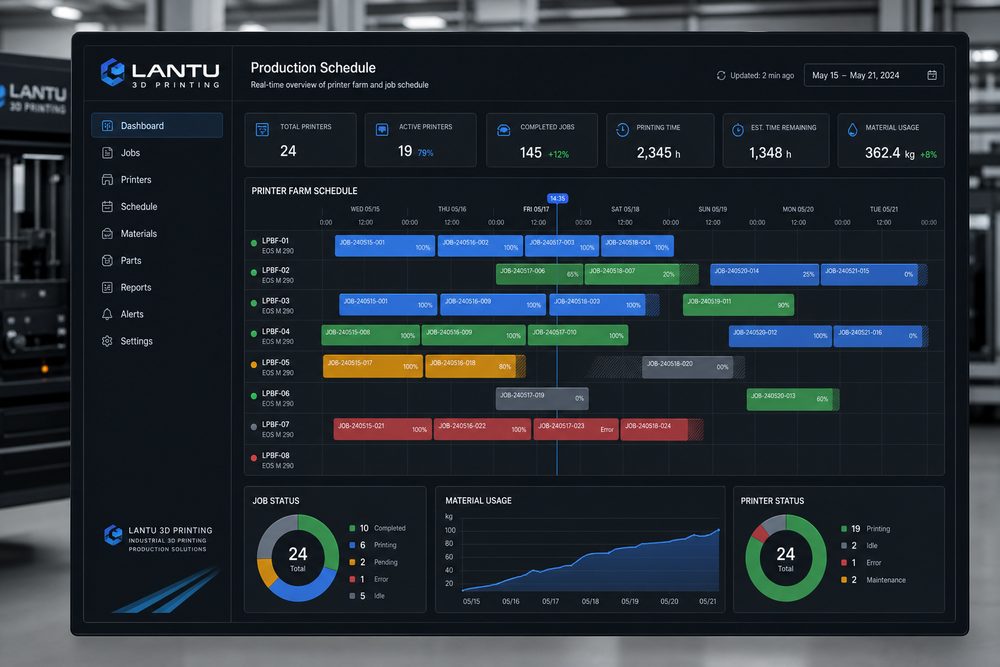
Introduction: 3D Printing Production Scheduling Optimization Is Moving from Experience-Based Management to Data-Driven Operations
As order volumes increase, the most common contradiction in a 3D printing workshop is that equipment appears busy, yet deliveries are still delayed. The reason is that printing is only one part of the total cycle. Cleaning, curing, cooling, powder removal, dyeing, painting, inspection, and packaging can all become bottlenecks.
1. Establish Quantifiable Business Scenarios and Boundary Conditions
The first step in scheduling optimization is to build a resource model. Each machine should record its build volume, compatible materials, layer height range, average run time, maintenance window, and historical success rate. Each post-processing step should also have standard labor times, such as SLA cleaning and curing, support removal, sanding, and painting.
2. Break Down Risk and Delivery Responsibility by Process Node
The second step is to define order priorities. It is recommended to combine due date, customer tier, process complexity, material compatibility, and post-processing load. Multiple small parts can be nested together in one build to improve equipment utilization, but urgent orders should never be delayed just to maximize machine occupancy. Orders using the same material and color can be produced in batches.
3. Lock Parameters, Data, and Acceptance Criteria into the System
Exception handling is the real test of scheduling maturity. Equipment failures, print failures, customer revisions, and urgent order insertions should all have predefined plans. For example, reserve safety time for key orders and keep 10% to 15% of flexible capacity available. Risk assessments should be performed for long-duration print jobs.
4. Continuous Improvement: From Single-Order Review to Organizational Capability
Continuous optimization depends on a closed data loop. Weekly statistics on equipment utilization, print success rate, average waiting time, post-processing backlog, delay causes, and rework ratio can reveal the true bottleneck. If paint waiting time accounts for 40% of the total cycle, adding more printers will not improve delivery performance.
Conclusion
The essence of production scheduling optimization is to turn complex and changing custom orders into a resource plan that is calculable, adjustable, and reviewable. A strong scheduling system improves equipment utilization and, even more importantly, on-time delivery.
Submit a model, drawing, image or written notes. Engineers will review material, process, finishing and delivery based on actual use.