
Introduction: Material Innovation Is Redefining the Boundaries of Metal Additive Manufacturing
Metal 3D printing has moved from simply being able to build parts to designing for performance. Aerospace, medical implants, energy equipment, and precision tooling industries are no longer concerned only with whether a part can be printed; they care more about material strength, fatigue life, corrosion resistance, heat-treatment windows, and lot-to-lot consistency. For service platforms, material selection is not a purchasing list, but an end-to-end engineering decision spanning design, process, inspection, and delivery. In project reviews, lantu3D typically evaluates material grade, part loads, post-processing requirements, and delivery lead time in the same table to avoid judging material options solely by unit price.
1. Ti6Al4V Remains the Mainstay, but the Parameter Window Is More Refined
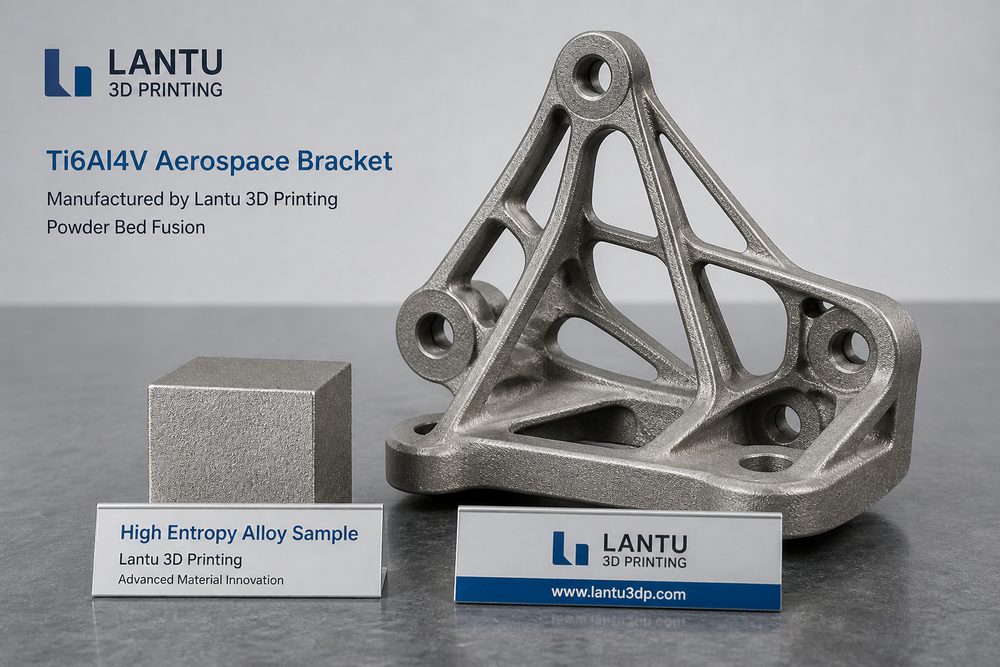
Ti6Al4V remains one of the most widely used materials in SLM metal printing because of its high specific strength, good corrosion resistance, and mature process base. Typical layer thickness can be controlled at 30-60 μm, while laser power, scan speed, and hatch spacing need to be rematched according to the machine spot size, powder particle size, and part wall thickness. For thin-walled brackets, excessive energy density can cause local overheating and deformation; for thick load-bearing parts, insufficient energy can easily lead to lack-of-fusion porosity. In engineering practice, it is usually necessary to establish a parameter package through density coupons, metallographic cross-sections, tensile specimens, and dimensional rechecks after heat treatment, rather than directly using the machine's default parameters.
2. The Value of Aluminum Alloys and Stainless Steel Lies in Scenario Fit
AlSi10Mg is suitable for lightweight structures, heat dissipation parts, and drone components, but its hot-cracking tendency, support design, and stress-relief heat treatment must be considered in advance. Stainless steel 316L is suitable for corrosion-resistant fixtures, fluid-handling components, and low-volume functional parts, where surface roughness and powder removal from internal channels are key quality-control concerns. Under the same printing price, aluminum alloys may reduce assembly weight, while stainless steel may lower maintenance costs, so quotations should include downstream machining, heat treatment, sandblasting, machining datum surfaces, and inspection costs.
3. High-Entropy Alloys and Functionally Graded Materials Are Opening New Opportunities
High-entropy alloys, nickel-based superalloys, and functionally graded materials are becoming major R&D hotspots. Their advantage is not that they are simply more expensive or more advanced, but that they offer high-temperature performance, wear resistance, corrosion resistance, or locally tunable properties. The challenges are equally clear: powder consistency, oxygen control, residual stress, crack sensitivity, and the lack of standards. For industrial applications, it is recommended to start with small validation coupons, process-window matrices, and service-environment testing, then gradually scale up to functional prototypes and low-volume delivery.
4. Material Selection Should Be Managed Across the Full Lifecycle
Engineering material selection should answer at least five questions: What loads will the part bear? What is the operating temperature and environment? Is machining of mating surfaces required? Is non-destructive testing required? How high is the cost if the part fails? lantu3D places greater emphasis on lifecycle management from blueprint to physical delivery: using DFAM to optimize structures in the early stage, using parameter packages to control forming in the middle stage, and using heat treatment, inspection reports, and traceability records to secure delivery in the final stage.
Conclusion
Future innovation in metal 3D printing materials will not be reflected only in the number of new grades introduced, but in the collaborative capability across materials, structures, processes, and inspection. When companies choose Ti6Al4V, aluminum alloys, stainless steel, or new alloys, they should keep application scenarios and validation evidence at the core, and build reusable material databases and process specifications in order to turn material innovation into stable delivery capability.
Submit a model, drawing, image or written notes. Engineers will review material, process, finishing and delivery based on actual use.