
Introduction: From Single Prints to a Deliverable Engineering Loop
3D printing equipment maintenance and OEE improvement are not about a single machine or a single material. They are about the full chain of design, process, manufacturing, inspection, and delivery. For industry practitioners, the challenge is often not whether a part can be built, but whether it can be delivered at stable cost, with traceable quality, and through a repeatable process. lantu3D Printing emphasizes lifecycle management from blueprint to physical part: after receiving a model or drawing, it evaluates materials, structure, batch size, post-processing, inspection, and lead time at the same time, rather than relying only on per-part pricing or one-time printing experience.
To improve maintenance and efficiency, companies need to turn experiential settings into executable standards. In the early review stage, confirm wall thickness, hole diameter, assembly clearances, support areas, and critical dimensions. In production, record layer thickness, power, scan speed, powder recycling count, or nozzle temperature. At delivery, use dimensional reports, appearance standards, and post-project reviews to build the basis for the next job. This system is what allows 3D printing to move from rapid prototyping to managed on-demand manufacturing.
1. Core Issue: Equipment Efficiency Is Not Uptime Alone, but the Combined Result of Good Output, Plan Achievement, and Recovery from Abnormal Events
The essence of equipment efficiency is to surface and quantify uncertainty in advance. Many projects focus only on material price and machine hours during quoting, while ignoring hidden costs such as design revisions, support removal, heat treatment, sanding or blasting, threaded inserts, dimensional re-checks, and packaging and transport. For metal SLM parts, common control items include 20 to 60 μm layer thickness, oxygen monitoring, substrate preheating, scan strategy, and stress-relief heat treatment. For SLS nylon parts, powder refresh rate, bed temperature, cooling curve, and post-dyeing process directly affect warpage, toughness, and color consistency. For FDM fixtures or tooling, nozzle diameter, infill ratio, wall count, and print orientation determine strength anisotropy.
From a management perspective, the key is not to chase the extreme of one parameter, but to establish a parameter window. For example, engineering prototypes may accept a shorter cycle and less surface finishing, while assembly verification parts must include hole location, snap-fit behavior, and mating clearances in inspection. Display parts, on the other hand, require attention to surface texture, paint adhesion, and color consistency. Defining the use case, risk level, and acceptance criteria at the start reduces rework and helps customers understand why quotations differ.
2. Engineering Decisions: How Materials, Processes, and Post-Processing Work Together
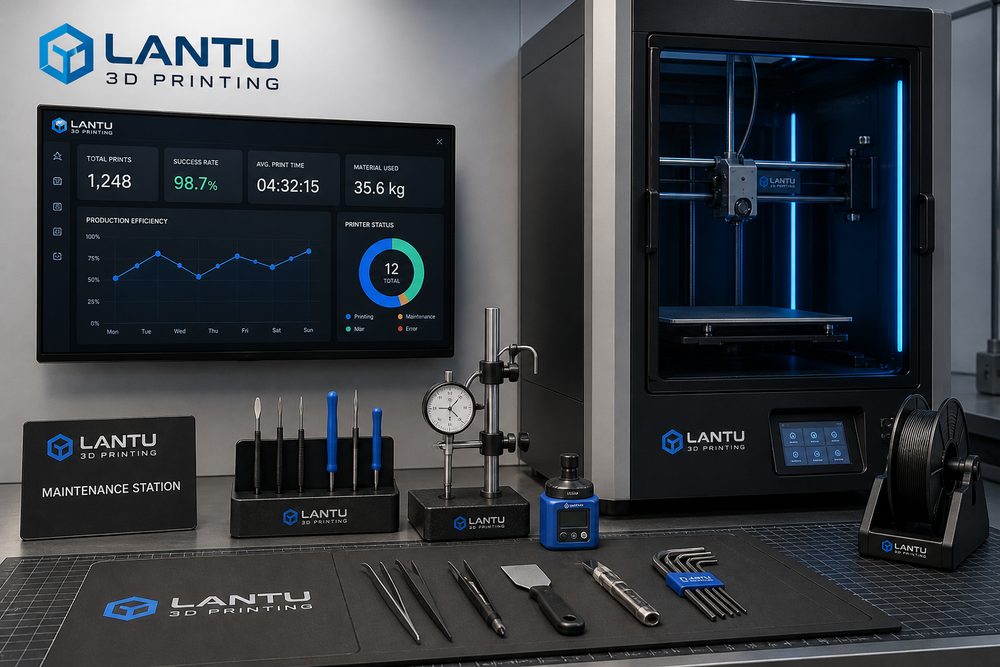
Material selection should serve the application scenario, not just the product name. Maintenance indicators can include nozzle or blade replacement cycle, laser power calibration, powder sieving frequency, platform leveling error, filtration pressure differential, and monthly effective machine hours. When a part needs impact resistance and light weight, PA12, PA11, or glass-fiber reinforced nylon usually enters evaluation first. When fine surface quality and transparency are required, SLA or DLP resin is more suitable. When high-temperature strength, fatigue performance, or complex internal channels are needed, aluminum alloy, titanium alloy, or stainless-steel metal printing has real engineering value. Each choice implies downstream processing: nylon parts may need blasting, dyeing, and impregnation; resin parts require secondary curing, grinding, and coating; metal parts may require support removal, heat treatment, machining, and nondestructive testing.
lantu3D Printing usually places DFAM design, process route, and inspection method on the same review sheet. For example, a thin-walled housing may be printable from a forming perspective, but if it will later be painted and take assembly screw torque, local ribs, fillets, and room for threaded inserts must be added. A metal flow channel part with trapped powder must be redesigned with powder-removal holes, inspection holes, or a different build orientation. The earlier the engineering decision is made, the lower the later cost.
3. Implementation Path: Use Data to Deliver Consistently
One print center changed equipment checks from verbal habits to a pre-shift form, logging powder-spreading issues, temperature fluctuations, and failure reasons. After three months, repeat failure rates dropped by about 28 percent and urgent rework decreased significantly. The common lesson is to validate parameters in small batches first, then expand to stable production; confirm critical dimensions and functional surfaces first, then optimize appearance; define inspection samples and sampling ratios first, then discuss lead time. For R&D samples under 10 pieces, every critical dimension can be fully inspected. For small-batch orders of 50 to 200 pieces, first article approval, in-process sampling, final piece review, and abnormal isolation should be established. This preserves the flexibility of 3D printing while giving customers quality certainty close to traditional manufacturing.
Digital record keeping is equally important. Each batch should retain the model version, quotation version, material lot, machine number, process parameters, post-processing method, and inspection results. When a customer places a repeat order or modifies the design, the platform can quickly determine which parameters can be inherited and which risks must be reassessed. For supply-chain collaboration projects, CNC finishing, surface treatment, assembly, and packaging can also be managed within one order view to reduce information loss across vendors.
4. Practical Checklist: Turning Experience into Repeatable Standards
The equipment checklist should include daily checks, weekly checks, monthly checks, spare parts inventory, parameter backups, ambient temperature and humidity, fault codes, and responsible owners. Companies are advised to embed the checklist into quotation and production workflows: first, confirm use case, load, temperature, appearance grade, and assembly relationship; second, check minimum wall thickness, hole diameter, overhang angle, powder removal path, and support accessibility; third, choose material and process and specify the critical parameter window; fourth, define post-processing, inspection, packaging, and delivery methods; fifth, record customer feedback and review conclusions after delivery. The checklist does not need to be complicated, but it must be executed on every project.
For service providers, standardization does not mean less flexibility. On the contrary, only by standardizing routine risks can the team focus on genuinely complex engineering problems. For buyers, a transparent process helps judge whether the quote is reasonable, the lead time is credible, and the quality responsibility is clear. Competition in 3D printing is shifting from whether a part can be printed to whether it can be delivered stably, improved continuously, and supported over the long term.
Conclusion: Increase Commercial Value Through a Lifecycle View
The core takeaway from 3D printing equipment maintenance and OEE improvement is that 3D printing must be managed as part of a complete manufacturing chain to unlock its true value. Materials, processes, equipment, quality, cost, and service are not isolated modules; they are interconnected systems. Through full lifecycle management from blueprint or design to physical delivery, lantu3D Printing connects early review, process execution, post-processing inspection, and customer feedback, helping companies achieve more controlled results in R&D validation, small-batch manufacturing, and complex part delivery.
Submit a model, drawing, image or written notes. Engineers will review material, process, finishing and delivery based on actual use.