
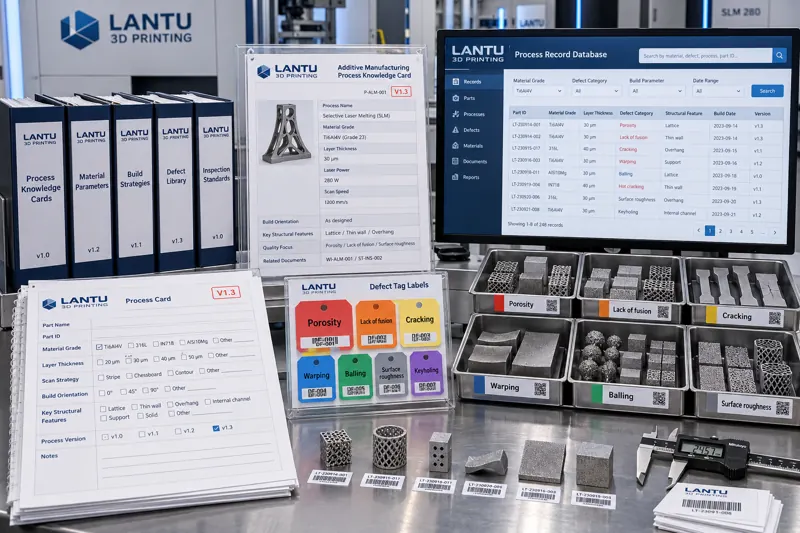
Introduction: The Knowledge Base Is Built, but Engineers Still Cannot Find What They Need
Many 3D printing teams have completed the first step of knowledge management: moving process parameters, defect photos, customer feedback, and trial-build records into shared drives or document systems. Yet, six months later, a review often reveals an awkward reality: the number of files has grown from hundreds to thousands, while only a dozen or so are repeatedly reused. When an engineer encounters a new thin-wall warpage issue, they may spend 20 minutes searching without finding last year's nearly identical solution record, and ultimately still call a senior technician for advice.
The problem is not a lack of accumulated knowledge, but that the accumulated content cannot be searched. Document systems solve the problem of "storage," not "retrieval." To turn process experience into genuinely reusable assets, it must be transformed from blocks of natural language into structured entries with fields, tags, and identifiers.
1. Why Folder-Based Filing Inevitably Fails
A common filing method is to create directories by project or by date: 2025/CustomerA/Bracket/. This works when there are few files, but once the volume exceeds several hundred records, it faces three fundamental limitations.
First, the single-path assumption does not hold. A record concerning "warpage caused by support spacing in a 316L thin-wall part" belongs simultaneously to the material dimension, defect dimension, and structural-feature dimension. A file system can place it in only one folder, leaving the other two access paths disconnected.
Second, retrieval depends on memory. Searching by file name requires users to remember the file name, while people generally remember only "that thin-wall case from last year," not the naming convention used at the time.
Third, conditional queries are impossible. A file system cannot answer questions such as, "List all process records with a 0.03 mm layer thickness, AlSi10Mg material, and keyhole defects." Yet this is precisely the most typical query pattern for process reuse.
The conclusion is straightforward: classification dimensions must shift from post hoc filing to capturing key fields when a record is first created.
2. Metadata Fields: Define the Minimum Required Set First
Structured data does not mean making tables as detailed as possible. Too many fields will discourage frontline personnel from completing them, ultimately producing a large number of empty values. In practice, a workable process record requires only nine mandatory fields, with all others treated as optional extensions.
1. Material grade: Use controlled nomenclature, such as AlSi10Mg, PA12, and 316L. Informal entries such as "aluminum powder" or "nylon" should not be permitted.
2. Process type: LPBF, SLS, SLA, FDM, Binder Jetting, and so on; these values must also be controlled.
3. Machine model and chamber ID: Measured variation between machines of the same model often fluctuates within ±3%, but this can still determine the success or failure of thin-wall parts and must therefore be traceable.
4. Key process parameters: Laser power, scan speed, hatch spacing, layer thickness, and hatch strategy. Layer thickness should be consistently recorded in mm to avoid mixed entries such as "30 microns" and "0.03."
5. Structural feature tags: Thin wall, deep hole, large flat surface, overhang, lattice, and conformal cooling channel. This is the dimension with the highest search hit rate.
6. Geometric envelope dimensions: Length × width × height, used to quickly determine whether a historical part is comparable in scale to the current part.
7. Post-processing chain: Stress-relief annealing, wire EDM, sandblasting, HIP, and machining, recorded in execution order.
8. Defects and corrective actions: Defect type (warpage, cracking, balling, lack of fusion, powder adhesion) + final action (adjust parameters, modify supports, change orientation, reject part).
9. Conclusion status: Verified / Pending verification / Obsolete. This field serves as a gate to prevent outdated or incorrect experience from being repeatedly referenced.
3. Controlled Vocabularies: Stop Everyone from Using Different Labels
Fields define what needs to be entered; vocabularies define which values may be entered. Without a vocabulary, three people may create three separate labels—"warpage," "deformation," and "lifting"—that do not overlap during searches.
A vocabulary should be maintained for each controlled field, with explicit synonym normalization rules: deformation → warpage, lifting → warpage, cracking → crack, incomplete fusion → lack of fusion. Maintaining these vocabularies requires little effort—process owners only need to consolidate new informal terms once per quarter—but the benefit is a direct increase in search recall from below 50% to above 90%.
The vocabulary should also distinguish hierarchical levels. For defects, for example, the first level may be major defect categories (geometric/surface/internal/performance), while the second level contains specific modes (warpage/crack/balling/lack of fusion/porosity). Users can perform a broad initial filter at the first level or drill down to the second level, accommodating the search habits of both beginners and experts.
4. Process Cards: Turn Experience into Executable Entries
Even structured records scattered across spreadsheets remain merely data. The format that is truly reused is the process card—a standardized work instruction for a specific "material + structural feature" combination.
A complete process card should include five sections: scope of application (material grade, wall-thickness range, and envelope-size limits), default parameter set (a parameter combination that can be directly imported into the machine), risk warnings (the two or three most common failure modes for this combination), mandatory inspection items (three to five items that must be confirmed before printing), and related records (links to relevant historical case entries).
The value of a process card lies in converting "the judgment of an experienced technician" into "fixed actions before printing." Even if a new engineer does not understand the underlying thermal-stress mechanism, they can avoid 80% of basic rework by confirming each mandatory inspection item.
It is important to emphasize that a process card is not finished once it is written. Whenever a new failure case occurs, it should be added to the risk warnings of the corresponding process card and trigger a version upgrade.
5. Identification, Versioning, and Retirement: Do Not Let Old Experience Contaminate New Decisions
Once records are structured, version confusion becomes one of the easiest hidden risks to create. A stable identifier + explicit version convention is recommended: once generated, an entry identifier never changes (for example, PC-LPBF-AlSi10Mg-ThinWall-007), while versions increase as v1.0 / v1.1 / v2.0.
When the conclusion of a record is disproven by subsequent validation, do not delete it—change its status to "obsolete" and retain the reason for invalidation and validation data in the record body. Disproven experience also has value: it tells future users which route does not work and prevents repeated trial and error. Deleting records is equivalent to destroying negative samples.
At the same time, establish one strict rule: the version must be specified whenever a process card is referenced. If process references in production work orders, quotations, and inspection records include only an identifier without a version, upgraded process cards may result in shop-floor parameters that differ from those used during review.
6. Implementation Path and Acceptance Metrics
Do not attempt to structure all thousands of historical records at once. A practical implementation sequence is: Step 1, require the nine mandatory fields only for newly created projects and accumulate a batch of high-quality new data over three months; Step 2, rank historical records by reuse frequency and complete fields for the 100 most frequently referenced records; Step 3, generate the first ten process cards based on this dataset; Step 4, embed the process cards into quotation and production workflows to form a closed loop.
Acceptance should not focus solely on "how many records have been entered." Instead, evaluate three real metrics: search hit rate (whether an engineer can find a matching record within three queries when raising a specific question), process card reuse rate (the share of new projects that directly use process cards), and repeated failure rate (the frequency with which the same type of defect recurs for the same material + structural-feature combination). These metrics correspond respectively to "can be found," "is willingly used," and "actually works." If any one is missing, the structured system remains superficial.
Conclusion
The true dividing line in knowledge management for 3D printing companies is not whether they have a knowledge base, but whether knowledge can be searched, referenced, and versioned. Transform records from natural language into field-based entries, standardize terminology with controlled vocabularies, turn experience into executable actions through process cards, and prevent outdated conclusions from contaminating new decisions through identification and versioning rules. Only after these four steps are completed does accumulated experience gain genuinely reusable engineering value.
Submit a model, drawing, image or written notes. Engineers will review material, process, finishing and delivery based on actual use.