Introduction: More Machines Do Not Necessarily Mean More Capacity
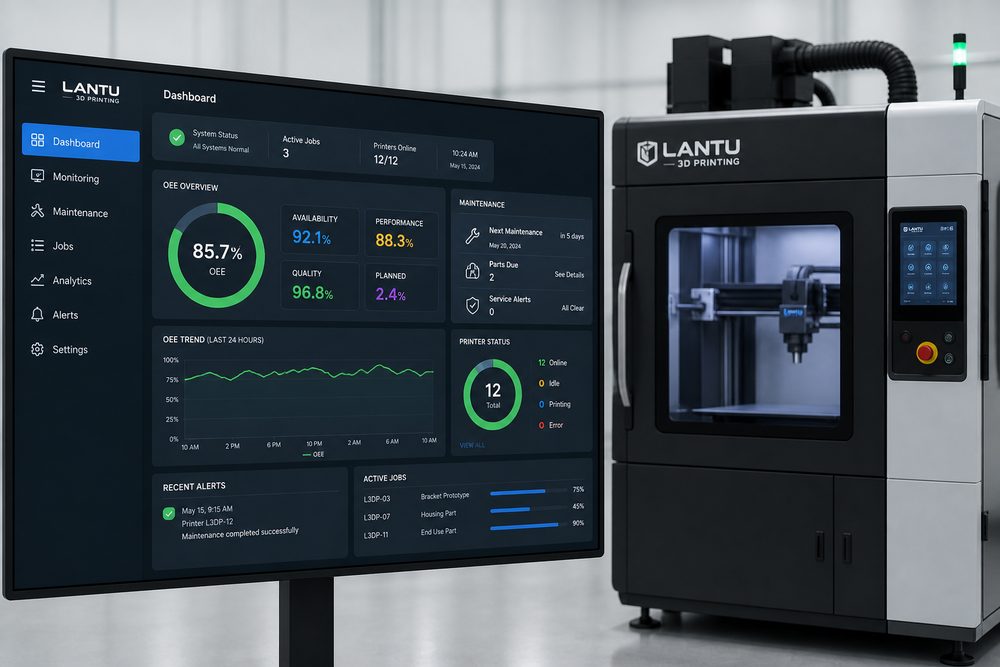
Many companies’ first reaction to rising orders is to add more equipment, but delivery bottlenecks often come from downtime, rework, scheduling conflicts, and delayed maintenance. The effective capacity of 3D printing equipment should be measured by OEE, or Overall Equipment Effectiveness, which is the product of availability, performance efficiency, and quality rate. Only by combining maintenance management with production data can you determine whether expansion is truly needed or whether existing equipment efficiency should be improved first.
1. Build a Preventive Maintenance Checklist
For FDM equipment, pay attention to nozzle wear, feeder gears, bed leveling, and hot-end temperature control. For SLA equipment, focus on light-source uniformity, resin vat film, blade condition, and ambient temperature. For SLS and metal systems, key items include the powder spreading system, filtration system, oxygen content, laser path, and safety interlocks. The maintenance checklist should clearly define daily, weekly, and monthly tasks, and record the person responsible, any abnormalities found, and the resolution.
2. Use Failure Data to Identify Hidden Losses
Machine downtime is only the visible loss. More issues are hidden in print failures, dimensional out-of-tolerance parts, urgent job insertions, and post-processing delays. It is recommended to classify failure causes into model issues, material issues, equipment issues, parameter issues, and human operation issues. If the same defect occurs three times in a row, root cause analysis should be triggered rather than simply reprinting the job.
3. Optimize Scheduling to Improve Availability
3D printing jobs typically span long periods of time, and poor scheduling can create idle machine windows or risks from unattended overnight runs. Production can be grouped by material, color, accuracy, post-processing route, and due date. Long-duration jobs should be started during periods when they can be monitored, and critical orders should have mid-run checkpoints. For multi-machine platforms, a unified job dashboard is more reliable than relying on individual machine experience for scheduling.
4. Use OEE as a Decision-Making Tool, Not a Punishment Metric
OEE should not be treated as a simple penalty metric; instead, it should help managers identify bottlenecks. For example, low availability points to maintenance and spare parts issues, low performance efficiency may indicate poor nesting or suboptimal parameters, and low quality rate suggests issues in design review and quality control. In project management, lantu3D places greater emphasis on whether equipment capability can be consistently converted into customer deliveries.
Conclusion
The goal of 3D printing equipment maintenance is not to make machines look clean, but to improve predictable capacity. Through preventive maintenance, fault classification, scheduling optimization, and OEE analysis, companies can improve delivery capability, reduce rework costs, and enhance the customer experience without blindly adding more equipment.
Submit a model, drawing, image or written notes. Engineers will review material, process, finishing and delivery based on actual use.