Introduction: Defect Management Must Shift from Outcome-Based Judgment to Root-Cause Prevention
3D printing defect analysis and prevention is not a single-process issue, but a systems engineering task spanning requirement clarification, model evaluation, materials and process setup, production scheduling, and delivery acceptance. For platforms like lantu3D, which provide full lifecycle management and realization from blueprint/design to physical delivery, defect management must be broken down into measurable, reviewable, and continuously improvable work items: Is the input file complete? Are key dimensions annotated? Are material batches and machine parameters traceable? Can inspection records support customer decision-making? Only by capturing this information early in the project can later quoting, prototyping, small-batch production, and quality closure avoid relying on ad hoc personal judgment.
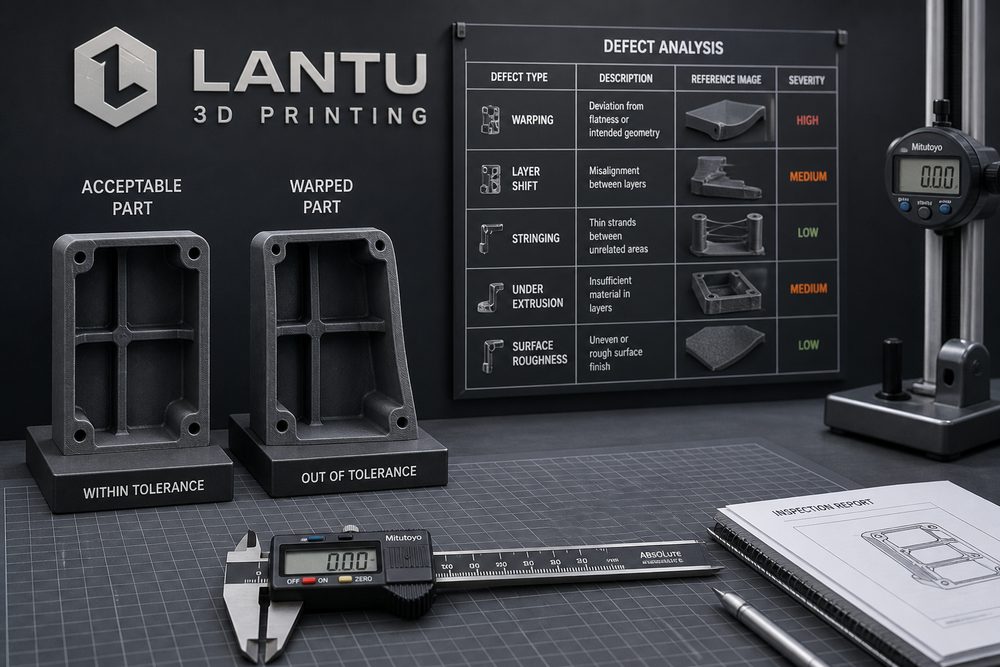
In real-world projects, companies often think of 3D printing defect analysis and prevention as a specialized skill for a single role, but what truly determines the outcome is cross-functional coordination. A seemingly simple sample may involve a 0.1-0.2 mm layer thickness choice, ±0.2 mm dimensional control, support contact treatment, thermal deformation risk, surface roughness targets, and transport protection methods. Without a unified methodology, rework costs often surge right before delivery.
1. Build a Defect Classification System and Traceable Records
First, establish a clear technical baseline. At project kickoff, confirm the part's purpose, load direction, assembly relationship, appearance grade, and delivery quantity, then translate those conditions into process parameters. For example, functional verification parts care more about strength and dimensional stability; display parts care more about texture, color, and surface consistency; small-batch parts care more about unit cost, takt time, and batch consistency. Different goals require different material and process combinations, and one set of experience cannot cover every scenario.
It is recommended to document key parameters in the project card: recommended material, build orientation, layer thickness range, critical dimension tolerances, post-processing requirements, inspection methods, and risk level. For SLA resin parts, pay attention to thin-wall warping, support marks, and brittleness changes after UV curing; for SLS nylon parts, focus on powder refresh rate, porosity, and dyeing uniformity; for metal SLM parts, prioritize residual stress, heat treatment procedures, and secondary machining allowance for critical hole positions.
2. Diagnose Problems from Five Dimensions: Design, Material, Equipment, Parameters, and Environment
Problem analysis should not stop at an outcome description like failed print, but should trace back to five dimensions: design, material, equipment, parameters, and operation. For example, part cracking may come from wall-thickness transitions, internal stress concentration, or an unreasonable heat-treatment curve; hole position deviation may stem from build orientation, insufficient support stiffness, or unclear post-machining datum references; uneven surfaces may be related to support layout, blasting media, polishing paths, and cleaning and drying conditions at the same time.
lantu3D places greater emphasis on the evidence chain in project management: retain slicing screenshots, machine batch information, material lot numbers, key parameters, process photos, and inspection data. The value of this is not just accountability, but also providing a basis for the next round of design optimization. For example, increasing local wall thickness from 1.0 mm to 1.5 mm, keeping overhang angles within 45°, or adding ribs to the back of large flat surfaces is often more effective than simply changing machines.
3. Preventive Measures Must Be Built into Process Review and First-Article Validation
An actionable plan should include process, roles, and acceptance criteria. In terms of process, a six-step method can be used: requirements review, DFAM design check, process review, pilot verification, pre-production confirmation, and delivery retrospective. In terms of roles, designers, process engineers, production, quality inspection, and project managers should all participate in key checkpoints. In terms of acceptance, besides dimensions, record appearance grade, assembly tests, strength validation, packaging condition, and customer feedback.
For medium- and small-batch projects, it is recommended to introduce tiered control: Class A items are safety-critical or assembly-critical parts and must undergo first-article inspection and 100% inspection of key dimensions; Class B items are functional verification parts and can use sampling inspection plus assembly validation; Class C items are appearance or display parts and should focus on surface and color consistency. With tiered control, resource allocation becomes more focused and customers can better understand the boundaries between cost and quality.
4. Use a Defect Database to Improve Batch Stability
The most easily overlooked part of implementation is the review mechanism. After each project, record actual labor hours, number of failures, reasons for rework, customer change requests, and final parameters, and turn one-off delivery experience into organizational assets. For repeat industries such as medical aids, automotive fixtures, consumer electronics housings, and aerospace prototypes, review data can be transformed into a material library, parameter library, risk list, and quotation templates.
At the same time, avoid positioning 3D printing simply as a way to make a part quickly. Its core value is shortening validation cycles, lowering the barrier to manufacturing complex structures, and connecting design, manufacturing, inspection, and delivery data. When companies integrate 3D printing defect analysis and prevention into standard workflows, 3D printing can evolve from a prototyping tool into a stable digital manufacturing capability.
Conclusion
The goal of defect analysis is not to explain failure, but to ensure the same problem does not happen again. For industry practitioners, the real competitiveness is not owning a specific machine, but being able to make fast judgments, execute reliably, and continuously accumulate experience under complex requirements. lantu3D will continue to focus on design evaluation, material and process engineering, production management, and delivery verification to provide complete realization support from blueprint to physical part.
Submit a model, drawing, image or written notes. Engineers will review material, process, finishing and delivery based on actual use.