Introduction: Energy Optimization Is More Than Saving Electricity
As the number of 3D printing machines increases, energy costs from electricity, air conditioning, compressed air, curing, heat treatment, and powder handling become more visible. For enterprise customers, green manufacturing and carbon footprint are also part of supply chain evaluation. While 3D printing has the potential to reduce material waste, inefficient scheduling, long machine standby periods, or repeated rework in post-processing can still lead to significant energy waste.
1. First Establish an Energy Measurement Framework
Before optimizing, you need to know where energy is being consumed. It is recommended to track electricity consumption by machine, process, and order, including the printing stage, preheating stage, cooling stage, standby stage, and post-processing stage. For powder bed processes, preheating and cooling time may account for a large share of the total cycle; for resin processes, cleaning, curing, and ventilation should also be included. Only when you establish energy metrics per part, per unit weight, or per effective build volume can comparisons be made meaningfully.
2. Increase Batch Loading Rate to Reduce Unit Energy Consumption
For many machines, baseline energy consumption is not fully proportional to the number of parts loaded. Proper batch consolidation can significantly reduce energy consumption per part, especially in SLS, MJF, and metal powder bed processes. However, batch consolidation must not compromise lead time or quality. Parts should be grouped according to material, color, accuracy requirements, and post-processing route. For urgent orders, small-batch rapid delivery can be used; for standard orders, scheduling rules can improve chamber utilization.
3. Reducing Rework Means Reducing Energy Waste
Rework and reprinting are often the largest hidden sources of energy consumption. Through upfront DFM, first-article confirmation, parameter locking, and quality traceability, failure rates can be reduced. Post-processing should also avoid repeated sandblasting, secondary painting, and excessive grinding. In some cases, selecting a more suitable material or process may result in a slightly higher unit price, but it can reduce failures and post-processing. From a full-process perspective, this is more energy efficient.
4. Equipment Management and Environmental Control Are Equally Important
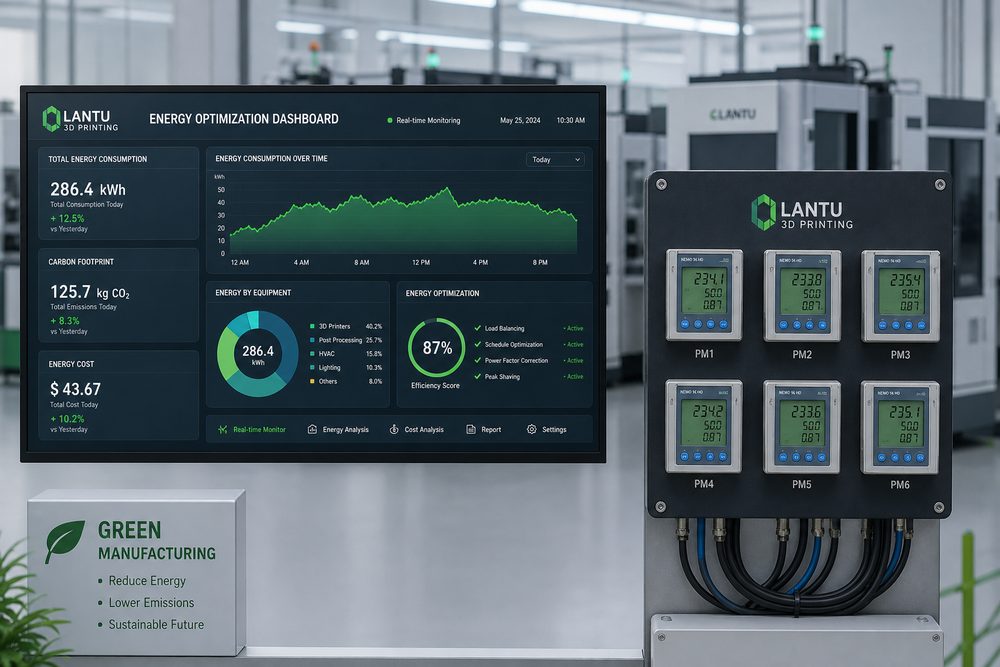
Regular maintenance of lasers, light sources, heating systems, and motion mechanisms can prevent inefficient machine operation. Air conditioning and ventilation systems should be controlled by zone according to process requirements, rather than operating the entire workshop at a uniformly high load. Machines without tasks for long periods should enter energy-saving mode while still maintaining the necessary material storage environment. Data dashboards can display standby duration, loading rate, and abnormal energy consumption, helping managers identify sources of waste.
Conclusion
Optimizing 3D printing energy consumption is not simply about lowering the power of a single machine; it is about reducing waste across the entire workflow from orders, processes, quality, and environmental control. When Blueprint3D connects design and manufacturing resources, it can also help customers choose a more efficient and sustainable implementation path through data-driven management.
Submit a model, drawing, image or written notes. Engineers will review material, process, finishing and delivery based on actual use.