Introduction: The Core Value of Equipment Utilization
In 3D printing service enterprises, equipment utilization directly determines profitability. Taking an SLM metal printer worth 800,000 RMB as an example, based on 5-year depreciation, the average daily depreciation cost is about 440 RMB. If equipment utilization is only 40%, equipment depreciation will account for as much as 35% of the cost per printed part; when utilization increases to 80%, this proportion can drop to 17.5%, significantly improving price competitiveness.
1. Current Status Analysis of Equipment Utilization
Utilization calculation model: Equipment utilization = actual printing time / (total time - planned downtime) × 100%. Taking a printing service center with 12 industrial-grade SLA machines as an example, its utilization analysis shows: standby time accounts for 25% (gaps between orders), maintenance downtime 10%, equipment failures 8%, process debugging 7%, and actual effective utilization is only 50%.
Typical causes of low utilization: (1) Uneven order distribution: large-size orders occupy equipment for long periods, while frequent switching for small orders leaves equipment idle; (2) Lack of maintenance planning: the proportion of unexpected failures is too high, with average fault repair time reaching 4.5 hours; (3) Insufficient process parameter optimization: each batch of new orders requires 2-3 test prints, and the material loss rate reaches 12%; (4) Manual scheduling decisions: reliance on operator experience leads to a 40% difference in equipment load.
2. Scheduling Optimization Strategies
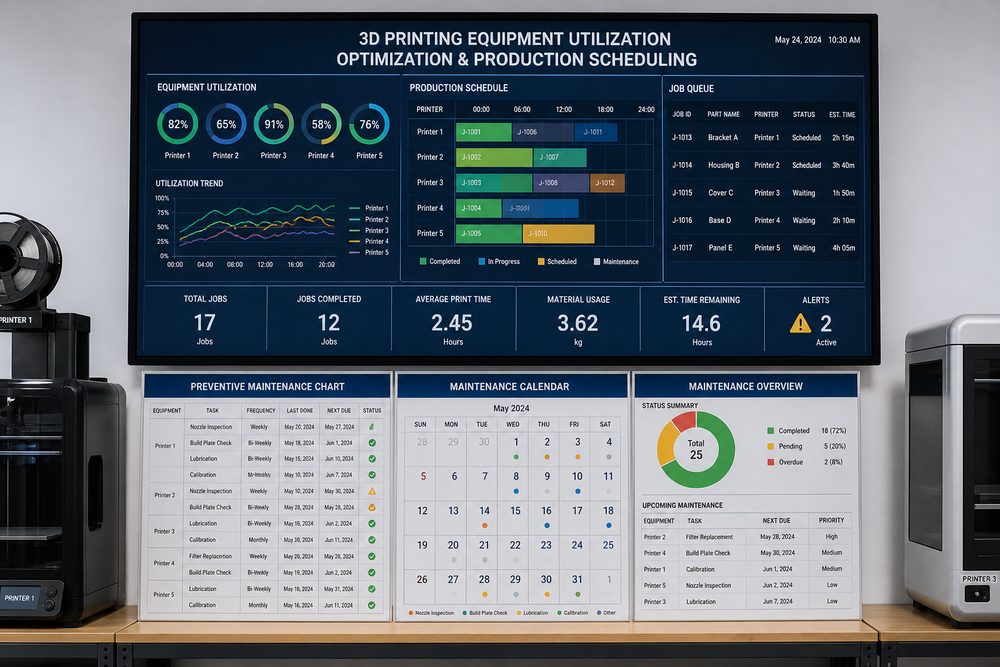
Elements of an intelligent scheduling system: Modern 3D printing enterprises adopt intelligent scheduling systems to automatically assign orders. Core algorithms include: equipment matching score (material compatibility 50 points, size fit 30 points, process capability 20 points), estimated completion time calculation (printing time × 1.2 safety factor), and equipment load balancing assessment (goal: utilization differences among equipment 75%); (2) Overall Equipment Effectiveness OEE = utilization rate × performance rate × quality rate (target: >70%); (3) Mean time between failures MTBF (target: >400 hours); (4) Mean time to repair MTTR (target: 95%).
Digital management platform
Submit a model, drawing, image or written notes. Engineers will review material, process, finishing and delivery based on actual use.