
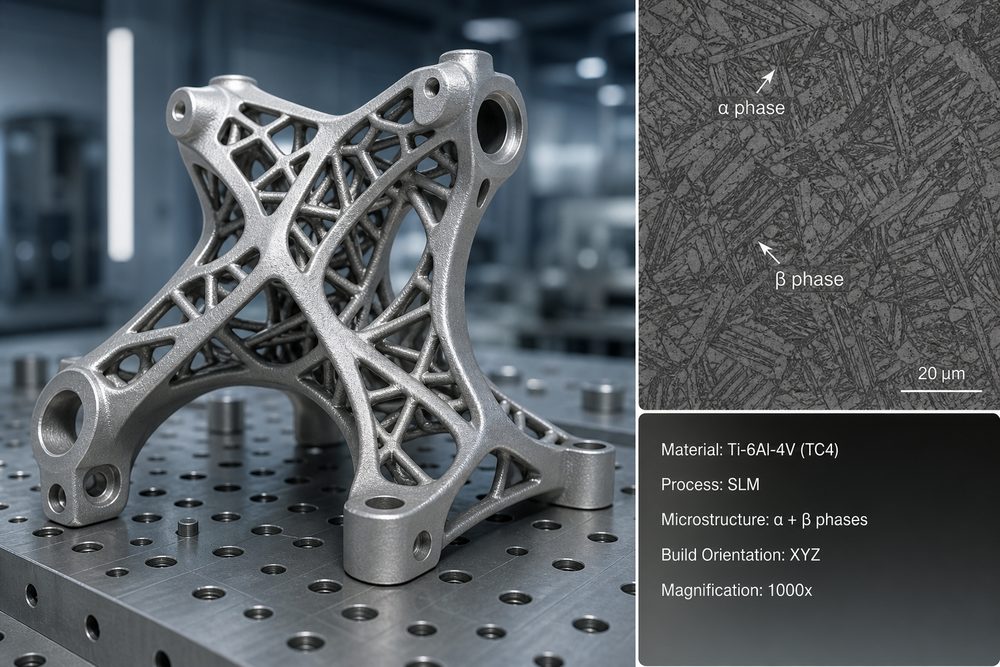
Material properties and 3D printing application background of titanium alloy TC4
Titanium alloy TC4 (Ti-6Al-4V) has become a key material in the aerospace, automotive industry and biomedical fields due to its excellent specific strength, good corrosion resistance and biocompatibility. Traditional casting and forging processes have problems with forming limitations and material waste when producing complex structural parts. However, metal 3D printing technology achieves near-net shape of high-performance titanium alloy complex components through layer-by-layer accumulation. Selective laser melting (SLM) and electron beam melting (EBM), as two mainstream metal 3D printing processes, have their own characteristics in TC4 alloy forming, and their microstructure formation mechanism and mechanical property optimization have become research hotspots.
Microstructure characteristics of TC4 in SLM process
The SLM process uses a high-energy-density laser beam to quickly melt metal powder. Its extremely fast heating and cooling rate (up to 10^4-10^6 K/s) causes the TC4 alloy to form a unique non-equilibrium microstructure. Research has found that TC4 formed by SLM is mainly composed of fine α' martensite phase, and the grain size is usually in the range of 1-5 μm, which is much smaller than the traditional casting structure. This fine-grain strengthening effect significantly improves the strength of the material, but the brittleness of the α' phase also reduces the ductility. In addition, the high temperature gradient during the SLM process promotes the growth of columnar crystals along the building direction, forming a strong texture, resulting in anisotropy of mechanical properties.
The impact of EBM process on the microstructure of TC4
Compared with SLM, the EBM process is performed in a vacuum environment and uses electron beams to preheat the powder bed to approximately 700°C, significantly reducing the temperature gradient and cooling rate. This process characteristic makes the microstructure of the TC4 alloy formed by EBM mainly consist of α and β phases, and the content of α' martensite is significantly reduced. The precipitation of β phase effectively improves the ductility and toughness of the material, making the comprehensive mechanical properties of EBM formed parts closer to that of the forged state. Research shows that the tensile strength of TC4 prepared by EBM process can reach 950-1050 MPa, and the elongation is maintained in the range of 10-15%, which meets the performance requirements of aerospace load-bearing components.
The optimization mechanism of heat treatment on the mechanical properties of TC4
Subsequent heat treatment is a key means to regulate the mechanical properties of metal 3D printed TC4 alloy. Annealing treatment (650-850°C heat preservation followed by air cooling) can effectively decompose α' martensite and precipitate fine β phases, significantly improving ductility while maintaining high strength. Hot isostatic pressing (HIP) treatment (900-950°C, 100-150 MPa pressure) can not only eliminate internal pore defects, but also promote tissue homogenization and improve fatigue performance. Experimental data shows that the fatigue limit of SLM-formed TC4 alloy processed by HIP can reach 500-600 MPa, reaching more than 90% of the forging level. For EBM formed parts, appropriate heat treatment can further optimize the morphology and distribution of α phase and improve the fracture toughness of the material.
Coordinated regulation of microstructure and properties by process parameters
Process parameters such as energy input, scanning strategy, and layer thickness during the metal 3D printing process directly affect the microstructure and mechanical properties of TC4 alloy. Higher laser power combined with appropriate scanning speed can obtain formed parts with a density exceeding 99.5%, reducing voids and unfused defects. Scanning strategy optimization (such as checkerboard scanning, interlayer rotation) can effectively reduce residual stress and texture strength, and improve the isotropy of mechanical properties. In addition, by controlling the relative relationship between the construction direction and the force direction, the columnar crystal strengthening effect can be fully utilized to obtain excellent performance in the key load-bearing direction. Research shows that rationally designed process parameters combined with appropriate heat treatment can make the comprehensive performance of metal 3D printing TC4 alloy surpass the level of traditional casting.
Future development trends and application prospects
As metal 3D printing technology continues to mature, titanium alloy TC4 has increasingly broad application prospects in aerospace, biomedical and other fields. Through the optimization of process parameters, improvement of heat treatment system and design of new alloy components, the mechanical properties of metal 3D printing TC4 alloy will be further improved. The development of in-situ monitoring and closed-loop control technology will achieve accurate prediction and real-time control of microstructure and performance. In the future, metal 3D printing TC4 alloy will develop in the direction of high performance, functional integration and intelligence, providing strong support for the rapid development and mass production of complex components.
Submit a model, drawing, image or written notes. Engineers will review material, process, finishing and delivery based on actual use.