Support type selection and performance comparison
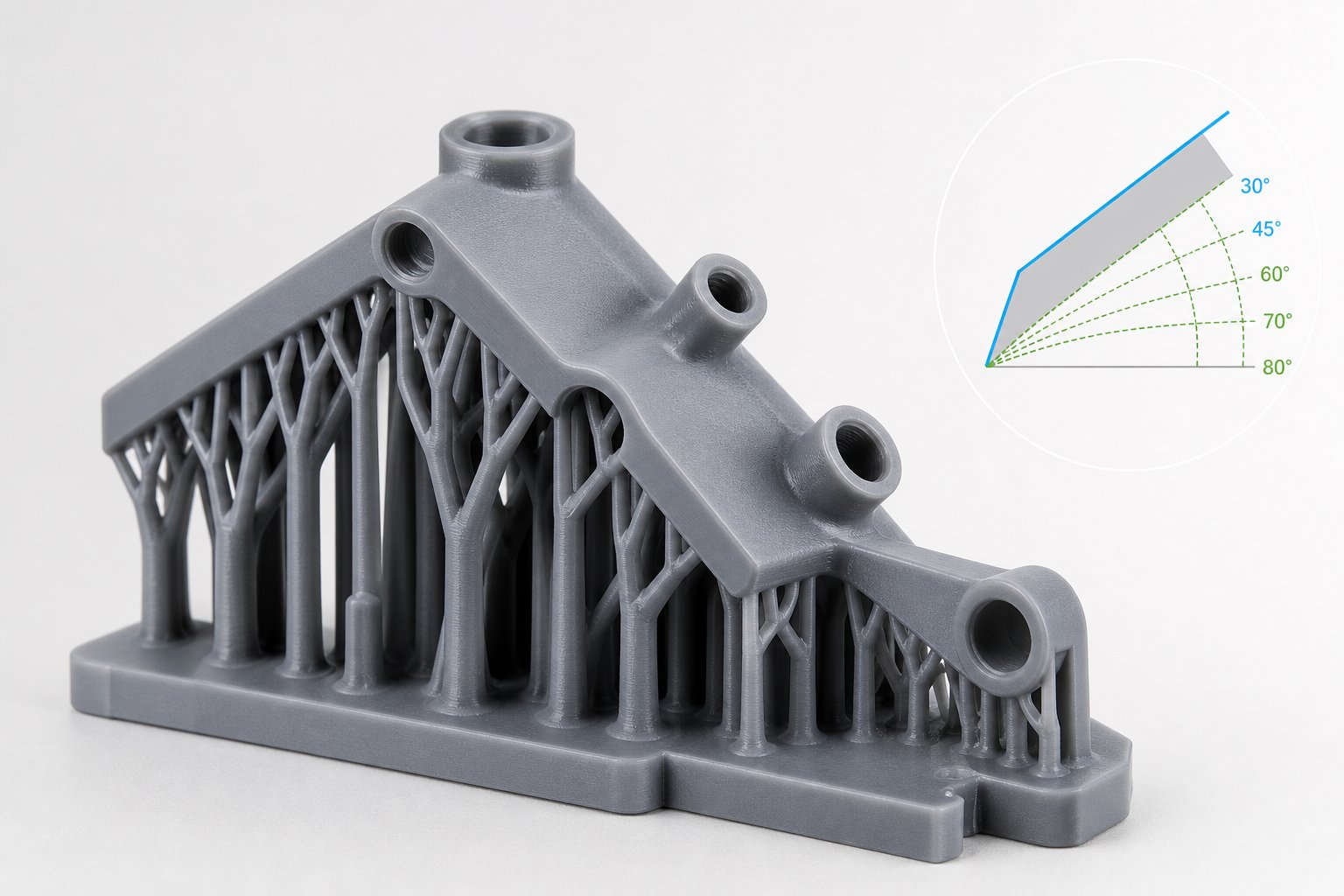
Compared with linear supports, tree supports use more than 40% less material, and the contact points with parts are more concentrated, making removal easier. The principle is to find the nearest effective attachment point at the overhang through the branch structure to avoid covering a large area. For desktop-level printing of resin parts, tree supports have become almost standard. For the SLS process, there is no need for traditional support structures at all. The unsintered powder itself plays a supporting role. This advantage should be used to reduce geometric restrictions during design.
Setting the support attachment angle
In the slicing software, you can set the overhang angle threshold that triggers the support. Usually, setting it to 45 degrees is a safe starting point. For parts with high surface requirements, it can be adjusted to 60 degrees to significantly reduce the support area, but it needs to be confirmed that the accuracy is within the allowable range. The distance between the support and the bottom affects the difficulty of removal. It is generally recommended to set it to 0.1 to 0.3mm - too close will cause damage to the bottom surface, and too far will cause the overhang section to be too long and easily deformed.
Contact surface optimization and position design
Designers should proactively plan the support attachment area on the non-appearance surface or assembly positioning surface. The support attachment platform can be reserved at the CAD stage to avoid supports appearing in positions that are still visible after painting. For symmetrical parts, supports should be distributed symmetrically to ensure uniform stress and reduce displacement and inter-layer misalignment during printing.
Submit a model, drawing, image or written notes. Engineers will review material, process, finishing and delivery based on actual use.