
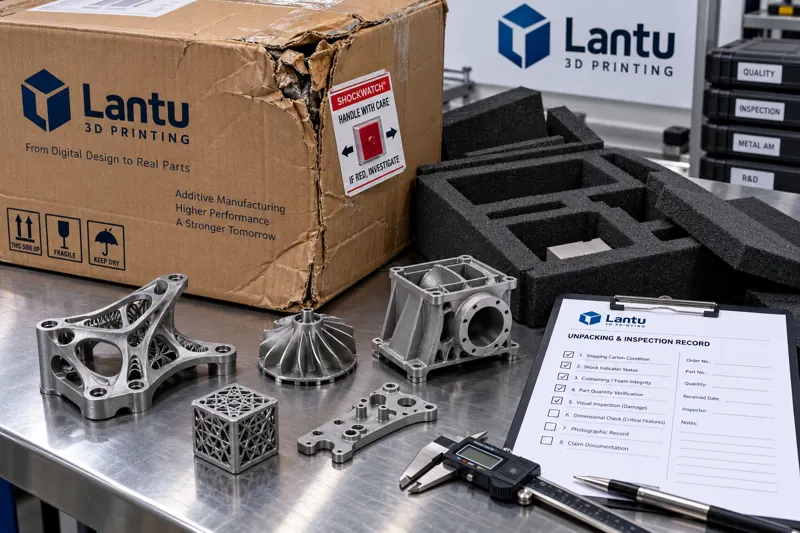
Introduction: Shipping Damage Is Not the End of Logistics, but a Test of Evidentiary Capability
A metal additively manufactured part that has passed full dimensional CMM inspection arrives at the customer site, where unboxing reveals flange-face dents, deformed threaded holes, and damaged packaging inserts. A dispute immediately arises: Did the defect exist before shipment, or was it caused by impact during transit? Was the packaging design inadequate, or was the damage caused by rough handling by the carrier? If a complete chain of evidence cannot be established at the unboxing site, liability is often left unresolved for weeks as both parties maintain their positions, eventually ending in concessions that result in both financial loss and damaged trust. For high-value, low-volume, highly customized 3D-printed parts, the core of shipping-damage handling is not post-incident negotiation skills, but whether reproducible unboxing acceptance procedures, fixed evidence-collection protocols, and determinable liability boundaries have been established in advance. In its lifecycle delivery management, lantu3D brings shipping-damage handling forward into shipping documentation and unboxing procedures so that every exception is supported by evidence.
1. Define Liability Boundaries First: How to Identify Four Types of Shipping Damage
The first step in handling shipping damage is not taking photographs, but determining which category the damage belongs to. In practice, it can be divided into four types. The first is manufacturing-related residual damage, where damage characteristics are associated with processing marks, such as support-removal residues, machining tool marks, or discontinuous grinding patterns; the boundaries of such damage often align with the process path. The second is inadequate-packaging damage, where damage is concentrated on edges, bosses, and slender features in contact with inserts, and multiple parts from the same batch show damage patterns in identical locations, indicating that cushioning design has not covered critical vulnerable surfaces. The third is transport-impact damage, characterized by random distribution, carton deformation, activated impact indicators, loosened stretch wrap, and damage directions consistent with the direction of a drop. The fourth is environmental-corrosion damage, including rust, oxidative discoloration, and condensation inside the packaging, corresponding in time to temperature and humidity data-logger curves.
The key to distinguishing these four categories is mapping damage characteristics to a timeline. Damage occurring before the delivery point may have traces that are covered or contaminated by subsequent processes; damage occurring during transportation must be temporally consistent with impact records and carton condition. From an engineering perspective, it is recommended to retain a condition baseline before shipment—clear images of every critical surface, along with identification records. This provides a reference frame for subsequent comparison. Without a baseline, any post-event assessment is merely speculation.
2. Standard Unboxing Procedures: Turn Evidence Collection into a Process Rather Than an Improvised Response
The aspect most likely to become uncontrolled during unboxing is the rush to remove a part after damage is discovered, thereby disrupting the original condition of the scene. Standard procedures should be formalized into six steps. First, before opening the package, take photos of all six sides of the outer carton, including shipping marks, seal condition, impact and tilt indicators, stretch-wrap condition, and strapping. Second, record the unboxing time, location, attendees, and outer-carton weight. Third, remove cushioning materials layer by layer in sequence, photographing each layer and preserving the original positional relationship of the inserts. Fourth, after removing the part, photograph its overall condition against the original packaging background before taking close-up photos of damaged areas with a scale. Fifth, conduct a preliminary dimensional check of the damaged area to determine whether assembly functionality is affected. Sixth, complete an unboxing record form and have both parties sign it for confirmation.
The value of this procedure is that it turns evidence collection from a personal habit into an organizational capability. For high-value individual printed parts, it is recommended to require mandatory video recording of unboxing, with continuous recording from the first cut of the seal and no editing permitted. Video provides a better reconstruction of the sequence of layers and can also rule out concerns about staged evidence. In addition, the outer carton should not be discarded or moved to another area before evidence collection is complete, because the carton itself is one of the most important evidence carriers.
3. Components of the Evidence Chain: Ensure Every Claim Is Supported by Corresponding Documentation
A claim supported by adequate evidence generally requires five categories of documentation to form a closed loop. The first is delivery-condition evidence, including pre-shipment inspection reports, images of critical surfaces, and identification and batch records, demonstrating that the product was compliant when shipped. The second is packaging-compliance evidence, including packaging specifications, cushioning-material specifications, drop or vibration validation records, and carton-sealing operation photos, demonstrating that the packaging design was reasonable. The third is in-transit condition evidence, including impact indicators, tilt indicators, temperature and humidity logger curves, and carrier handover and receipt documents, used to reconstruct the transportation process. The fourth is damage-fact evidence, including unboxing videos, outer-carton photos, close-up images of damage, and dimensional verification records. The fifth is value evidence, including contract prices, invoices, and estimates for rework or remanufacturing costs.
These five categories of documentation are connected chronologically from beginning to end; if any category is missing, a break appears in the chain. The most common gap is the second category: packaging designs have never been validated, making it impossible to demonstrate compliance when shipping damage occurs. The next most common is the third category: without indicators or data loggers, damage cannot be attributed to the transportation process. Therefore, the focus of building evidentiary capability lies before shipment, rather than after unboxing.
4. Liability Determination Criteria and Allocation of the Burden of Proof
Liability should be determined based on criteria rather than positions. Practical criteria include the relationship between the damage location and cushioning structure, consistency between the damage direction and the activation direction of indicator labels, whether damage distribution across parts from the same batch follows the same pattern, whether damaged fracture surfaces show fresh oxidation or contamination, and whether in-transit data curves exhibit abnormal peaks. If indicator labels are not activated but the part has random dents, the cause is more likely insufficient internal fixation or a pre-shipment condition issue; if labels are activated and the outer carton is deformed, carrier liability is more clearly indicated; if a data logger shows prolonged high humidity and the damage presents as rust, environmental-control responsibility becomes prominent.
For the burden of proof, it is recommended that contracts and delivery documents specify in advance that the consignee is responsible for following standardized unboxing procedures, the shipper is responsible for proving pre-shipment condition and packaging compliance, and the carrier is responsible for recording in-transit conditions. Prior agreement is better than subsequent argument. For cases where causation cannot be determined, clear handling thresholds should be established. For example, losses below an agreed amount may be handled through expedited replacement, while losses above that threshold should trigger a joint investigation, preventing minor disputes from consuming labor costs far exceeding the value of the goods.
5. Time Limits, Loss Calculation, and Closed-Loop Improvement
The success of a claim often depends on timeliness. Transportation contracts generally impose strict deadlines for notifying parties of shipping damage; some are calculated as a specified number of days after receipt, with late notification deemed a waiver. Therefore, anomalies found during unboxing must be reported internally on the same day, and written notice with preliminary images must be sent to the carrier and insurer within the agreed time limit. The time at which written notice is sent must itself be documented.
Loss calculations should distinguish between direct and indirect losses. Direct losses include remanufacturing costs, materials and machine time, rework operations, reshipment, and packaging costs. Indirect losses include schedule delays and production-line downtime caused by material shortages; the latter are generally recoverable only when separately stipulated in the contract. Cost calculations should include a detailed cost breakdown rather than a lump-sum quotation.
More importantly, continuous improvement must form a closed loop. Every shipping-damage incident should be fed back into revisions of the packaging solution: which vulnerable feature was not covered, which cushioning clearance was insufficient, and which carton type failed in actual testing. Only by converting individual cases into design rules can similar problems be prevented from recurring. It is recommended to establish a dedicated shipping-damage register within the quality system, classify and analyze incidents by type, and incorporate high-frequency issues into packaging design specifications and shipping work instructions.
Conclusion
The engineering-based handling of shipping damage is fundamentally about converting post-incident disputes into pre-agreed requirements and evidence retention during execution. Classifying damage types, standardizing unboxing procedures, building five categories of evidence, defining determination criteria and burden-of-proof responsibilities, controlling time limits, and feeding improvements back into the process form a complete closed loop. For delivery models such as 3D printing, characterized by high customization, high individual part value, and low volumes, the benefits of establishing this closed loop extend far beyond a single claim—it makes delivery certainty demonstrable and helps preserve strong customer relationships even when exceptions occur.
Submit a model, drawing, image or written notes. Engineers will review material, process, finishing and delivery based on actual use.