Introduction: The Core Value and Challenges of Order Quotation
In the 3D printing service industry, order quotation is not only the process of determining a price, but also an important step in demonstrating professional capability, building customer trust, and realizing business value. A scientific and transparent quotation system can stand out in intense market competition and win long-term cooperation from customers.
However, many 3D printing service companies face numerous challenges in the quotation process: inaccurate cost accounting leads to insufficient profit margins, inconsistent quotation standards trigger customer doubts, and inadequate value presentation traps companies in the mire of price wars. These issues directly affect a company’s profitability and market competitiveness.
This article will systematically explain how to build a quotation process for 3D printing service orders from four dimensions: cost accounting, value-based pricing, standardized processes, and communication mechanisms, helping companies achieve professional and transparent quotation management.
1. Cost Accounting Model: Building an Accurate Cost Analysis System
1.1 Direct Cost Accounting
Direct costs are the basic components of a quotation, including material costs, equipment usage costs, and labor costs.
Material cost calculation: Based on the model file provided by the customer, calculate the volume and weight of the required material. For FDM printing, consider material shrinkage and the material consumption of support structures; for SLM printing, powder recovery rate and material loss must be taken into account.
Equipment usage costs: These include equipment depreciation, energy consumption, and the cost of occupied time. The cost differences between different process equipment are significant; the hourly cost of SLM equipment can be 5–10 times that of FDM equipment.
Labor costs: These include labor hours for pre-processing (slicing, nesting), print monitoring, and post-processing (support removal, polishing, inspection), among other steps. A standard labor-hour database needs to be established to estimate labor hours based on part complexity and process requirements.
1.2 Indirect Cost Allocation
Indirect costs include site rent, administrative expenses, depreciation of quality inspection equipment, marketing costs, and more. A reasonable allocation mechanism is needed, usually using either the labor-hour allocation method or the order-amount allocation method.
For scaled enterprises, it is recommended to establish a cost center system to accurately allocate indirect costs to different business units and achieve precise cost accounting.
1.3 Cost Accounting Tools
Establish tools such as material consumption calculators, equipment labor-hour estimation tables, and standard labor-hour databases to enable fast and accurate cost accounting. For commonly used parts and standard processes, a cost reference database can be established to improve quotation efficiency.
2. Value-Based Pricing Strategy: From Cost-Driven to Value-Driven
2.1 The Core Logic of Value-Based Pricing
Value-based pricing is based on the actual value obtained by the customer rather than on cost. The value of 3D printing services is reflected in rapid delivery, design freedom, small-batch economics, customization capabilities, and more.
Rapid delivery value: Compared with the weeks or even months required by traditional manufacturing processes, 3D printing can be completed within days. For time-sensitive projects, customers are willing to pay a premium.
Design freedom value: 3D printing can produce complex structures that are difficult to achieve with traditional processes, such as integrated parts, internal flow channels, and lattice structures. The performance improvements and functional enhancements brought by these design innovations are an important source of value.
Small-batch economics value: For small-batch production, 3D printing does not require mold making, avoiding the high mold investment of traditional manufacturing and offering significant cost advantages in small-batch scenarios.
2.2 Differentiated Pricing Strategies
Develop differentiated pricing strategies based on customer type, project characteristics, and service content.
Customer-tiered pricing: Offer preferential prices to long-term partners, apply standard prices to one-time customers, and charge rush fees for urgent orders.
Service-tiered pricing: Basic services (printing only) are priced lower, while value-added services (design optimization, post-processing, quality inspection) are charged separately to form a multi-tiered pricing system.
Process-tiered pricing: Different processes and materials have significant cost and value differences. The price of metal printing and high-performance material printing can be 3–10 times that of standard material printing.
2.3 Competitive Pricing Reference
Regularly research market conditions to understand competitors’ price levels and quotation strategies. However, avoid blindly competing on low prices; pricing should be based on your own strengths and value proposition.
3. Quotation Standardization System: Achieving Transparent and Professional Quotation Management
3.1 Standardization of Quotations
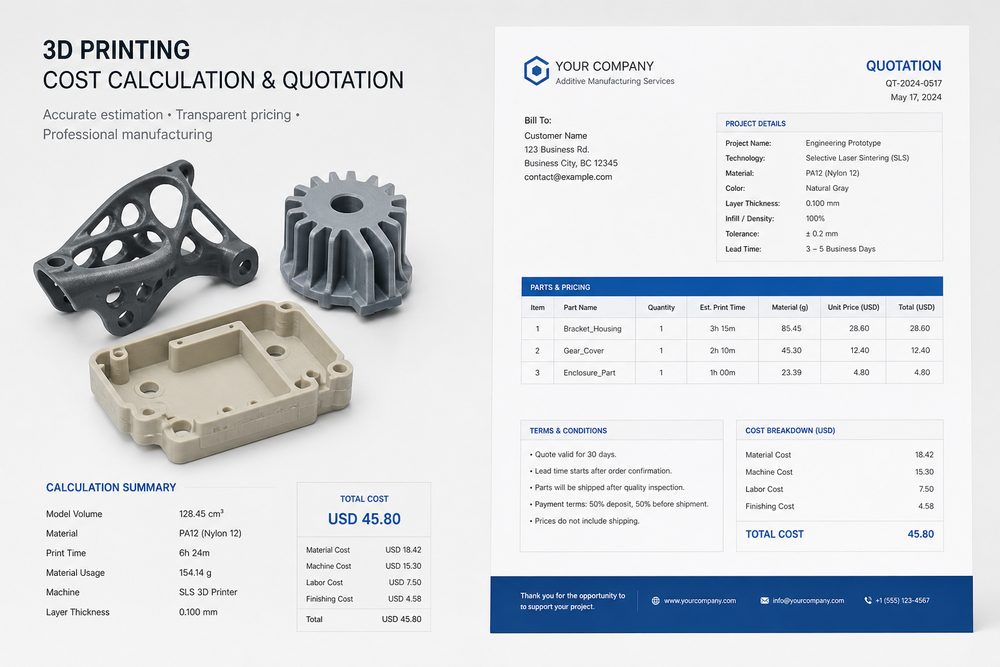
Establish a standardized quotation template that includes the following elements:
- Project information: Order number, customer name, project name, quotation date, validity period
- Part information: Part name, quantity, material, process, delivery time
- Cost breakdown: Material fee, printing fee, post-processing fee, inspection fee, packaging and shipping fee
- Service terms: Payment method, quality standards, after-sales service, liability for breach of contract
- Additional notes: Technical recommendations, risk warnings, alternative solutions
3.2 Quotation Flow
Submit a model, drawing, image or written notes. Engineers will review material, process, finishing and delivery based on actual use.