Introduction: Transformation Challenges Facing 3D Printing Enterprises
Under the wave of Industry 4.0, 3D printing technology is shifting from rapid prototyping to large-scale batch production. However, most 3D printing enterprises still have production lines at the semi-automated or even manual-operation stage, facing core issues such as equipment silos, data fragmentation, and difficulties in quality traceability. Industry research shows that the equipment utilization rate of traditional 3D printing production lines is only 45%-55%, while intelligent production lines can reach more than 85%; the proportion of manual intervention exceeds 60%, resulting in a product quality fluctuation coefficient as high as ±15%, far above the industrial-grade acceptance standard of ±5%.
More critically, without the support of a digital management system, enterprises find it difficult to achieve real-time monitoring of the production process and optimized decision-making. Before introducing an MES system, a medium-sized 3D printing service provider had an average order delivery cycle of 12 days, an equipment fault response time of up to 4 hours, and a monthly capacity-planning error of over 20%. These problems severely constrain the enterprise's competitiveness and profitability, making it urgent to improve both production efficiency and product quality through intelligent transformation.
1. Construction of the Automation Equipment Layer: From Standalone Machines to Line Collaboration
The physical foundation of an intelligent production line is automated equipment, but this is not simply about piling up machines; it requires building collaborative operation capabilities among the equipment. The automation equipment layer of a 3D printing enterprise mainly includes four major systems: a printing equipment cluster, automated post-processing units, a logistics transfer system, and quality inspection stations.
1. Clustered Configuration of Printing Equipment
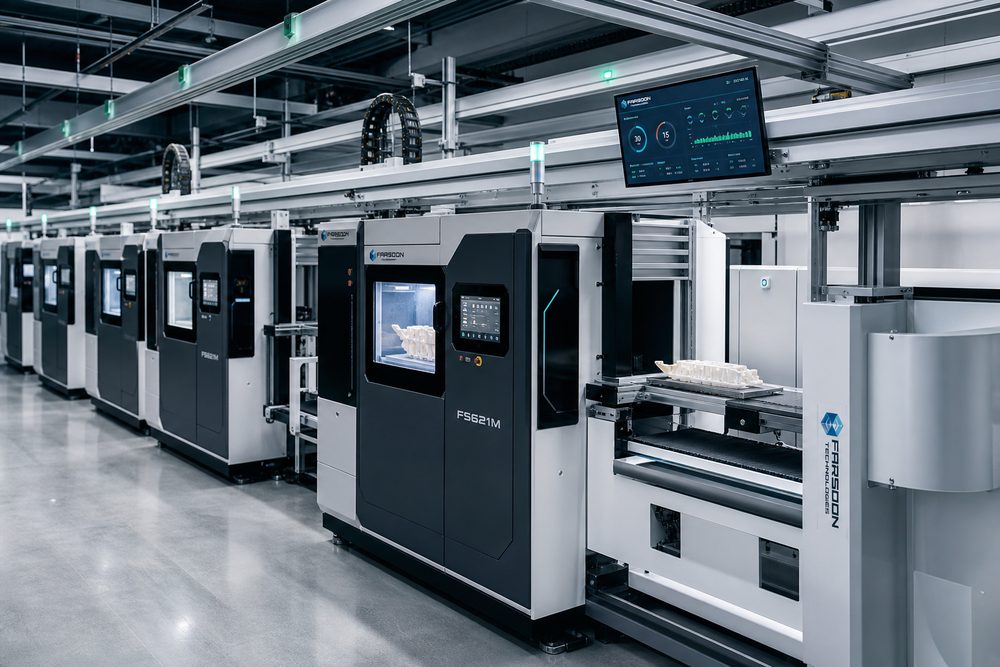
Traditional 3D printing workshops adopt a decentralized layout, with each machine operating independently and material handling and workpiece transfer relying on manual labor. Intelligent transformation first requires cluster-based equipment management. Taking the SLS (selective laser sintering) process as an example, the standard configuration is 4-8 printers forming a production unit, equipped with a centralized powder-feeding system and a powder recycling device. The specific technical parameters are as follows:
- Printing equipment: laser power 200W-400W, build chamber size from 300×300×350mm to 500×500×500mm, layer thickness 0.08-0.15mm
- Powder-feeding system: powder storage tank capacity 500-1000L, automatic powder-feeding accuracy ±2%, powder temperature control range 20-80°C
- Recycling device: powder sieving accuracy <63μm, recovery efficiency ≥95%, oxygen content under inert gas protection <0.1%
The BMW IDAM project established two modular additive manufacturing production lines at its Bonn plant. By using automated logistics carts to automatically transfer the moving build chambers of the printers, equipment utilization increased from 52% before the upgrade to 89%, and production capacity increased by 71%. This case proves that automated collaboration among equipment is the primary prerequisite for an intelligent production line.
2. Automated Post-Processing Units
The post-processing stage is a bottleneck in 3D printing production lines. Traditional manual powder cleaning, support removal, surface grinding, and other processes consume 40%-50% of the entire production cycle, and quality consistency is poor. Intelligent production lines need to be equipped with automated post-processing units, including:
- Powder cleaning system: uses high-pressure airflow + vibratory screening, improving cleaning efficiency by 300%, with residual powder <0.5%
- Support removal unit: for SLA/DLP processes, equipped with dual modes of CNC cutting + chemical dissolution, processing accuracy ±0.1mm
- Surface treatment station: CNC finishing + sandblasting/polishing, reducing surface roughness Ra from 3.2μm to 0.8μm
Yantai Moon's intelligent technology casting 3D printing production line, by introducing a robotic automatic cleaning system, shortened the post-processing time for sand molds from 45 minutes per piece manually to 12 minutes per piece, improving efficiency by 275%, while reducing the sand mold damage rate from 8% to below 1.5%.
2. Digital Workshop Layout: Networked Data Acquisition and Transmission
Automated equipment solves the efficiency problem at the physical layer, but to achieve intelligent decision-making, the nervous system of the digital workshop— the data acquisition and transmission network—must be established. The core task of this layer is to collect and transmit equipment operating status, process parameters, and quality data to the central control system in real time, eliminating information silos.
1. Industrial Internet of Things Architecture Design
A 3D printing digital workshop adopts a four-layer architecture of "device layer - edge layer - platform layer - application layer." The device layer collects raw data through PLCs, sensors, and cameras; the edge layer deploys edge computing nodes to achieve data preprocessing and local storage; the platform layer builds a data center to support storage and analysis of massive data; the application layer provides interfaces for business systems such as MES, ERP, and quality management.
Key technical parameters:
- Data acquisition frequency: device status data once per second, process parameter data 10 times per second, quality inspection data 100 times per part
- Network latency: from device to edge node <50ms, from edge to data center <200ms
- Data protocol: OPC UA unified interface, supporting ISO/ASTM 52910 standard data format
- Storage capacity: 100TB/year at the production-line level, supporting historical data traceability for more than 3 years
2. Real-Time Monitoring and Visualization System
Based on the collected data, a workshop-level digital twin system is built to achieve real-time visualization of the production process. Specific functions include: equipment operating status monitoring (power-on
Submit a model, drawing, image or written notes. Engineers will review material, process, finishing and delivery based on actual use.