
3D printing enterprise cost control and quotation strategy: comprehensive accounting method for materials, working hours, and profits
3D printing needs to establish a standardized management system and production process from the laboratory to the factory floor. Cost control and quotation strategies for 3D printing companies: Comprehensive accounting of materials, working hours, and profits is the only way for 3D printing companies to achieve scale, standardization, and high-quality development.
Management system framework
The management system of a 3D printing enterprise should cover the four major modules of quality management, production management, equipment management and personnel management. The quality management system ensures that products meet customer requirements; the production management system optimizes resource utilization and delivery cycles; the equipment management system ensures stable operation of equipment; and the personnel management system improves team skills and efficiency.
International standards are an important reference for establishing management systems. ISO 9001 quality management system provides a universal quality management framework; ISO 13485 is a special standard for the medical device industry; AS9100 is a quality standard for the aerospace industry. Enterprises should choose an appropriate standard system based on the target market.
Core process design
The core business processes of 3D printing companies include: order review, document preparation, material inspection, printing production, post-processing, quality inspection, packaging and delivery. Each process needs to develop a standard operating procedure (SOP) with clear inputs and outputs, responsible persons and quality control points.
Order review is the first step in quality control. Technical feasibility, capacity availability, cost reasonableness and delivery feasibility need to be assessed. For complex orders, process trials and risk analysis are recommended. It is necessary to check the 3D model quality, slicing parameters and support strategies during the file preparation stage to avoid problems during the production stage.
Production planning and scheduling
3D printing production planning needs to consider equipment capacity, material inventory, personnel arrangements and delivery requirements. Since 3D printing is a layer-by-layer accumulation process, the production time of a single piece is long (several hours to dozens of hours), and the production plan needs to be accurate to the hour level.
Equipment utilization is the core indicator of production management. By properly arranging printing tasks and reducing equipment idle time, productivity can be significantly increased. For example, centralized typesetting and printing of small parts and using night time to run long-cycle tasks are all effective ways to improve equipment utilization.
Material management is equally important. Powder materials need to be stored in a moisture-proof manner, resin materials need to be stored away from light, and wire materials need to control temperature and humidity. Establishing a material traceability system to record batch numbers, production dates and usage is crucial to quality control.
Quality control system
3D printing quality control runs through the entire production process:
Incoming material inspection: Material performance directly affects printing quality. After each batch of materials arrives, key performance indicators should be tested, such as powder particle size distribution, resin viscosity, wire diameter tolerance, etc.
Process control: Parameters such as temperature, speed, laser power during the printing process need to be monitored in real time. Establish process records to facilitate quality traceability and problem analysis.
Finished product inspection: Dimensional accuracy, surface quality, and mechanical properties are the core contents of finished product inspection. Critical parts require non-destructive testing (such as X-ray detection of internal defects) and destructive testing (such as tensile testing).
Customer feedback: Establish a customer feedback mechanism, collect problems and improvement suggestions during use, and continuously optimize products and services.
Cost control strategy
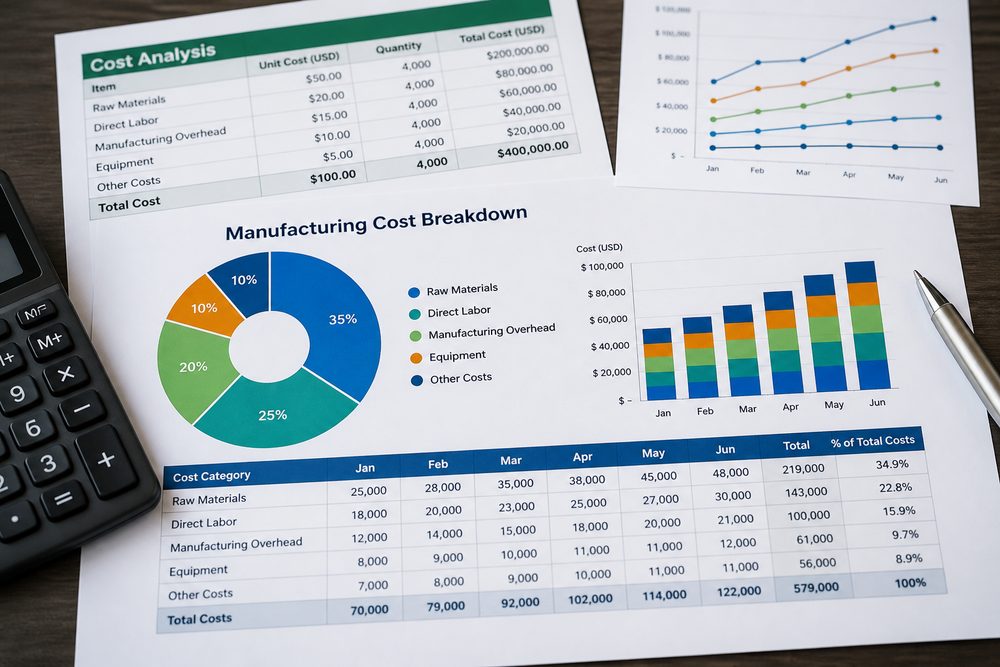
The cost structure of 3D printing companies is complex, mainly including material costs, equipment depreciation, labor costs, energy costs and management expenses. Effective cost control strategies include:
Material cost: Reduce material waste by optimizing layout, recycling unsintered powder for reuse, and selecting cost-effective alternative materials.
Equipment cost: Improve equipment utilization, extend equipment service life, and reasonably arrange equipment maintenance and upgrades.
Labor costs: Reduce manual intervention through automation, train multi-skilled employees, and optimize staffing.
Energy Cost: Choose equipment with high energy efficiency and use the difference between peak and valley electricity prices to arrange production and reduce standby energy consumption.
Continuous improvement mechanism
The management system is not static and needs to establish a continuous improvement mechanism. The PDCA cycle (Plan-Do-Check-Act) is the core method of continuous improvement. Conduct regular internal audits, management reviews and customer satisfaction surveys to identify improvement opportunities and implement them.
Technological innovation is also an important driving force for continuous improvement. Pay attention to new technologies, new processes, and new materials in the industry, and introduce and test them in a timely manner to maintain the company's technological competitiveness.
Summary
3D printing enterprise cost control and quotation strategy: The comprehensive accounting method of materials, working hours, and profits is a systematic project that requires management attention, participation of all employees, and continuous investment. lantu3D has rich practical experience in the field of 3D printing and can provide corporate customers with full-process consulting services from system construction to implementation, helping companies achieve high-quality development.
Submit a model, drawing, image or written notes. Engineers will review material, process, finishing and delivery based on actual use.