Introduction: When orders are numerous, materials are mixed, and post-processing takes a long time, simply lining jobs up by order sequence leads to idle machines and deadline conflicts
Tight Deadlines, Full Machines: Practical Methods for Optimizing 3D Printing Production Scheduling is not a single technical problem, but a systematic effort spanning customer requirements, model data, process selection, scheduling and delivery, and post-delivery review. For a full lifecycle management platform like lantu3D, which covers everything from blueprint/design to physical delivery, the key is not “can it be printed,” but whether uncertain demand can be transformed into a manufacturable process that is planable, traceable, and deliverable. A common mistake in the industry is focusing only on machine parameters while ignoring order batches, validation checkpoints, quality records, and cross-department information flows, which ultimately leads to rework, delays, or runaway costs. This article focuses on 3D printing production scheduling optimization and, combined with small-batch manufacturing scenarios, provides a practical framework that can be implemented.
1. The scheduling unit is not the order, but the process package
A single order may include resin, nylon, metal, and painted parts, so it cannot be managed on one timeline. A more reasonable approach is to break the order into process packages: printing, cleaning, post-processing, quality inspection, and packaging should each be scheduled separately. Only then can the real bottlenecks be identified. For example, printing may take only 8 hours, but paint queueing may take 48 hours; in that case, the delivery risk is not on the machine side.
2. Merge batches according to material and equipment capability
SLS nylon is suitable for combining by powder batch, SLA is suitable for combining by resin type and precision requirements, and FDM is suitable for combining by material and nozzle configuration. Batch consolidation can improve equipment utilization, but it cannot be pursued endlessly just to keep machines full. For urgent orders and high-priority projects, rush-job rules and impact assessments should be established to clearly define which batches will be delayed by an insertion and by how many hours.
3. Build a visual dashboard to reduce communication losses
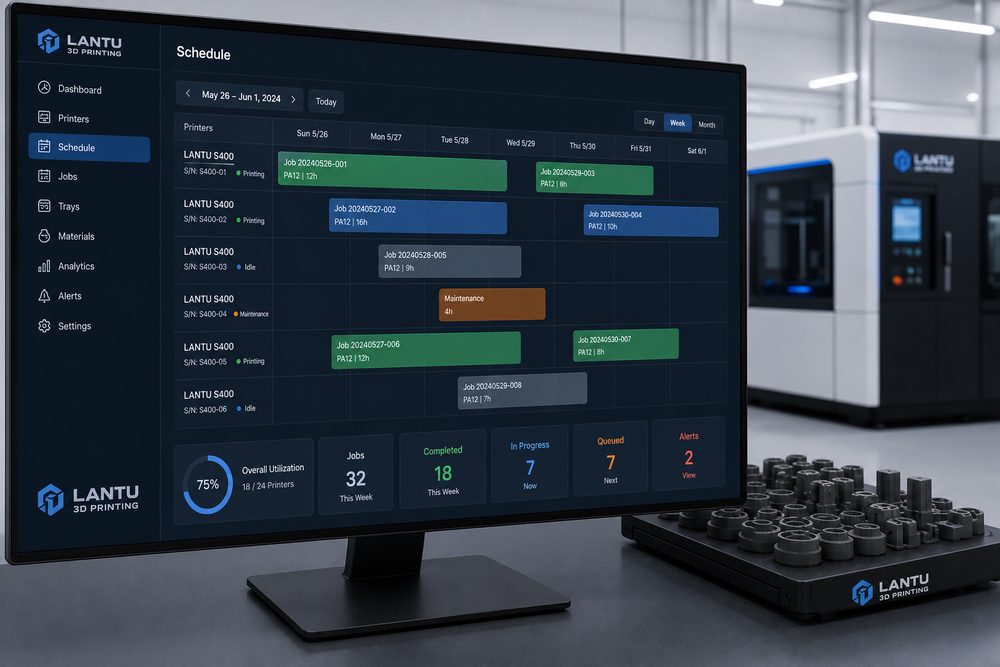
Scheduling information should be visible to sales, engineering, production, post-processing, and customer service on the same version. At a minimum, the dashboard should include order status, estimated print completion time, post-processing milestones, quality inspection status, and the reason for any exception. If the information is only kept in a scheduler’s personal spreadsheet, cross-department communication costs will rise sharply.
4. Use data to review scheduling accuracy
Each week, compare estimated labor hours with actual labor hours to identify materials, equipment, and personnel links with large deviations. Common causes include ignored model repair time, underestimated support removal time, excessively long dyeing batch waits, and quality rework that was not included. Scheduling optimization is not a one-time software deployment, but a continuous calibration of the process time database.
Conclusion: Turn experience into repeatable delivery capability
The core of Tight Deadlines, Full Machines: Practical Methods for Optimizing 3D Printing Production Scheduling is to condense fragmented experience into standardized actions: there is an entry point for demand, a basis for judgment, records for the process, a closed loop for exceptions, and reviewable results. Companies are advised to start with one high-frequency product category or one typical customer project, first establish a minimum viable workflow, and then gradually expand into a material library, process library, pricing rules, and quality traceability system. What lantu3D focuses on is precisely this kind of continuous capability building from design blueprint to physical delivery, making 3D printing not just a prototyping tool, but a reliable node for rapid validation, small-batch production, and on-demand manufacturing.
Submit a model, drawing, image or written notes. Engineers will review material, process, finishing and delivery based on actual use.