
The Starting Problem: Operating a Machine Does Not Equal Delivering Parts
In most additive manufacturing workshops, employee capabilities are described using vague labels such as “can operate the machine,” “can prepare files,” or “understands post-processing.” Once the order mix changes—for example, from one-off prototypes to small-batch production, or from resin parts to metal parts—management often discovers that only two or three people can independently handle recoating issues, assess thermal-stress deformation, or complete first-article acceptance. Everyone else can work only under supervision. This structure, in which capability is concentrated in a few individuals, is a major cause of delivery-time variation and inconsistent batch quality, as well as one of the most difficult staffing risks to absorb. The core purpose of a skills matrix is to convert individual experience into a manageable data structure.
1. A Skills Matrix Is Not an Employee Roster, but a Capability-to-Task Map
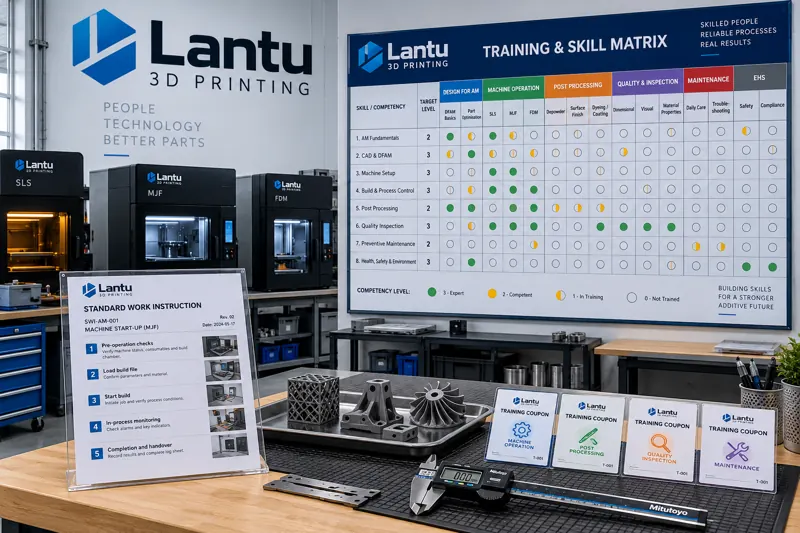
A skills matrix is essentially a two-dimensional table: job roles and employees form the vertical axis, while critical work items form the horizontal axis. Each cell contains a proficiency level rather than a simple “can/cannot” designation. For a 3D printing workshop, the horizontal axis typically includes model repair and wall-thickness checks, support design and part orientation, powder spreading and powder-bed condition assessment, equipment inspection and optical-component cleaning, build-process monitoring and abnormal shutdowns, support removal and cleaning, heat treatment and deformation correction, dimensional inspection and report interpretation, post-processing surface finishing, and packaging and labeling. A four-level scale from 0 to 3 is recommended: 0 means no exposure, 1 means completion under guidance, 2 means independent completion of standard parts, and 3 means the ability to handle abnormalities and train others. Ratings must be supported by work records and outcome data, not by a supervisor’s impression.
2. How to Build the Matrix: From Task Breakdown to Level Calibration
The first step in building a matrix is task breakdown: divide each process into observable actions. For example, “build-process monitoring” should not be scored as a single broad item. It should be divided into tasks such as checking protective-window transmittance and recoater condition before startup, identifying uneven powder layers and insufficient powder at the recoater, recognizing melt-pool abnormalities and executing a shutdown, recording the shutdown cause, and confirming recovery after restart. The second step is level calibration. Process engineering, quality, and equipment teams should jointly define verifiable criteria for Levels 2 and 3 for each item, such as “independently completes 10 consecutive standard parts with first-pass acceptance” or “can identify the cause of a shutdown and restore operation within 30 minutes.” The third step is a trial assessment. Use two widely recognized top performers and one newly hired employee as anchors to calibrate the scoring scale and prevent systematically inflated ratings.
3. How to Use the Matrix: Scheduling, Authorization, and Cross-Training
Once established, the matrix can be used most directly for scheduling and work authorization. Set entry-level requirements for critical processes; for example, metal-machine build monitoring may require Level 2 or above, while heat treatment and first-article acceptance may require Level 3, or Level 2 with secondary review. Use the matrix to select qualified personnel for shifts, preventing a situation in which a critical process has only one available operator—the “single-point bottleneck.” A second use is identifying capability gaps: sum proficiency levels across all employees and rank work items accordingly. The items with the lowest total scores are the workshop’s most vulnerable areas and should receive priority for cross-training. Third, the matrix supports cross-training plans by assigning each employee a primary role and a secondary role. The secondary-role target is typically Level 2, with a defined completion date and trainer, while secondary-role achievement rates are included in team performance metrics.
4. Engineering the Development Mechanism: Mentorship, Standard Work, and Closed-Loop Assessment
Multi-skilled employees are not developed simply by observing others. An effective approach embeds training into daily work: Level 3 personnel provide instruction, trainees perform each step according to standardized work instructions, and every step has clear acceptance criteria and traceable records. Standard work instructions should include four elements: work sequence, critical parameters, common abnormalities and corrective actions, and quality confirmation points. These should correspond one-to-one with the work items in the skills matrix, allowing training records to directly update matrix ratings. Assessments should not rely solely on written tests. A dual approach combining practical execution and results is recommended: the trainer confirms each practical step against the work instruction, while results are measured by the first-pass acceptance rate of the first N parts independently completed by the employee. After passing the assessment, update the matrix, grant authorization, and establish a validity period and reassessment cycle.
5. Common Pitfalls and Corrective Actions
The first common mistake is inflated ratings, where “has seen it” is recorded as “can do it.” The corrective action is to tie ratings to work records: without records of independently completed work, an employee cannot be rated at Level 2. The second mistake is treating the matrix as static after it is created and failing to update it for six months, making it unreliable for scheduling. Update incremental changes monthly and conduct a full reassessment quarterly. The third mistake is covering only operating roles while excluding process programming, inspection interpretation, and equipment maintenance—areas where bottlenecks are often concentrated. The fourth mistake is defining multi-skilling as everyone being able to do everything. In reality, cross-process training is costly. A reasonable goal is to have two or three interchangeable personnel for each critical process, rather than making every employee fully proficient in every task.
6. Quantifiable Management Metrics
Four metrics should be tracked continuously: the number of qualified personnel for critical processes, with fewer than two triggering a training plan; skill-level coverage, defined as the proportion of personnel at Level 2 or above for a given task; the multi-skilled employee ratio, defined as the proportion of employees with at least one secondary role at Level 2; and training completion time, measured as the actual number of months required to progress from Level 1 to Level 2. These metrics can be derived directly from the matrix without additional data collection, while reflecting both delivery flexibility and workforce risk. For management, the greatest value is not the matrix itself, but its ability to turn “who can do what and what is still missing” into data that can be reviewed and acted upon every week.
Conclusion
Skills matrices and multi-skilled workforce development fundamentally convert employee capability from tacit experience into explicit data, allowing scheduling, work release, and training to use the same basis for decision-making. The recommended implementation sequence is to first define task breakdowns and proficiency standards, then conduct trial assessments for calibration, integrate the matrix into scheduling and work authorization, and finally use assessment records to drive rolling matrix updates. This closed loop reduces dependence on individual key personnel and makes delivery performance more predictable for low-volume, high-mix production.
Submit a model, drawing, image or written notes. Engineers will review material, process, finishing and delivery based on actual use.