Introduction: A Change Is Not Just a Drawing Revision—It Must Answer Three Questions
In 3D printing projects, “Can we make a small change?” is almost certainly one of the most frequently asked questions. A customer’s engineer identifies an assembly interference and requests two additional holes in a flange; the design organization changes a wall thickness from 1.6 mm to 2.2 mm; the production department wants to increase powder-bed layer thickness from 30 μm to 40 μm because powder flowability has declined for a particular batch. These requests may all appear to be “minor changes,” but their impact pathways on delivery are entirely different.
The real questions that need to be answered are: What does the change affect—geometry, material, process, or documentation and deliverables? How broad is the impact—in-process parts, delivered parts, inventory, tooling, or quotations? Who has the authority to decide, and what must be updated once the decision is made? Addressing these three questions upfront turns a verbal request into an engineering event that can be reviewed, traced, and priced.
1. Classify First: Distinguish Between “Change Requests” and “Technical Status Deviations”
The first engineering task is classification, because different categories follow entirely different workflows.
Category 1: Customer-requested geometric or technical specification changes. Typical examples include hole locations, wall thicknesses, tolerance zones, material grades, and surface treatment requirements. Such changes directly alter the acceptance criteria for the deliverable and require quotations and lead times to be reassessed, since material consumption, print duration, post-processing steps, and inspection requirements may all change accordingly.
Category 2: Internal process changes. Examples include layer thickness, scan strategy, support configuration, heat-treatment profiles, and changes in machine model. These changes do not alter the drawing, but they can alter the internal quality condition of the part, including density, residual stress, surface roughness, and mechanical properties. Therefore, they must undergo process validation with documented evidence and cannot be decided by operators on the shop floor.
Category 3: Deviations and concessions. These are not changes; they are a process for handling cases where original requirements have not been met. For example, if a batch has a dimensional deviation of 0.08 mm but it does not affect assembly function, it should follow a concession acceptance process, with the approver, validity period, and impact on subsequent batches clearly specified. Treating deviations as changes is a major reason why change records become inaccurate in many companies.
The value of classification is clear: Category 1 requires commercial terms to be recalculated, Category 2 requires process validation to be repeated, and Category 3 requires authorization and time-limit controls. When they are handled together, typical failures arise, such as “the drawing was revised but the quotation was not” or “parameters were adjusted without validation records.”
2. Entry Point: Turn Verbal Requests into a Reviewable Change Request Form
The root cause of uncontrolled changes almost always lies at the entry point: requests arrive in fragmented form through WeChat, phone calls, and emails, with no standardized fields and therefore no basis for review. A single entry point should be established, and the request form should include at least the following fields:
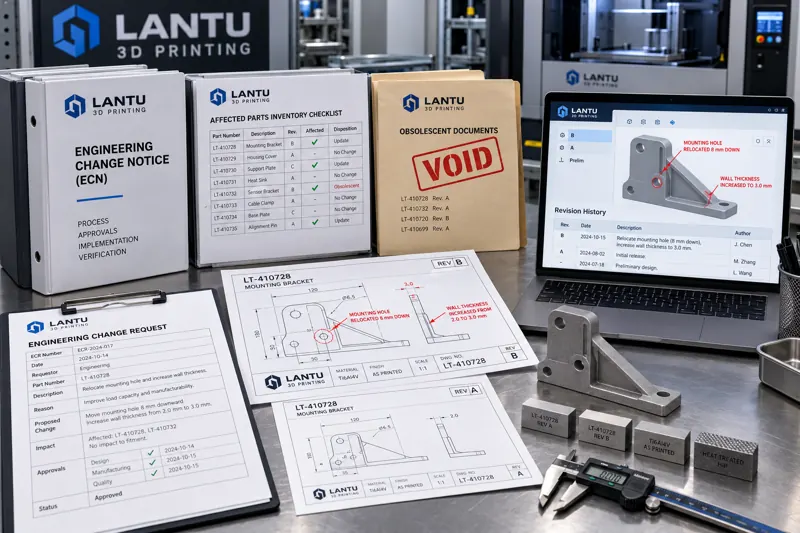
Change number and requester: Use a format such as CR-2026-018, and record the requester, request date, related project, and order number. The number is the anchor for all subsequent traceability activities.
Change content and rationale: The request must clearly state “change from what to what.” For example: “Change the pilot hole for an M6 threaded hole from φ5.0 to φ5.2; reason: the thread GO gauge fails after tapping with the original pilot hole.” A request that merely states “make the hole slightly larger” should be returned.
List of affected items: 3D model files, including revision numbers; engineering drawings; process documents; inspection instructions; quotations; released production work orders; work in process; delivered parts; inventory; dedicated tooling; and fixtures. This is the input to change impact analysis and one of the items most likely to be overlooked.
Desired effective date: Effective immediately, effective from the next batch, or effective after a specified operation number. This directly determines how work in process will be handled.
Urgency and self-assessed consequences: The requester should explain the consequences of not implementing the change, preventing every request from being marked “urgent.” In practice, fewer than 30% of changes labeled urgent actually require expedited handling.
3. Impact Analysis: Check Five Lists One by One—No Steps May Be Skipped
After receiving the request form, engineering, process engineering, quality, planning, and commercial teams should jointly complete the impact analysis. Five checklists can be used to ensure complete coverage:
Checklist 1: Technical feasibility: Determine whether the new requirement falls within process capability. For example, increasing wall thickness from 1.6 mm to 2.2 mm is generally easier to manufacture, whereas reducing it from 2.2 mm to 1.2 mm may cause thin-wall distortion and powder-removal difficulties, requiring simulation or test-coupon validation. Material grade changes require verification against the machine qualification list and powder inventory.
Checklist 2: Process and validation: Determine whether a new process parameter window is needed, whether first article inspection (FAI) must be repeated, and whether additional non-destructive testing or mechanical test specimens are required. Internal process changes in particular must be documented—at minimum, retain a parameter sheet, test-coupon inspection report, and approver signature.
Checklist 3: Work in process and inventory: Specify how parts already being printed will be handled—whether they will continue to completion and be assessed against the previous revision, or whether printing will be stopped and the parts scrapped; whether completed but undelivered parts can be reworked; how finished and semi-finished inventory will be segregated and identified; and whether dedicated tooling remains valid. This checklist must state specific quantities and disposition methods; “under evaluation” is not sufficient.
Checklist 4: Documents and data: Upgrade the model revision, with revision numbers increasing sequentially; update engineering drawings, process sheets, inspection instructions and acceptance criteria, quotations and contract terms, and customer change confirmation letters. Document updates must have assigned owners and completion deadlines.
Checklist 5: Commercial impact and lead time: Assess additional material and labor hours, whether re-quotation is required, the number of days of lead-time extension, and whether contract change clauses are triggered. If the amount exceeds an agreed threshold, such as 5% of the original contract value, a written supplementary agreement should be executed.
Only after all five checklists have been completed and signed off should the change proceed to approval. Skipping any item rarely “saves time”; instead, it usually leads to rework and loss of trust when inconsistent document revisions are discovered at the customer site.
4. Decision and Execution: Tiered Authorization with Closed-Loop Validation
Approval should be tiered: minor internal process adjustments that do not affect acceptance criteria may be approved by the process owner; changes that alter deliverable geometry or technical specifications must be confirmed in writing by the technical owner and the customer; changes affecting cost or lead time must be confirmed by the commercial owner. Tiered approval allows a large number of low-risk changes to be handled at the operational level while ensuring that high-risk changes are not decided on the shop floor.
After approval, execution depends on three critical actions: a clearly defined effective point—state from which batch or operation number the change will apply; withdrawal and invalidation of obsolete documents—controlled documents must be retrieved or marked obsolete, as simply overwriting stored files is insufficient; and post-change first-article validation—at least one part from the first batch must undergo full dimensional inspection against the new criteria, with metallographic examination or mechanical sampling added where necessary.
Once implementation is complete, the change request can be closed. The following records must be archived: the change request form, impact analysis form, approval records, document update records, first-article validation report, and customer confirmation letter where applicable. This file is the sole basis for resolving future disputes, claims, and lessons-learned reviews.
5. Common Failure Points and Countermeasures
Failure Point 1: The model was changed but the quotation was not updated. The countermeasure is to make the quotation a mandatory item in the change impact checklist and link it to the order number in the system.
Failure Point 2: Obsolete drawings continue circulating on the shop floor. The countermeasure is controlled document management with mandatory sequential revision numbers, while printed documents attached to work orders must display the document revision identifier.
Failure Point 3: Urgent changes bypass review. The countermeasure is to establish an “urgent channel” while requiring review records to be completed within 24 hours afterward; blank records may not remain open indefinitely.
Failure Point 4: Internal process parameters are adjusted casually on the shop floor. The countermeasure is access-controlled machine parameters, logged parameter changes, and inclusion of these logs in internal audit spot checks.
Failure Point 5: Change records are scattered across emails and chat messages. The countermeasure is a single entry point with standardized numbering; every verbal request must be entered into the change register.
Conclusion
The essence of change management in 3D printing projects is not to restrict change, but to ensure that every change has a source, assessment, approval, validation, and record. By dividing changes into geometric/technical specification changes, internal process changes, and deviations/concessions; using a complete request form as the single entry point; conducting impact analysis through five checklists covering technical, process, work in process, documentation, and commercial factors; and closing the loop through tiered authorization and first-article validation, a verbal “small change” can become a controllable engineering process. For a full-lifecycle management platform such as lantu3D, covering everything from design blueprints to physical delivery, change records are also part of the process knowledge base: today’s validation record for a wall-thickness adjustment becomes the basis for quotation and risk assessment of similar structures in the future.
Submit a model, drawing, image or written notes. Engineers will review material, process, finishing and delivery based on actual use.