
Introduction: Why the Lowest Price on a Comparison Sheet Is Often Not the Lowest Cost
In a typical metal 3D printing project review, three candidate suppliers quoted prices for the same 316L stainless steel bracket that varied by 37%. Procurement followed the standard process, prepared a comparison sheet, and selected the lowest-priced supplier. Within two months of delivery, however, the project incurred costs far exceeding the price difference: 7 of the first 32 parts required rework due to dimensional nonconformities; the second batch failed mechanical-property retesting because the powder batch had been changed without notice; and overall delivery was delayed by 11 working days against the original schedule. A post-project review found that only one of the three quotations specified powder-batch control and first-article inspection responsibilities—and it was not the lowest-priced one.
Such situations are common in 3D printing procurement. Additive manufacturing quotations cannot be compared by unit price alone as standard components can. Differences in powder batches, machine utilization, post-processing steps, inspection methods, and change-notification obligations can all create a substantial gap between nominal unit price and actual total cost. The real task of procurement is not to select the lowest figure, but to turn incomparable quotations into a comparable decision basis and convert potential future disputes into enforceable contractual terms.
1. The Distinctive Nature of 3D Printing Procurement: Variables Hidden in Quotations
The cost structure of conventional machining quotations is relatively transparent: material cost, labor cost, and surface-treatment cost. A 3D printing quotation, however, includes at least five variables where important differences can easily remain hidden.
The first is the material-condition variable. Even for 316L, virgin powder and recycled powder differ in oxygen content, particle-size distribution, and apparent density. Reclaimed powder may be sieved and blended at a specified ratio, which directly affects cost and consistency of performance. If a quotation states only “316L powder,” a supplier may legitimately increase the recycled-powder blend ratio under cost pressure, but this may be fatal for fatigue-sensitive parts. A qualified quotation should specify the powder grade, batch number, maximum blend ratio, and notification obligations when the limit is exceeded.
The second is the machine and process-parameter variable. For the same part, increasing layer thickness from 30 to 60 microns can nearly halve printing time, but it also changes surface roughness and dimensional accuracy, requiring corresponding adjustments to machining allowance. If the quotation does not lock in layer thickness, scan strategy, and support approach, the comparison is effectively between two different processes.
The third is the post-processing variable. Stress-relief annealing, hot isostatic pressing, wire EDM, sandblasting, and machining are each separately chargeable items. Some suppliers include annealing in their quotation, while others list it separately; some charge per part, while others charge per furnace cycle. For low-volume orders, furnace-cycle pricing can be substantially higher than per-part pricing.
The fourth is the inspection variable. Does the supplier perform only sampled dimensional inspection, or does the scope include a full first-article inspection report, industrial CT, and mechanical test coupons? Differences in inspection scope can account for more than 20% of the quoted price, yet they also determine who has evidence when a dispute arises later.
The fifth is the change and notification variable. If a supplier changes a powder batch, adjusts parameters, or uses outsourced processes, must it provide advance written notification and obtain approval? This issue is often left unaddressed in procurement contracts, yet it is the dividing line between traceable and untraceable quality.
2. Making Quotations Comparable: Establishing a Cost-Validation Benchmark Table
The prerequisite for price comparison is normalization. It is advisable to provide every candidate supplier with the same technical package at the RFQ stage and require itemized quotations using a standardized template. At a minimum, the template should include: material grade and batch requirements, maximum powder blend ratio, build-machine model and layer thickness, support and nesting plan, heat-treatment profile, post-processing operations and units of measure, inspection scope and sampling plan, packaging method, delivery location and trade terms, quotation validity period, minimum order quantity, and volume-based unit-price tiers.
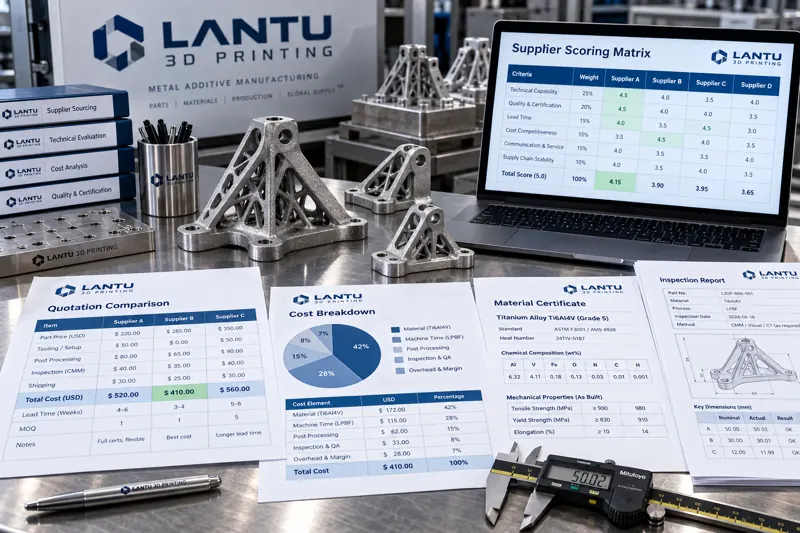
After quotations are received, procurement should not compare total prices directly. It should first perform scope alignment. A common method is to convert all quotations to the same basis. If Supplier A includes annealing while Supplier B does not, adjust Supplier A to an “excluding annealing” basis using Supplier B’s separate price, or add an estimated annealing cost to Supplier B. If Supplier A includes only sample inspection while Supplier B includes full first-article inspection, convert the difference using the internal inspection labor rate. Only normalized prices are genuinely comparable.
The second step is risk adjustment. Differences that cannot be directly reflected in price should be expressed through risk factors or contingency allowances. For example, if a supplier cannot provide powder-batch traceability records, add a quality-risk cost based on historical rework rates during price comparison. If a supplier’s delivery commitment is unsupported by capacity data, add the opportunity cost of potential project delays. Risk adjustment does not need to be accurate to the smallest currency unit, but it must allow decision-makers to see the cost behind the lowest price.
The third step is to establish a cost-validation benchmark. Compare normalized itemized pricing with historical transaction prices and internal cost models to establish a benchmark range for that part category. All subsequent quotations should first be assessed against this range: prices below the lower limit require clarification of whether scope items are missing, while prices above the upper limit require clarification of potential over-specification. The benchmark is not a weapon for forcing down prices; it is a yardstick for identifying scope anomalies.
3. From Price Comparison to Supplier Nomination: Decisions Cannot Be Based on Price Alone
Once normalization is complete, the process moves to supplier nomination. A fixed scoring model is recommended to avoid restarting the same arguments in every review. One practical weighting allocation is: technical compliance, 30 points; quality system and inspection capability, 25 points; delivery capability and capacity flexibility, 20 points; price, 15 points; and service responsiveness and change management, 10 points.
Technical compliance assesses whether the supplier can meet mandatory drawing and specification requirements, including material certification, dimensional tolerances, mechanical properties, and surface requirements. It is an entry threshold: suppliers that fail it should be eliminated rather than scored. Quality systems and inspection capability assess whether the supplier has traceable records, can provide first-article inspection reports and process records, and maintains calibrated inspection equipment. Delivery capability evaluates capacity flexibility for rush orders and schedule changes, not merely a stated lead time. Price is scored on a relative basis after normalization. Service responsiveness and change management assess issue-response speed, discipline in notifying changes, and whether the supplier proactively proposes alternatives when abnormalities occur.
The nomination result should not rely on a single supplier. For critical parts, a dual-source strategy is recommended: the primary supplier handles most production volume, while the backup supplier remains active through small-volume orders and periodic validation parts, ensuring it can take over within two transition cycles if the primary supplier encounters capacity or quality issues. Dual sourcing may slightly increase unit prices, but it provides continuity of supply. Whether it is worthwhile depends on the consequences of a supply interruption: if a shortage would stop an entire production line, dual-source costs are far lower than line-stoppage losses; if the item is only a routine spare part, a single source may be sufficient.
4. Writing Dispute Prevention into the Contract: Key Procurement Terms
Price comparison and supplier nomination address “who to select”; contract terms address “what happens when something goes wrong.” The following types of clauses are often overlooked and frequently lead to disputes in 3D printing procurement contracts.
Material and batch clauses. Specify the material grade, applicable standards, maximum allowable recycled-powder blend ratio, and the requirement for advance written notification and approval before changing batches. Also require a material certificate and powder test records with every delivery batch, retained for no less than the product-liability period.
First-article and process-record clauses. Define first-article inspection items, methods, and acceptance criteria, and clarify which party bears the schedule and cost consequences if the first article fails. Define the minimum set of process records: machine identification, build batch number, parameter version, post-processing records, and original inspection data. These records are the sole basis for subsequent traceability.
Change-control clauses. Any change affecting geometry, material, process parameters, post-processing, or inspection methods must be submitted through a change request and may be implemented only after written approval. Unapproved changes are deemed nonconforming deliveries, even if the parts meet dimensional requirements.
Acceptance and disposition clauses. Define sampling plans and acceptance criteria, as well as the conditions and authority for release, concession acceptance, and rejection. Full inspection or tightened sampling should be specified for critical characteristics, while standard sampling may be used for general characteristics. Also define the retest institution in the event of disputes, responsibility for retest costs, and the final validity of retest results.
Nonconformance and claim clauses. Define the disposition method and time limit for nonconforming products, including rework, repair, scrap, and replacement parts; define reinspection requirements after rework; and specify how consequential losses caused by quality issues are calculated and the time limit for claims. The claim period must clearly state its starting point: date of receipt, date the defect is discovered, or date of acceptance.
Intellectual property and confidentiality clauses. Define ownership of model files, process parameters, and inspection data; whether the supplier may use part data for other customers or public display; and how data must be handled and destroyed at the end of the collaboration. For projects involving a customer’s core designs, restrictions or approval requirements for subcontracting and outsourced operations should also be stipulated.
5. Implementation Checklist: Actions Procurement Teams Can Take Immediately
First, create and standardize the RFQ technical package and quotation template so that all suppliers quote on the same basis. Second, establish a cost-validation benchmark table and archive historical transaction prices and itemized cost structures by part family. Third, add “scope alignment” and “risk adjustment” columns to comparison sheets, and prohibit direct comparison of total prices. Fourth, use a fixed weighted model for supplier-nomination scoring and retain scoring records for audit purposes. Fifth, establish dual sourcing for critical parts and maintain periodic validation of the backup source. Sixth, standardize six categories of clauses in contract templates: material batches, first articles and process records, change control, acceptance disposition, claim periods, and intellectual property. Seventh, update supplier performance records after every delivery, including on-time delivery rate, first-pass yield, abnormal-event response speed, and change-notification discipline, and use these records as input for the next nomination decision.
Conclusion
The central challenge of 3D printing procurement is not price negotiation. It is making quotations with different scopes comparable and writing potential future disputes into contractual terms in advance. The lowest price on a comparison sheet is often merely a reflection of scope differences; the true total cost is determined by omitted details such as material condition, process parameters, post-processing, and inspection. By organizing quotations into a cost-validation benchmark, using a fixed model for supplier-nomination decisions, and preventing disputes through six categories of contract clauses, procurement becomes a risk-control function rather than a price-squeezing exercise. In lifecycle management from blueprint to physical delivery, this is one of the most underestimated factors—and one of the factors with the greatest impact on final delivery outcomes.
Submit a model, drawing, image or written notes. Engineers will review material, process, finishing and delivery based on actual use.