Introduction: Digital files make manufacturing faster, and protection boundaries more important
3D printing intellectual property protection is not a single-process issue, but a systematic effort spanning requirement clarification, model evaluation, material and process selection, production scheduling, and delivery acceptance. For platforms like lantu3D Printing, which provide full lifecycle management and implementation from blueprint/design to physical delivery, the fact that digital files make manufacturing faster also makes protection boundaries more important. These boundaries need to be broken down into measurable, reviewable, and continuously improvable work items: Are the input files complete? Are the critical dimensions clearly marked? Are material batches and equipment parameters traceable? Can the inspection records support customer decisions? Only by accumulating this information early in the project can quoting, prototyping, small-batch production, and quality feedback loops avoid relying on ad hoc personal judgment.
In real projects, companies often see 3D printing intellectual property protection as a specialized capability of a single role, but what truly affects the outcome is cross-functional collaboration. A seemingly simple sample may involve 0.1-0.2 mm layer height selection, ±0.2 mm-level dimensional control, support contact treatment, thermal deformation risk, surface roughness targets, and transport protection methods at the same time. Without a unified approach, rework costs often surface in a concentrated way right before delivery.
1. Clarify the ownership boundaries of models, drawings, and process data
The first step is to establish a clear technical baseline. At project kickoff, the part's purpose, load direction, assembly relationship, appearance grade, and delivery quantity should be confirmed, and those conditions converted into process parameters. For example, functional validation parts focus more on strength and dimensional stability, display parts focus more on texture, color, and surface consistency, and small-batch parts focus more on unit cost, cycle time, and batch consistency. Different goals require different combinations of materials and processes, and the same experience cannot be used for every scenario.
It is recommended to write key parameters into a project card: recommended material, build orientation, layer-height range, critical dimensional tolerances, post-processing requirements, inspection method, and risk level. For SLA resin parts, pay attention to thin-wall warping, support marks, and brittleness changes after UV curing. For SLS nylon parts, pay attention to powder refresh rate, porosity, and dyeing uniformity. For metal SLM parts, residual stress, heat-treatment schedule, and secondary machining allowance for critical holes must be closely managed.
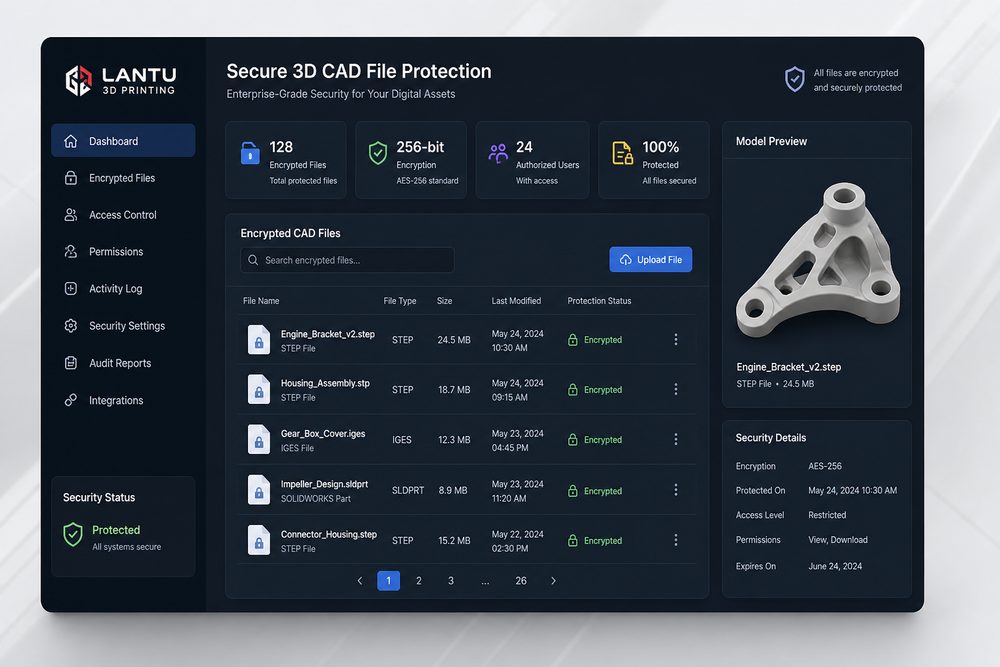
2. Control file circulation with permissions, versioning, and watermarks
Problem analysis should not stop at a result description such as "print failure"; it should trace back through five dimensions: design, material, equipment, parameters, and operation. For example, cracking may result from sudden wall-thickness changes, internal stress concentration, or an unreasonable heat-treatment curve. Hole position deviation may come from build orientation, insufficient support stiffness, or unclear post-machining locating references. Uneven surface quality may be related to support layout, blasting media, polishing paths, and cleaning and drying conditions all at once.
In project management, lantu3D Printing places greater emphasis on the evidence chain: retaining slicing screenshots, equipment batch numbers, material lot numbers, key parameters, process photos, and inspection data. The value of doing this is not only accountability, but also giving the next round of design optimization a basis. For example, increasing local wall thickness from 1.0 mm to 1.5 mm, keeping overhang angles within 45°, or adding ribs to the back of a large flat surface is often more effective than simply changing equipment.
3. Delivery records are important evidence in IP disputes
An executable plan should include process steps, roles, and acceptance criteria. For the process, a six-step method can be used: requirement review, DFAM design check, process review, prototype validation, pre-production confirmation, and delivery retrospection. For roles, design, process, production, quality inspection, and the project manager should all participate at key milestones. For acceptance, in addition to dimensions, records should also include appearance grade, assembly testing, strength verification, packaging condition, and customer feedback.
For small- and medium-batch projects, it is recommended to introduce tiered control: Level A for safety-critical or assembly-critical parts, requiring first-article inspection and full inspection of critical dimensions; Level B for functional validation parts, using sampling inspection plus assembly verification; Level C for appearance or display parts, focusing on surface and color consistency. After tiering, resource allocation becomes more focused, and customers can better understand the boundary between cost and quality.
4. Agree in advance on confidentiality and reuse rules during collaboration
The part that is most easily overlooked in implementation is the review mechanism. After each project, actual labor hours, failure counts, rework reasons, customer revision points, and final parameters should be recorded, turning one-time delivery experience into organizational assets. For repeat industries such as medical aids, automotive fixtures, consumer electronics enclosures, and aerospace samples, review data can be turned into a material library, parameter library, risk checklist, and quotation templates.
At the same time, 3D printing should not be positioned simply as "a fast way to make a part." Its core value lies in shortening validation cycles, lowering the threshold for manufacturing complex structures, and connecting design, manufacturing, inspection, and delivery data. When companies incorporate 3D printing intellectual property protection into standard procedures, 3D printing can evolve from a prototyping tool into a stable digital manufacturing capability.
Conclusion
The core of intellectual property protection is ensuring that innovation outcomes, customer assets, and process experience all have clear boundaries. For industry practitioners, the real competitive advantage is not owning a certain machine, but whether they can make fast judgments, execute reliably, and continuously accumulate experience under complex requirements. lantu3D Printing will continue to focus on design evaluation, material and process development, production management, and delivery validation, providing customers with complete realization support from blueprint to physical part.
Submit a model, drawing, image or written notes. Engineers will review material, process, finishing and delivery based on actual use.