Introduction: The Overlooked Cost of Collaboration
In high-mix, low-volume 3D printing operations, a single part often passes through multiple departments—sales, design, process engineering, production, quality, and logistics—from customer request to final delivery. Any “information funnel” in the process—requirements not aligned, designs not considering process constraints, or scheduling not seeing delivery deadlines—can turn into rework, delays, and complaints. Based on lantu3D’s collaborative practices in on-demand manufacturing scenarios, this article breaks down a cross-department collaboration method from requirement alignment to closed-loop delivery, helping teams move from “firefighting” to “fire prevention.”
1. Why 3D Printing Depends Especially on Cross-Department Collaboration
Compared with traditional mold-based manufacturing, the mold-free nature of 3D printing amplifies both design freedom and process uncertainty. The same model, when produced with SLS nylon (PA12, printing temperature 185–195°C, layer thickness 0.1–0.15 mm) versus SLM metal (titanium alloy Ti6Al4V, laser power 200–370 W, scanning speed 800–1500 mm/s), will result in completely different lead times, costs, and manufacturability. If sales brings a process perspective into the quotation stage and design accepts a Design for Manufacturability (DFM) review during modeling, more than 60% of later rework can be blocked upfront. According to our statistics, after introducing early-stage collaboration, the average review cycle for a single order dropped from 3.2 days to 1.4 days, and the first-pass approval rate from quotation to first-article confirmation increased from 54% to 81%.
2. Requirement Alignment: Turning Vague Needs into Manufacturable Metrics
Customers often say things like “make it lighter,” “make it stronger,” or “make it faster.” These words must be translated into quantifiable indicators. lantu3D’s approach is to establish a “requirement conversion table”: lightweighting corresponds to target surface density (g/cm²) and weight-reduction ratio; strength corresponds to load conditions (static load, impact, or fatigue cycle count); speed corresponds to the delivery window (hours or days) and batch quantity (pieces). Sales and design complete the table together during the initial alignment meeting, while process engineering and quality confirm feasibility boundaries online. In this way, requirements are transformed from “vague adjectives” into engineering language with tolerance ranges. All subsequent departments work from the same set of metrics, significantly reducing the cost of disputes.
3. Collaboration from Design to Process: Moving DFM Forward
The most expensive modification is the one discovered only after the part has already been printed and found not to fit. For this reason, we move the DFM checkpoint forward to the same day as modeling: after design submits the model, process engineering provides feedback within 2 hours on wall thickness (minimum manufacturable wall thickness: 1.0 mm for nylon and 0.4 mm for metal), overhang angle (self-supporting threshold around 45°), support strategy, and recommended print orientation. Collaboration does not mean having fewer meetings; it means allowing the right information to flow earlier in the process. We require all structural parts to include a “manufacturability checklist.” Models whose checklists are not completed are not allowed to enter the production scheduling queue, preventing “printing while revising” at the source.
4. Real-Time Sharing of Scheduling and Quality Information
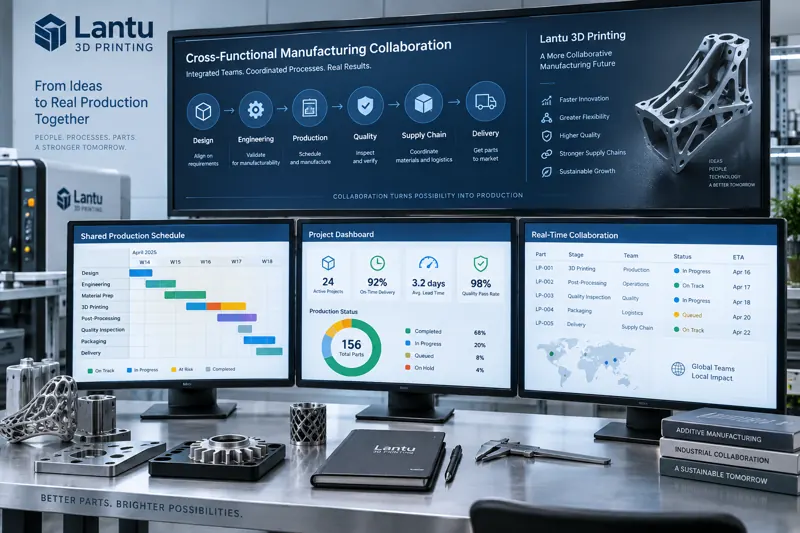
The hardest part of cross-department collaboration is information being out of sync. lantu3D consolidates order status, equipment occupancy, batch progress, and inspection conclusions into a single Kanban board: production sees priorities based on reverse scheduling from delivery deadlines, quality sees first-article records for corresponding batches, and logistics sees the available shipping time. When an SLM machine is shut down for maintenance, scheduling automatically postpones the estimated delivery of affected orders and pushes notifications to sales, rather than waiting for customers to ask. Data speaks faster than layer-by-layer reporting, and exception response shifts from “discovered after the fact” to “visible during the process.”
5. Closed-Loop Delivery and Review Mechanism
Collaboration is not a one-time project; it must be accumulated through mechanisms. After each batch is completed, four departments conduct a “delivery review” within 48 hours: which requirements were misunderstood, which process parameters fluctuated, and which logistics delays occurred. The review conclusions are written into the knowledge base—lantu3D’s process asset library—so similar parts can be referenced directly next time. We attribute customer complaints across five dimensions: requirements, design, process, production, and logistics. Over the past year, the share of complaints caused by requirement misinterpretation fell from 38% to 11%, showing that the collaboration mechanism is truly preventing leaks.
Conclusion
The competitiveness of 3D printing lies not only in equipment parameters, but also in turning scattered departments into a single production flow. Requirement alignment sets standards, early DFM blocks rework, shared Kanban visibility eliminates errors, and closed-loop reviews prevent recurrence. This four-step method turns cross-department collaboration from “depending on people to follow up” into “depending on mechanisms.” For companies building a collaborative system, it is recommended to start with a high-frequency, high-rework small-batch scenario, run a closed loop over three months, and then replicate it horizontally across more product lines.
Submit a model, drawing, image or written notes. Engineers will review material, process, finishing and delivery based on actual use.