Introduction: Cost Control Should Focus on Total Cost of Ownership
When customers compare 3D printing quotes, they often focus on the unit price. But the lowest unit price does not always mean the lowest project cost, because rework, delays, assembly failures, missed post-processing, and communication costs may be pushed into later stages. A professional quotation should be built around total cost of ownership, incorporating manufacturing, verification, delivery, and risk.
1. Cost Is More Than Material and Machine Time
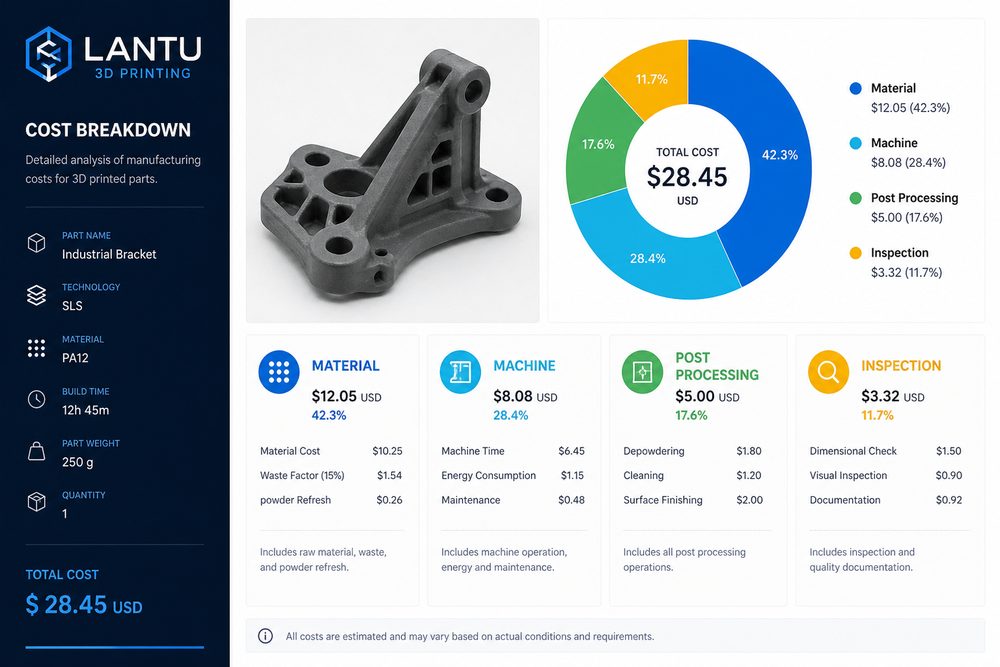
3D printing costs include material consumption, machine time, labor operations, nesting preparation, support removal, powder cleaning, heat treatment, machining, surface finishing, inspection, packaging, and management overhead. For metal printing, heat treatment and machining can account for a large share of the cost; for SLS batch production, powder removal and dyeing efficiency can significantly affect unit cost.
2. Design Optimization Can Directly Reduce Cost
Excessive wall thickness, overly solid infill, unnecessary complexity, and poor part orientation all increase cost. By hollowing, lightweighting, consolidating parts, reducing supports, optimizing hole locations, and leaving machining allowances where needed, it is often possible to reduce material use and labor hours without sacrificing function. Providing design optimization suggestions during the quotation stage is a key value-added service for a manufacturing platform.
3. Quotation Strategy Should Match Project Uncertainty
For mature processes and orders with clear acceptance criteria, a fixed quote can be provided. For new materials, complex assemblies, or projects with unknown performance requirements, a staged quotation model is more suitable: first conduct manufacturability review and sample validation, then determine the batch price. This protects the customer’s budget while avoiding uncontrolled risk for the service provider.
4. Improve Quotation Accuracy Through Data Accumulation
Historical order data is the foundation of cost control. Actual print time, failure rate, post-processing labor hours, material utilization, and the number of customer change requests should be recorded. As the sample size grows, quotations can shift from experience-based estimates to data models, improving response speed and profit stability.
Conclusion
3D printing quotations are not better simply because they are lower; they are more valuable when they are more transparent and controllable. Companies should take total cost of ownership as their perspective, and through design optimization, phased pricing, and data-driven cost models, achieve true cost control while ensuring quality and lead time.
Submit a model, drawing, image or written notes. Engineers will review material, process, finishing and delivery based on actual use.