
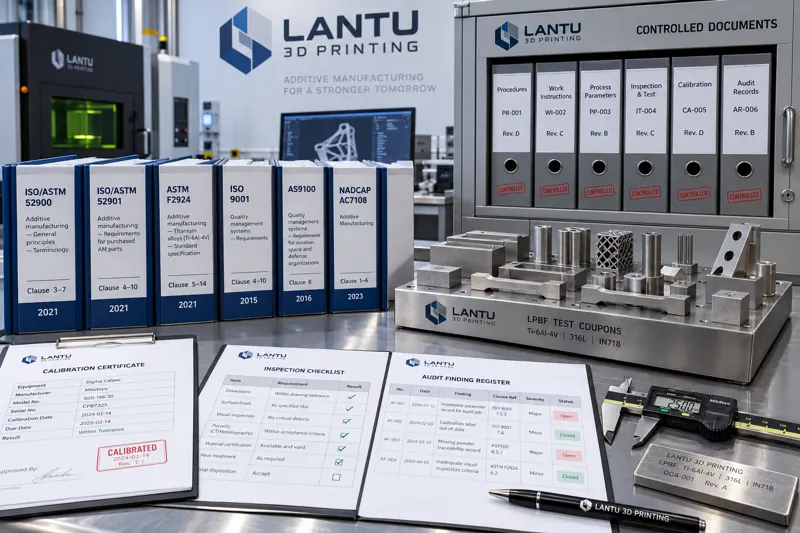
Introduction: System Documents Exist, but the Audit Cannot Establish “Compliance with Which Clause?”
Many 3D printing companies limit their standardization efforts to simply having documents: quality manuals, procedure documents, and work instructions are all in place, and management-system certificates are displayed on the wall. Yet during customer audits or third-party certification audits, auditors ask: “Which standard number and clause do you follow? What is the acceptance basis? Where are the supporting records retained?” If the only answer is, “This is how we have always done it,” the system has deteriorated from being executable to merely presentable. lantu3D has repeatedly encountered this disconnect while participating in aerospace, medical, and automotive component projects: process capability may be sound, but unclear clause mapping, non-quantifiable criteria, and incomplete evidence chains lead to repeated first article qualification efforts and nonconformities raised during external audits. Advancing standards from the document level to the clause level is the dividing line at which a standardization system gains real binding force.
1. First Distinguish Standard Types and Their Hierarchy of Authority
The most common mistake in standardization work is treating every “standard” as the same type of document with equal status. In practice, their authority and functions differ significantly: national standards (GB) and industry standards establish general requirements and test methods and serve as entry thresholds; association standards are typically closer to specific processes, evolve more quickly, and contain more detailed technical indicators; enterprise standards are the highest-level internally binding documents and can incorporate customer-specific requirements. Citation relationships must be explicit: the technical requirements of enterprise standards must not be lower than those of higher-level standards, and the document cover must list all referenced documents and their edition years. At a minimum, an executable standards register should include the standard number, title, edition year, issuing organization, applicable-scope clauses, applicable internal processes, supersession relationship, and withdrawal date. Missing edition years are among the most common deficiencies: if an obsolete criterion is still used after a standard revision, test results may be legally invalid.
2. Break Standards into Clauses and Map Them to Internal Control Points
Copying the full text of a standard into work instructions is meaningless. The correct approach is to break each standard down into four levels: clause, requirement, control point, and record. For laser powder bed fusion of metals (LPBF), for example, a clause concerning raw-material acceptance can be divided into four control points: powder chemical composition re-testing, particle-size distribution testing, apparent density and flowability measurement, and batch retention samples. Each control point should specify the inspection frequency (every batch/every five batches), sampling method, acceptance criterion (for example, oxygen content ≤0.13%, with the specific value determined by the alloy grade and standard edition), record form number, and retention period. Only after this level of work is completed does the standard truly reach the production workstation. In practice, one primary process standard can be broken down into 30 to 60 auditable control points, approximately one-third of which require quantitative criteria, while the remainder are conformity-verification items.
3. Criteria Must Be Measurable: Avoid “Appropriate” and “As Necessary”
Conformity criteria are where audits most often lose points. Statements such as “the surface shall be clean” or “clean as necessary” cannot be evaluated or traced. They should be converted into measurable and reproducible requirements: no more than three residual powder particles larger than 50 μm per 100× field of view; residual powder mass in internal flow channels shall not exceed 0.5% of total part mass; following cleaning, drying shall be performed at 60°C for 60 minutes, with moisture content after removal from the oven not exceeding 0.05%. Criteria should also specify the measurement method and instrument-resolution requirements—a caliper with 0.02 mm resolution cannot be used to determine compliance with a 0.01 mm tolerance zone, as the data itself is invalid. Measurement system analysis (MSA) and gauge R&R are therefore not optional; they are prerequisites for valid acceptance criteria.
4. Document Control: Revisions, Controlled Copies, and Obsolescence
Controlled documents are the physical vehicle for clause-level implementation. Document control must address four issues. First, revision uniqueness: two revisions of the same numbered work instruction must not coexist on the shop floor, and obsolete revisions must be withdrawn or marked “obsolete—retained.” Second, changes must be traceable: every revision must retain the reason for change, scope of impact, and effective date. Third, external documents must be identified: customer drawings, supplier material certificates, and referenced standards are all external documents and must be included in the register and periodically reviewed for updates. Fourth, records and documents must be managed separately: records are evidence that work was performed and must not be mixed with documents that prescribe how work is to be performed. Enterprise standardization-system documents are generally organized into four levels: manuals, procedure documents, work documents, and record forms. The lower the level, the more specific it becomes and the closer it is to the job role.
5. Audit Checklists and Closed-Loop Evidence
Internal audits should not be limited to finding typographical errors. They should verify whether clauses have been implemented, criteria have been met, and evidence is traceable. An audit checklist for an LPBF workshop can be organized by clause number, with columns covering the clause number, audit question, sampling method (such as three records from the past three months), decision criterion, evidence type, and finding description. Nonconformities should be managed by severity: minor nonconformities require correction and root-cause analysis, while major nonconformities involving batch risk require traceability actions and customer notification. The criterion for closure is not that a corrective-action report has been written; it is that similar issues no longer appear in sampling during the next audit cycle. Linking corrective-action effectiveness to sampling in the next internal audit is the key mechanism for preventing corrective actions from becoming paperwork exercises.
6. Integrating Industry-Specific Standards
General quality management systems address whether a management system exists; industry-specific standards address whether it is sufficiently specialized. Aerospace emphasizes special-process validation, first article inspection, and qualification of nondestructive testing personnel. The medical sector emphasizes biocompatibility, traceability, and sterilization validation. The automotive sector emphasizes process audits and production part approval processes. These requirements often appear as customer-specific requirements and take precedence over general clauses. The standards register must therefore include a separate field for customer-specific requirements and clearly define their relationship to enterprise standards and the rules for resolving conflicts: apply the more stringent requirement and confirm it in writing in the technical agreement, thereby avoiding post-delivery disputes caused by inconsistent interpretations of acceptance criteria.
Conclusion
The maturity of a standardization system does not depend on the number of documents; it depends on whether it can answer three questions: which standard number and clause apply, what measurable criterion is used, and in which form the evidence is retained. Only by breaking standards down into clauses, mapping clauses to control points, writing control points as quantitative criteria, and embedding those criteria in controlled documents and audit checklists can standardization move from a display item to a productivity tool. For 3D printing operations centered on the delivery path from digital blueprint to physical part, the more robust this foundation is, the more controllable first-pass first article approval, external-audit nonconformities, and cross-project reuse efficiency become.
Invia un modello, un disegno, un'immagine o note scritte. Gli ingegneri valuteranno materiale, processo, finitura e consegna in base all'uso effettivo.