Introduction: The value of sample validation lies in exposing problems early
In product development, 3D printing samples are often used for appearance confirmation, assembly testing, and functional validation. However, if the validation process stops at “does it look right” or “can it be assembled,” many issues will only surface in subsequent low-volume production or even during market testing. An effective sample validation process should establish clear goals: what to validate, how to validate it, and what the pass criteria are, as well as how to iterate if it fails.
In its projects, lantu3D typically divides sample validation into four stages: design input, process output, test feedback, and production transfer. The advantage of this approach is that every print is not an isolated trial-and-error exercise, but evidence that supports the next round of decisions.
1. Validation plan: define pass criteria first
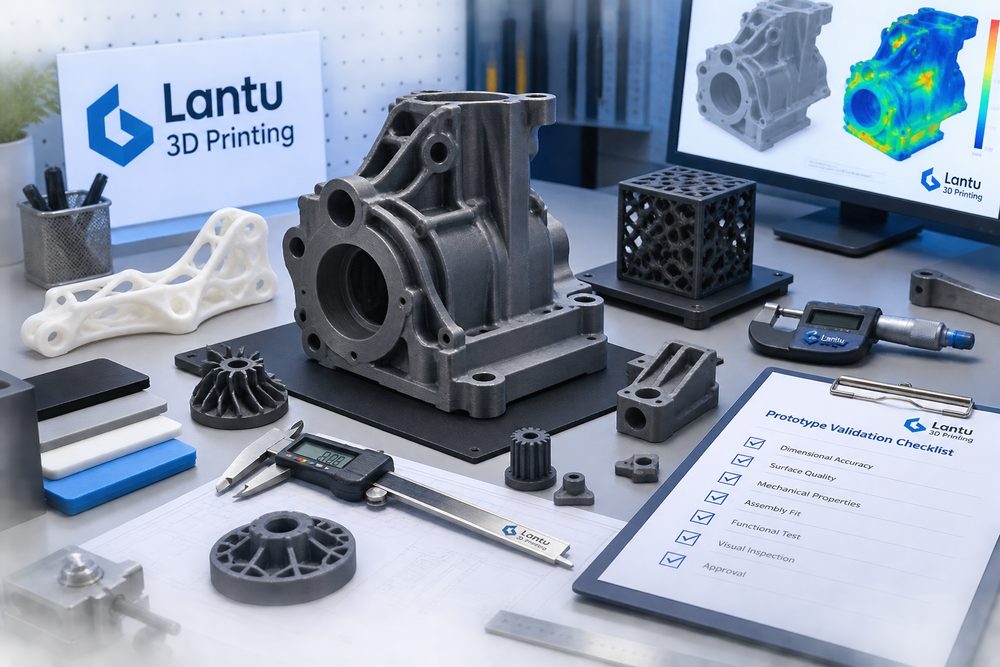
Before sample production begins, a validation checklist should be established. Appearance samples should focus on silhouette, surface texture, color, and presentation effect; structural samples should focus on wall thickness, ribs, screw bosses, snap-fits, and assembly clearance; functional samples should focus on load capacity, heat resistance, wear resistance, sealing performance, or fatigue performance. Each metric should ideally have a quantifiable standard, such as hole diameter tolerance of ±0.15 mm, snap-fit assembly without fracture after 20 cycles, or an enclosure seam gap below 0.3 mm.
If standards are missing, sample reviews become subjective discussions. The project team can translate customer requirements into engineering language. For example, “feels more solid” can correspond to wall thickness, reinforcing ribs, and material modulus; “looks premium” can correspond to layer-line direction, sandblasting grade, coating color code, and surface roughness.
2. First article review: confirm the model, material, and process direction
After the first sample is completed, the version and process should be checked first. Common mistakes include the customer uploading an outdated model, confusing inches with millimeters, wall thickness below the process limit, or insufficient clearance left for assembly parts. For SLA resin parts, transparent parts and high-toughness parts require different post-curing times; for SLS nylon parts, the powder refresh ratio and part orientation will affect dimensional stability.
The first article review is recommended to check three types of content at the same time: whether the dimensions meet key interfaces, whether the structure has any weak fracture points, and whether the surface matches the customer’s usage scenario. If the sample is for display, appearance can be prioritized; if it is for assembly or testing, dimensions and strength should be prioritized.
3. Functional testing: turn the usage scenario into test conditions
Functional validation must closely match the real application scenario. A handheld enclosure must not only be assemblable, but also withstand drops, grip pressure, and repeated screw removal and reinstallation; a flow-channel model must not only have the correct shape, but also verify sealing and chemical resistance. Test conditions should include load, time, temperature, humidity, cycle count, or the contact medium.
For example, a fixture sample can undergo 20 to 100 clamping cycles to observe deformation and wear; a snap-fit structure can be tested for retention force after 10, 30, and 50 assembly/disassembly cycles; a thin-walled enclosure can undergo a localized pressing test to record whether whitening, cracking, or permanent deformation occurs. The more specific the test records are, the clearer the direction for design iteration will be.
4. Iteration loop: every modification must explain why
Design changes after sample validation should avoid “feeling-based” modifications. It is recommended to manage issues using numbering, for example P01 hole position too small, P02 snap-fit root cracking, P03 obvious surface layer lines. Each issue should correspond to root cause analysis, a modification plan, and a re-test result. A hole position that is too small may be resolved through dimensional compensation; snap-fit cracking may require adding fillets, changing the material, or adjusting the print orientation.
When the sample moves toward low-volume production, a final transfer package should be created, including the model version, material and process, key dimensions, post-processing requirements, inspection standards, and packaging requirements. This allows the mass production team to replicate the results confirmed during the sample validation stage.
Conclusion: The validation process determines whether a sample can be transformed into production capability
The real value of 3D printing samples is not just obtaining a physical part quickly, but using low cost to validate product assumptions. By establishing a clear validation plan, conducting first article reviews, performing functional testing, and closing the loop through iteration, companies can identify problems before tooling or mass production investment. lantu3D hopes to help customers transform every sample build into accumulated engineering data, thereby reducing subsequent production risks.
Submit a model, drawing, image or written notes. Engineers will review material, process, finishing and delivery based on actual use.