Introduction: Why This Issue Is Becoming Critical
From requirement communication to after-sales closure: the seven key nodes in optimizing the 3D printing service process are, in essence, about building the capability to move 3D printing from “can be made” to “stable, explainable, and deliverable.” As customers shift from appearance prototypes to functional parts, small-batch production, and rapid spare parts, relying solely on experience-based quoting and ad hoc machine tuning can no longer meet delivery, quality, and cost requirements. lantu3D Printing is positioned as a lifecycle management and implementation platform from blueprint/design to physical delivery, so every step needs to be managed in a structured way.
1. Process Transparency Is More Important Than Single-Point Response
3D printing services should confirm the intended use, load, accuracy, appearance, assembly, budget, and delivery time as soon as the model is received, avoiding situations where a customer sends only an STL file and production begins immediately. In real projects, engineers cannot look at a single metric alone; they must place part function, stress direction, assembly relationships, surface requirements, temperature resistance, and budget on the same decision table. For example, precision appearance parts are typically prioritized with SLA or high-precision resin, wear-resistant structural parts may use SLS nylon, and parts with high load-bearing and temperature-resistance requirements need evaluation of SLM aluminum alloy, titanium alloy, or stainless steel.
Key parameters should be turned into verifiable records: common layer thickness ranges from 0.05-0.2mm, functional part wall thickness is generally not recommended to be below 1.2-2.0mm, and allowances for process compensation should be reserved for hole diameters, threads, and snap-fit positions. Only by feeding these constraints back to the design side in advance can manufacturing avoid repeated rework later.
2. From Problem Analysis to Engineering Decisions
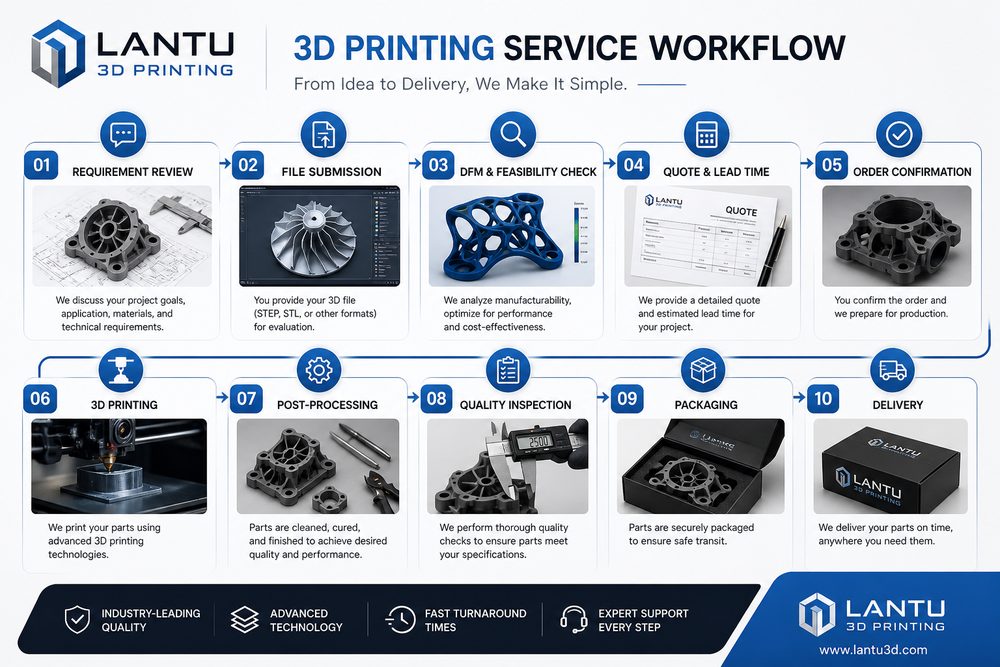
A closed loop should be formed through requirement review, DFM feedback, quotation confirmation, first article verification, production tracking, quality inspection reports, and after-sales review. Common failures do not necessarily come from the equipment itself, but from a lack of alignment among requirement input, model design, material selection, printing orientation, post-processing, and inspection standards. For example, if a customer asks for “high strength, good surface finish, low price, and delivery tomorrow,” and priorities are not sorted out, rework is likely to occur late in production.
It is recommended to complete three judgments during the project initiation stage: first, whether the part is a display prototype, assembly prototype, or functional part; second, whether the key indicator is dimension, strength, appearance, heat resistance, or delivery time; third, who bears the cost of failure and whether first article confirmation is required. The earlier this judgment is completed, the more likely the project is to proceed on schedule.
3. Practical Implementation Methods
For implementation, a combination of “standard parameter library + project review form + abnormality review” can be used. The standard parameter library records recommended settings for different materials, machines, and layer thicknesses; the project review form is used to confirm model integrity, minimum wall thickness, support risks, post-processing methods, and inspection standards; and abnormality reviews turn issues such as warping, delamination, porosity, dimensional deviation, and surface defects into rules that can be avoided next time.
For small-batch orders, first articles or sample verification should be completed before batch production starts. Key dimensions can be checked with calipers, coordinate measuring machines, or scan comparisons; appearance parts should clearly define standards for sanding, painting, dyeing, or polishing; and assembly parts should undergo actual fit testing before delivery. This not only reduces customer risk but also cuts internal rework.
4. Management Metrics and Continuous Optimization
What companies should monitor is not the peak speed of a single machine, but the overall efficiency from order intake to delivery. It is recommended to continuously track quotation response time, first-pass review rate, first article pass rate, material loss rate, equipment utilization, rework rate, on-time delivery rate, and customer repurchase rate. Each metric corresponds to a process that can be improved.
As data accumulates to a certain scale, the platform can further support automated quoting, intelligent scheduling, risk warnings, and knowledge-base recommendations. In its services, lantu3D Printing should condense these experiences into reusable workflows, so that customers obtain not just a single part, but a more certain manufacturing path.
Conclusion
Competition in the 3D printing industry is shifting from the number of machines to engineering capability, process capability, and delivery capability. Whether it is materials, processes, applications, equipment, services, quality, cost, customer experience, digitalization, or the supply chain, the truly valuable practice is to identify, quantify, and manage uncertainty in advance. For industry practitioners, establishing standards, accumulating data, and continuously reviewing outcomes are the core path to turning 3D printing into stable productive capacity.
Submit a model, drawing, image or written notes. Engineers will review material, process, finishing and delivery based on actual use.