
Introduction: Why “It Can Be Made” Does Not Mean “It Can Be Adopted”
In lantu3D's lifecycle management practice from blueprint/design to physical delivery, the most common misjudgment is treating “one successful print” as proof that a process can be introduced into volume production. Three titanium-alloy brackets may all pass in the laboratory, yet low-volume delivery may reveal batch variation, increased post-processing rework, and inspection records that cannot be closed in a traceable loop. The root cause is often not inadequate equipment or materials, but the absence of readiness criteria that progressively translate “technical feasibility” into “repeatable, verifiable, scalable manufacturing.” Technology Readiness Level (TRL) and Manufacturing Readiness Level (MRL) were developed for precisely this purpose: the former answers “to what extent have the principle and solution been validated,” while the latter answers “whether the process, supply chain, quality system, and capacity support stable delivery.” This article provides a practical method for ratings, stage gates, and adoption thresholds that turns adoption decisions from subjective judgment into a sign-off-ready, auditable evidence matrix.
1. The Roles of TRL and MRL: Two Axes, Not One Table
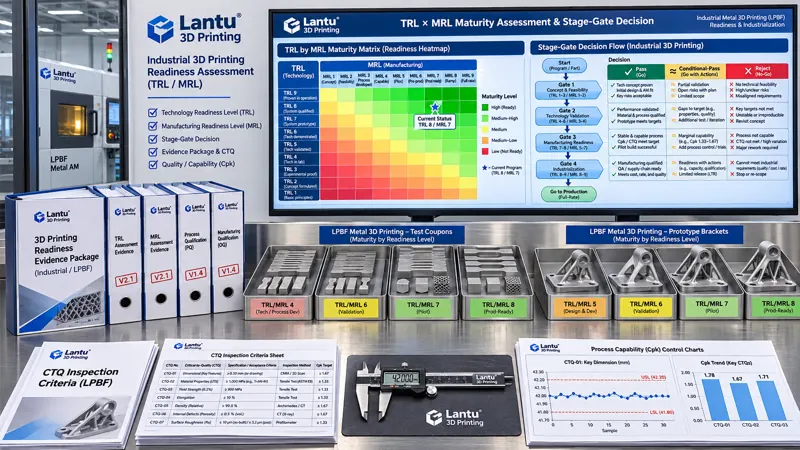
TRL is typically divided into nine levels: Levels 1–2 cover basic-principle observation and concept formulation; Levels 3–4 validate critical functions using laboratory test coupons; Levels 5–6 validate samples in relevant environments using actual materials, actual equipment, and simulated loads; Level 7 demonstrates an engineering prototype in its operational environment; Level 8 covers process finalization and qualification; and Level 9 validates actual delivery. MRL is commonly divided into ten levels and assesses more than technology, including material and powder-lot consistency, equipment capability and uptime, whether the process parameter window is frozen, whether inspection and measurement traceability are closed-loop, whether suppliers and subcontractors are qualified, and whether cost and takt time meet requirements. The two ratings must be kept separate: a project with TRL=7 and MRL=4 represents a typical risk condition—the prototype can operate in the real environment, but cannot be reproduced after changing the powder batch or machine. In practice, a “TRL × MRL matrix” is recommended for positioning. If either axis falls below its gate requirement, the project must not advance; a higher score on one axis must never offset a lower score on the other.
2. Evidence Packages for the Nine TRL Levels: What Must Be Submitted at Each Level
The greatest mistake in rating is assigning only a number; each level must be tied to a minimum evidence set. Level 3 requires principle test coupons and measured critical functions, such as lattice compressive stiffness or flow-channel pressure drop, with no fewer than three specimens. Level 4 requires 5–10 specimens made with the same material and equipment, measured CTQ values, and a failure-mode list. Level 5 requires at least three independent builds in a relevant environment—for example, Ti6Al4V with shielding-gas oxygen content below 1,000 ppm and dew point ≤−40 °C, or an SLS chamber temperature controlled within ±2 °C—with at least five parts per build and a mean inter-batch shift of < σ/3. Level 6 requires reliability validation under an engineering load spectrum, including sampling orientation; vertical versus horizontal elongation may differ by 20–40%, so reporting only one orientation conceals the weakest cross-section. Post-processing history must also be included. Level 7 requires an engineering prototype demonstration in the operational environment, with six-view photographs, load-spectrum data, and assembly-torque records. Level 8 requires the parameter package version, material grade and condition, and inspection criteria to be frozen, along with first article inspection (FAI) and process capability for critical dimensions of Cpk ≥1.33. Level 9 closes with at least three consecutive delivery batches and a first-pass yield ≥95%. Evidence at every level must have an identifier, revision, and index to original records. If any item is missing, the level is not achieved; no rounding up is permitted.
3. Six MRL Dimensions and Quantitative Thresholds
Break MRL into six scoreable dimensions, each rated from 1 to 5 and weighted before conversion to Levels 1–10: ① materials (incoming inspection records, D50/Hall flow rate/oxygen content, maximum recycled-powder usage, and blending ratio); ② equipment (annual geometric-accuracy verification, laser-power degradation, and uptime ≥85%); ③ process (a parameter window established by DoE and narrowed by 10%, controlled process cards, and closed-loop change orders); ④ quality (CTQ list, measurement-system analysis, calibration certificates with U ≤ T/3 to T/10, and inspection-lot and retained-sample retest requirements); ⑤ supply chain (pre-validation of dual powder sources within the same process window, qualified subcontractors, and claim-response timing); and ⑥ economics (unit cost, takt time, yield, and scrap/rework amplification factors). Recommended thresholds are: MRL≥6 before quoting delivery commitments, and MRL≥8 before release to batch production. A score of ≤2 in any dimension triggers an automatic veto. In particular, the materials and quality dimensions often become compliant before equipment; do not use “the machine has just arrived” to conceal that “inspection criteria have not yet been written.”
4. Stage Gates: How Decision Gates Are Opened
Establish six gates: G0 project initiation, G1 principle validation, G2 relevant environment, G3 operational environment, G4 process finalization, and G5 production release. Each gate has a fixed three-part package: an input evidence-package checklist, a criteria table covering metric, method, threshold, and decision, and an output decision of pass / conditional pass / return. A conditional pass must specify the gap, responsible owner, and closure deadline, and gaps may not accumulate across more than two gates. For example, G2 requires CTQ inter-batch variation of < σ/3 across three independent builds and density ≥99.5%. G4 requires a frozen parameter package, full first-article dimensional compliance, Cpk ≥1.33 for critical dimensions, and archived location maps for in-build test coupons. G5 requires a first-pass yield ≥95% for three consecutive batches, unit cost within ±10% of the quoted-cost sheet, and active retained-sample and retest rules. The review team must include design, process engineering, quality, and delivery functions, with quality holding veto authority over the criteria. Decision records must be entered into the change log and linked to ECN numbers and technical-agreement revisions, preventing situations where “the meeting approved it, but the shop floor changed nothing.”
5. Adoption Thresholds: From Project Conclusions to Platform Capability
The endpoint of readiness assessment is not approval of a single part, but the conversion of evidence into reusable platform capability. It is recommended to establish a three-dimensional “process–material–part family” readiness dashboard. After each project, write back the achieved TRL/MRL levels, parameter-package revisions, inspection-criteria library, failure cases, and Cpk baseline into the relevant cell. When a new project is introduced, consult the dashboard first: if it matches an already qualified combination, reuse the evidence package with only differential validation required; if it does not match, restart the assessment from G1. Fix three adoption thresholds in writing: the evidence package must be complete and auditable, reproducibility must be demonstrated in at least two independent batches, and cost and takt time must fall within the quotation baseline. In this way, lantu3D's path from design to physical delivery no longer relies on repeated trial and error, but becomes a capability map illuminated cell by cell along a readiness ladder.
6. Common Failure Modes and Checklist
Five frequent problems are: ① assessing only TRL and not MRL, producing impressive prototypes but uncontrolled production; ② evidence without identifiers or revisions, leaving reviews dependent on PowerPoint screenshots; ③ using data from one batch to represent inter-batch stability, without at least three independent builds; ④ treating “conditional pass” as a pass, allowing gaps to accumulate across gates; and ⑤ failing to freeze parameter packages and inspection criteria, allowing ad hoc shop-floor parameter adjustments. The minimum eight-item checklist is: separate TRL/MRL ratings; numbered evidence packages for every level; variation criteria across three independent builds; reporting for both sampling orientations; a six-dimension MRL scorecard; complete three-part gate packages; Cpk and first-pass-yield thresholds; and dashboard write-back and reuse records.
Conclusion
Technology readiness and manufacturing readiness are not merely another set of forms; they are a chain of criteria that translates “can it be printed?” into “can it be delivered reliably, verifiably, and at scale?” With TRL × MRL dual-axis positioning, nine evidence packages, six stage gates, and three adoption thresholds, adoption decisions can be grounded in an evidence matrix that is signable, traceable, and reusable. For platforms focused on lifecycle management and execution, this is the critical step in turning a one-time success into sustained delivery capability.
Submit a model, drawing, image or written notes. Engineers will review material, process, finishing and delivery based on actual use.