Introduction: 3D printing project failures are often not printing failures
In enterprise-level 3D printing projects, the real causes of delays, rework, or disputes are often not that the machine failed to print the part, but that requirements were never frozen, model risks were not identified, material selection did not match the application scenario, post-processing expectations were inconsistent, or acceptance criteria changed late in the project. 3D printing has a short chain and fast response, but that does not mean project management can be skipped.
lantu3D positions its 3D printing service as a lifecycle management platform from blueprint design to physical delivery. For prototype samples, display models, tooling fixtures, and small-batch parts, establishing a standardized risk checklist allows customers, designers, and manufacturers to collaborate under the same rules and reduce losses caused by vague communication.
1. Requirements freeze: first define the part's purpose and acceptance priority
At the start of a project, the most important question is not "how much does it cost to print," but "what is this part for." For the same housing model, if it is used for visual display, the focus is on color, texture, and seam lines; if it is used for assembly verification, the focus is on hole positions, snap fits, and mating clearance; if it is used for functional testing, then strength, heat resistance, chemical resistance, and fatigue performance must be considered. Different use cases require different materials, processes, post-processing methods, and inspection criteria.
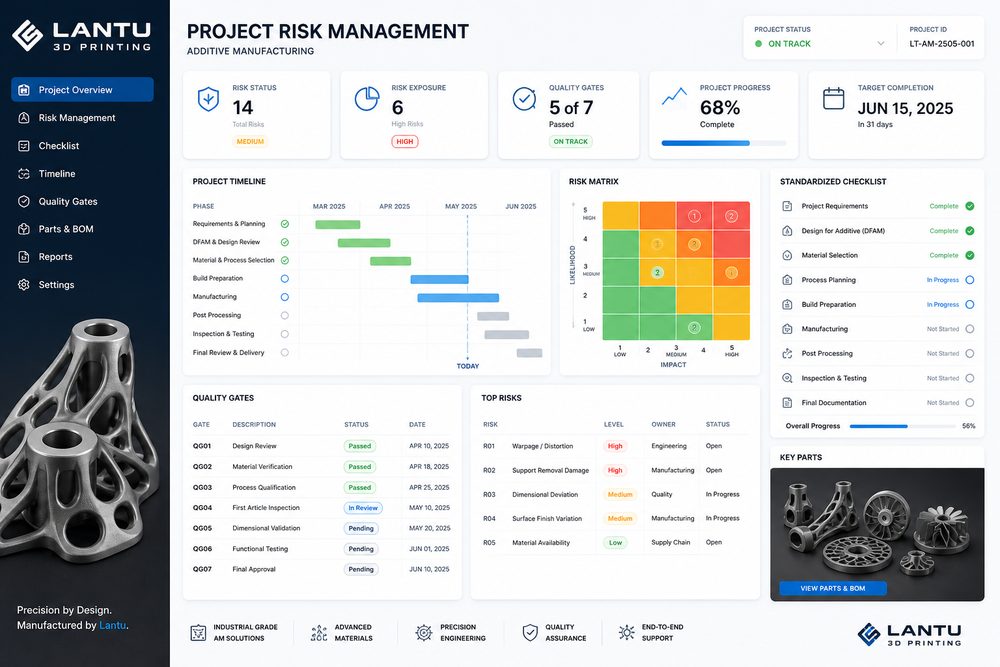
A requirements freeze checklist should include at least: usage scenario, load conditions, appearance level, assembly relationships, dimensional tolerances, color requirements, quantity, lead time, budget range, and unacceptable defects. If this information is missing, the supplier can only quote based on a generic solution, and the result often becomes "it was made, but it is not what we wanted."
2. Model review: identify risks before production
Model review is a core step in reducing project risk. Common issues include non-manifold geometry, reversed normals, insufficient wall thickness, sharp thin edges, holes that are too small, sealed internal cavities, supports that cannot be removed, powder that cannot be cleared, and scaling errors. For complex models, manufacturability checks should be completed before quoting, and risk points should be fed back to the customer in the form of screenshots or a checklist.
Model risk does not mean the part cannot be produced; it means a clear handling strategy is needed. For example, if powder cannot be removed from an internal cavity, powder escape holes can be added or the part can be split; if thin walls are prone to breaking, local thickness can be increased or ribs can be added; if support marks will appear on an exterior surface, the orientation can be adjusted or the part can be redesigned into multiple sections. Moving these decisions earlier helps avoid disputes over responsibility after production.
3. Material and process confirmation: avoid making decisions based on a single metric
Material selection should not be based only on price or strength. Resin is suitable for high detail and excellent appearance, but some materials have limited long-term weather resistance and impact resistance; SLS nylon offers good toughness and adaptability to complex structures, but the surface is visibly granular; metal printing is suitable for high-strength complex parts, but it comes with higher cost, thermal stress, and post-processing requirements. Process selection should comprehensively consider size, accuracy, strength, surface quality, quantity, and post-processing.
A standardized confirmation sheet should list the recommended material, alternative materials, key performance characteristics, potential risks, and sample validation recommendations. For projects where the customer is uncertain, it is better to start with a small sample or a local feature test rather than directly producing the final full-size part.
4. First-article verification: a sample must be established before small-batch production
When the project quantity exceeds a single piece, or when appearance and assembly requirements are high, first-article verification becomes critical. A first article is not a formality; it is a quality gate that determines the production direction. Dimensions, appearance, post-processing results, assembly relationships, packaging method, and the customer's subjective impression should all be checked. Only after the first article is approved does the batch production have a stable reference.
For color and surface effects, it is recommended to keep physical samples or high-resolution photos as the standard; for dimensions and assembly, it is recommended to record measured values of key dimensions. If the customer changes requirements after first-article approval, cost and lead time should be re-evaluated instead of folding the new requirements into the original quote.
5. Delivery acceptance: turn points of dispute into measurable criteria
Common disputes during delivery include whether layer lines are acceptable, whether color differences exceed the limit, whether support marks count as defects, whether dimensional deviation affects assembly, and how responsibility for packaging damage should be assigned. The best way to solve these problems is to define acceptance criteria at the beginning of the project rather than judging them ad hoc after delivery.
The acceptance checklist can be divided into critical items and general items. Critical items include assembly dimensions, functional performance, quantity, and damage condition; general items include slight layer lines on non-appearance surfaces, support marks in non-visible areas, and color differences within the allowable range. This both protects the customer's rights and avoids placing unlimited undefined responsibility on the manufacturer.
Conclusion
The value of risk management in 3D printing projects lies in turning uncertainty into items that can be discussed, recorded, and verified. From requirements freeze, model review, material and process confirmation, first-article verification, to delivery acceptance, every step helps reduce rework and disputes. For enterprise customers, choosing a platform with full-process management capabilities is far more likely to ensure project success than simply looking for the lowest unit price.
Submit a model, drawing, image or written notes. Engineers will review material, process, finishing and delivery based on actual use.