Introduction: If the requirements are unclear, every step afterward gets more expensive
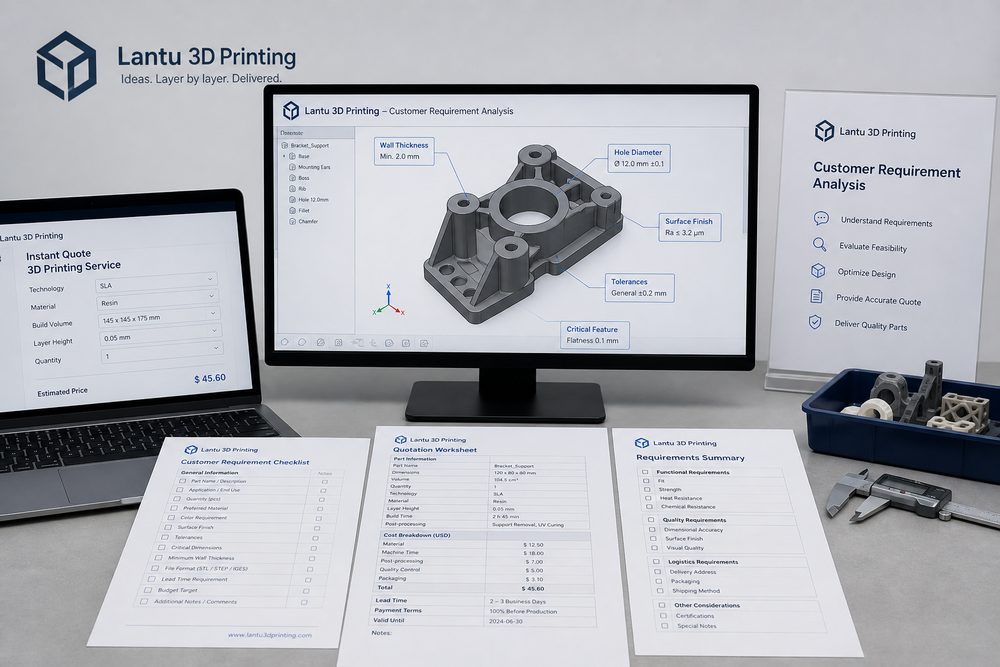
The most common opening line in 3D printing services is: “I have a model, please print it for me.” If the service team only quotes based on volume and material, deviations are likely to appear later: the customer actually needs a functional part but chose brittle resin; the customer wants a display-quality finish but did not budget for post-processing; the customer wants fast delivery but requires high precision on critical dimensions. The goal of requirement analysis is to make these hidden needs explicit before quoting.
lantu3D Printing treats requirement analysis as the starting point of lifecycle management. Only by understanding the use case, risks, and acceptance method can the team choose the right material, process, post-processing, and delivery plan, instead of reducing 3D printing to “upload a file and charge by weight.”
1. What is this part for? The use case determines the material and process
The use case is the most important question. Display models focus on appearance and color; functional prototypes focus on strength and assembly; fixtures and jigs focus on wear resistance and stability; medical or automotive parts may involve compliance and safety. Different use cases can lead to completely different material choices for the same model.
For example, transparent appearance parts may be best produced with SLA transparent resin plus sanding and painting; impact-resistant functional parts may be better suited to SLS PA12 nylon; high-temperature or high-strength metal parts may require SLM or a hybrid CNC manufacturing approach. Without use-case information, material recommendations can only be guesses.
2. What are the loads and operating conditions? Functional parts require a clear working profile
For functional parts, it is necessary to understand load direction, load magnitude, usage frequency, temperature, humidity, chemical exposure, and service-life requirements. A fixture under static load and a clip that is repeatedly bent have completely different design requirements. Z-axis interlayer strength, fatigue in thin walls, and stress concentration at holes can all become risk points.
If the customer cannot provide exact load data, the team can still estimate the risk level from the usage scenario. The service team should clearly state which projects can be printed and validated directly, and which require structural optimization, simulation, material testing, or a small pilot sample first. Explaining the risks upfront is usually more professional than explaining a failure after delivery.
3. What appearance level and post-processing are expected?
Customers define “good-looking” very differently. Some accept layer lines and support marks, while others want a finish close to injection molding. Requirement analysis should clarify the appearance surfaces, color, texture, painting, polishing, transparency, and acceptable defects. Grade-A display samples often require multiple rounds of sanding, filling, primer, and topcoat, and both cost and lead time are significantly higher than for ordinary functional parts.
Post-processing also affects dimensions. Painting, dyeing, sandblasting, and vapor smoothing can all change surface condition and fit clearance. For assembled parts, the post-processing sequence and the method for protecting critical dimensions should be explained in advance.
4. Which dimensions are truly critical? Accuracy requirements must be defined by level
Not every dimension needs high precision. Requirement analysis should ask the customer to mark critical dimensions, mounting holes, locating faces, and functional surfaces. Ordinary overall dimensions can be controlled within standard process tolerances, while critical fit areas may require design adjustments, allowance reservations, or secondary machining.
For example, threaded holes can be printed as pilot holes and then tapped; shaft holes can be printed first and then reamed or CNC-finished; snap-fit structures need sample verification of elasticity and clearance. Defining accuracy by level helps avoid raising the cost of the entire project for only a few critical areas.
5. How do quantity, lead time, and budget balance?
The strategy for a single prototype, small-batch validation, and mass delivery is different. Single-piece projects focus on speed and first-time success; small-batch projects focus on nesting efficiency and consistency; mass projects must also consider tooling, inspection, packaging, and traceability. When the lead time is tight, some appearance finishing may need to be sacrificed or a faster process selected; when the budget is limited, the core function should take priority.
The service team should break the solution into required and optional items. For example, base printing, critical-dimension finishing, appearance painting, strength testing, and expedited delivery can be quoted separately so the customer understands where the cost comes from. Transparent quoting helps build trust.
6. Is the file ready for production?
The model file should be checked for units, watertightness, wall thickness, normals, overlapping surfaces, tiny features, and assembly segmentation. STL files often have broken surfaces and thin-wall issues, while STEP files are more suitable for engineering modifications. For oversized models, complex internal cavities, or multi-part assemblies, manufacturability should be assessed before quoting.
If the model is not ready for direct printing, the service provider should clearly define the repair scope and responsibility boundaries: is it a free minor fix, or does it require remodeling, structural optimization, or engineering design services? Otherwise, later modifications can easily become hidden costs.
7. What are the acceptance criteria? Define success before delivery
Project success should be defined before the work begins. Acceptance criteria can include a dimensional report, appearance sample, assembly test, functional test, material certificate, photo confirmation, or on-site customer trial use. Without acceptance criteria, both sides can only judge quality by feel at delivery.
For complex projects, it is recommended to set a first-article confirmation step. Produce one part or a group of key samples first, confirm the material, appearance, and fit, and then move on to the remaining quantity. First-article confirmation can significantly reduce the risk of batch rework.
Conclusion: Good requirements are half of good delivery
3D printing requirement analysis should revolve around seven questions: use case, operating conditions, appearance, dimensions, quantity, files, and acceptance. The clearer the questions, the more accurate the material selection, the more transparent the quote, and the lower the production risk. lantu3D Printing connects requirements, design, process, and delivery through a platform-based workflow, helping customers turn a simple “please print this for me” into a clear, executable manufacturing project.
Submit a model, drawing, image or written notes. Engineers will review material, process, finishing and delivery based on actual use.