
Introduction: Environmental impact and sustainable development needs of 3D printing
The global manufacturing industry generates more than 7 billion tons of industrial waste every year. The material utilization rate of traditional subtractive manufacturing is only 15-25%, and a large amount of leftover materials and cutting waste cause resource waste. As an additive manufacturing technology, 3D printing has a theoretical material utilization rate of more than 95%, but actual production still faces environmental challenges such as material waste, energy consumption, and waste disposal. According to a 2023 report by Wohlers Associates, the global 3D printing industry consumes more than 120,000 tons of plastic materials annually, of which about 25% becomes printing waste and support materials.
The EU's "Green Deal" requires the manufacturing industry to reduce carbon emissions by 55% by 2030. China is promoting the green transformation of the manufacturing industry under the "double carbon" goal. With its characteristics of on-demand production, zero inventory, and near net shape, 3D printing technology has become an important technological path to achieve sustainable development. This article systematically explains the practical solutions for 3D printing environmental protection and sustainable development from the four dimensions of green materials, recycling, energy optimization, and business models.
1. Green materials and environmentally friendly processes
The 3D printing green material system mainly includes three categories: bio-based materials, degradable materials, and recycled materials. Each material has specific environmental protection parameters and application scenarios.
Bio-based materials:PLA (polylactic acid) is the most widely used bio-based 3D printing material. The raw materials are derived from renewable resources such as corn starch and sugar cane. Typical PLA material performance parameters: tensile strength 50-70MPa, flexural strength 80-100MPa, biocarbon content ≥85%, and can be completely degraded in 45-90 days under industrial composting conditions. Compared with traditional ABS materials (petroleum-based), PLA production reduces carbon emissions by 68% and does not contain harmful volatiles such as styrene. The PLA+PHA composite material developed by the Dutch company ColorFabb improves toughness by adding 20% PHA, and the elongation at break increases from 6% of PLA to 15%, and is widely used in consumer product printing.
Degradable materials:PVA (polyvinyl alcohol) water-soluble support material can be dissolved in 60°C warm water after printing, achieving zero-waste support removal and avoiding the use of chemical solvents. Typical dissolution parameters: It takes 15-20 minutes for a 50μm thick PVA support to completely dissolve in 40°C water. In the Ultrafuse 3D printing material series launched by BASF in Germany, the BVOH (butadiene-ethylene-styrene copolymer) support material can be quickly dissolved in cold water. The dissolution rate is 3 times faster than PVA, and the hygroscopicity is reduced by 60%. It is suitable for printing complex structures in the FDM process.
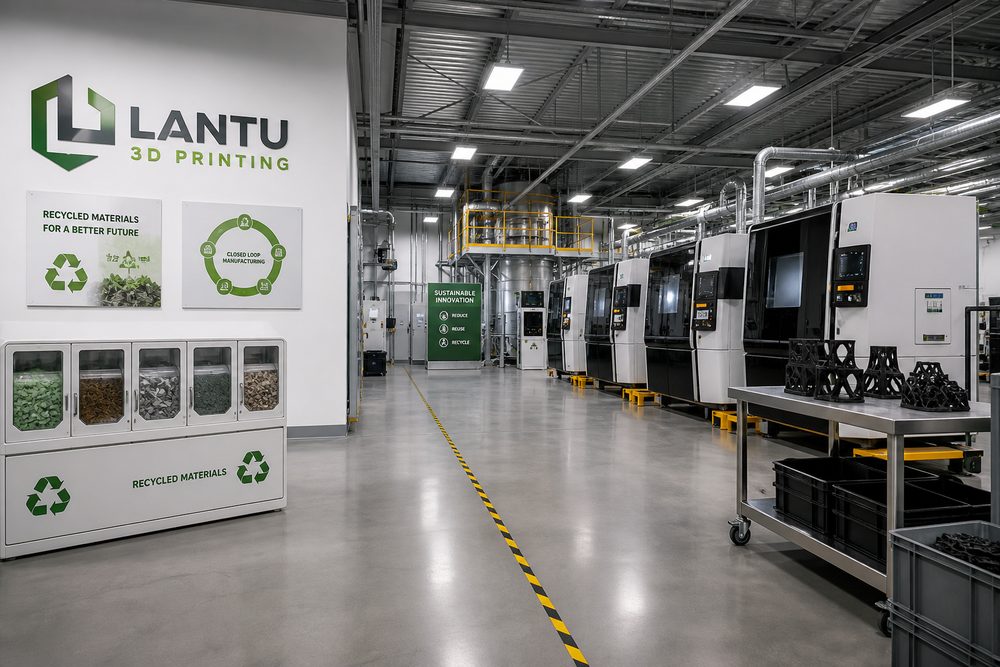
Recycled materials: Consumer-grade PET bottles are recycled into PETG printing materials and have been commercialized. Gigabot The German recycling material certification standard DIN EN 15343 requires the recycling ratio of recycled materials to be marked. Currently, the recycling content of mainstream recycled PLA/PETG materials in the market is 30-50%, and high-end products can reach more than 80%.
Environmentally friendly process parameters: Material extrusion temperature directly affects energy consumption and emissions. The recommended printing temperature for PLA is 190-220°C, which reduces energy consumption by about 15% compared to ABS (230-260°C); the SLS process PA12 powder preheating temperature is 170°C, and the laser power is 30-50W, which reduces energy consumption by 25% compared to injection molding PA12 (melting temperature 260°C). HP Multi Jet Fusion technology uses infrared heating to replace laser sintering, reducing energy consumption by 40% compared to traditional SLS, and shortening the single-piece manufacturing cycle to 1/10 of traditional processes.
2. Waste recovery and recycling
3D printing waste mainly includes three types: failed printing parts, support structures, and powder residues. Establishing a closed-loop recycling system is the key to realizing a circular economy.
FDM waste recycling process:A typical recycling system includes four steps: crushing, cleaning, granulating, and drawing. The industrial-grade waste crusher can crush the printing waste into 5-10mm particles, and the crushing energy consumption is about 0.5kWh/kg; cleaning removes oil stains and impurities, and using water-based cleaning agents can reduce environmental pollution; the granulator melts and extrudes the particles, and the granulation temperature is 180-200°C; the wire drawing machine processes the particles into printing consumables with a diameter of 1.75mm or 2.85mm, and the diameter tolerance is controlled at ±0.05mm. The all-in-one recycling, granulating and drawing machine developed by 3devo, a Dutch startup company, can realize closed-loop recycling of laboratory-grade waste, with a single batch processing capacity of 2-5kg and a retention rate of 85-90% of the mechanical properties of recycled materials.
Powder recycling technology:SLS/MJF process powder utilization rate is a key indicator of environmental protection. The standard powder refresh rate of EOS PA2200 (PA12) is 1:50, that is, 1 part of recycled powder can be added for every 50 parts of new powder, and the proportion of recycled powder is about 2%. HP MJF technology uses full powder bed fusion, and the recovery rate of unmelted powder can reach 80%, which can be directly reused after screening (particle size range 50-80μm). Actual production data shows that after the powder is recycled 10 times, the material fluidity and sintering performance still meet the standard requirements, and the tensile strength decreases by
Submit a model, drawing, image or written notes. Engineers will review material, process, finishing and delivery based on actual use.