Introduction: The Additive Manufacturing Revolution in Energy Equipment Manufacturing
The energy equipment manufacturing industry serves as a crucial safeguard for national energy security and is a core sector of the high-end equipment manufacturing industry. With the acceleration of the global energy transition and the advancement of "dual carbon" goals, energy equipment is developing towards high efficiency, cleanliness, and intelligence. With advantages such as a high degree of design freedom, high material utilization rates, and short production cycles, 3D printing technology is bringing new possibilities to energy equipment manufacturing. From burner optimization to the manufacturing of wind turbine blades, 3D printing is demonstrating immense application value across multiple energy equipment sectors.
Optimized Design and Manufacturing of Burners
The burner is a core component of energy equipment such as gas turbines, boilers, and industrial kilns, and its performance directly affects energy conversion efficiency and pollutant emissions. Traditional burner designs are constrained by manufacturing processes, resulting in relatively simple structures that struggle to achieve optimal aerodynamic and combustion characteristics. 3D printing technology enables the manufacturing of burners with complex internal flow channels, porous structures, and biomimetic structures, significantly improving combustion efficiency and reducing pollutant emissions. For example, gas turbine burners manufactured using 3D printing have achieved a 5-8% increase in combustion efficiency and a 30-50% reduction in nitrogen oxide emissions by optimizing the fuel-air mixing structure. Key technologies for 3D printed burners include: combustion chamber structure design (optimizing fuel injection, airflow organization, and flame stabilization); cooling structure design (integrating conformal cooling channels to improve the burner's temperature resistance); material selection (high-temperature alloys and ceramic matrix composites to withstand high-temperature corrosive environments); and post-processing techniques (hot isostatic pressing and coating treatments to enhance density and corrosion resistance). Burners operate in harsh environments, placing extremely high performance requirements on 3D printed parts, which necessitates rigorous testing and certification.
High-Efficiency Heat Exchanger Manufacturing
Heat exchangers are widely used devices in energy equipment for heat transfer and recovery. Constrained by manufacturing processes, traditional heat exchangers typically adopt shell-and-tube or plate structures, resulting in limited heat transfer efficiency. 3D printing technology enables the manufacturing of heat exchangers with complex flow channels, high specific surface areas, and compact structures, significantly enhancing heat transfer efficiency, reducing equipment volume, and lowering material consumption. For instance, 3D-printed microchannel heat exchangers exhibit a 50-100% increase in heat transfer efficiency and a 60-70% reduction in volume compared to traditional shell-and-tube heat exchangers. Key technologies for 3D-printed heat exchangers include: flow channel design (optimizing fluid flow paths, enhancing turbulence, reducing pressure drop); structural design (thin-walled structures, lattice structures, and biomimetic structures to increase specific surface area); material selection (stainless steel, titanium alloys, and aluminum-silicon alloys selected based on operating temperature and medium); and surface treatment (coating and surface modification to improve corrosion resistance and anti-fouling properties). 3D-printed heat exchangers have broad application prospects in industries such as aerospace, automotive, chemical, and power generation, and are particularly suitable for application scenarios where space is limited, weight is critical, and high efficiency is required.
Wind Turbine Blade Manufacturing
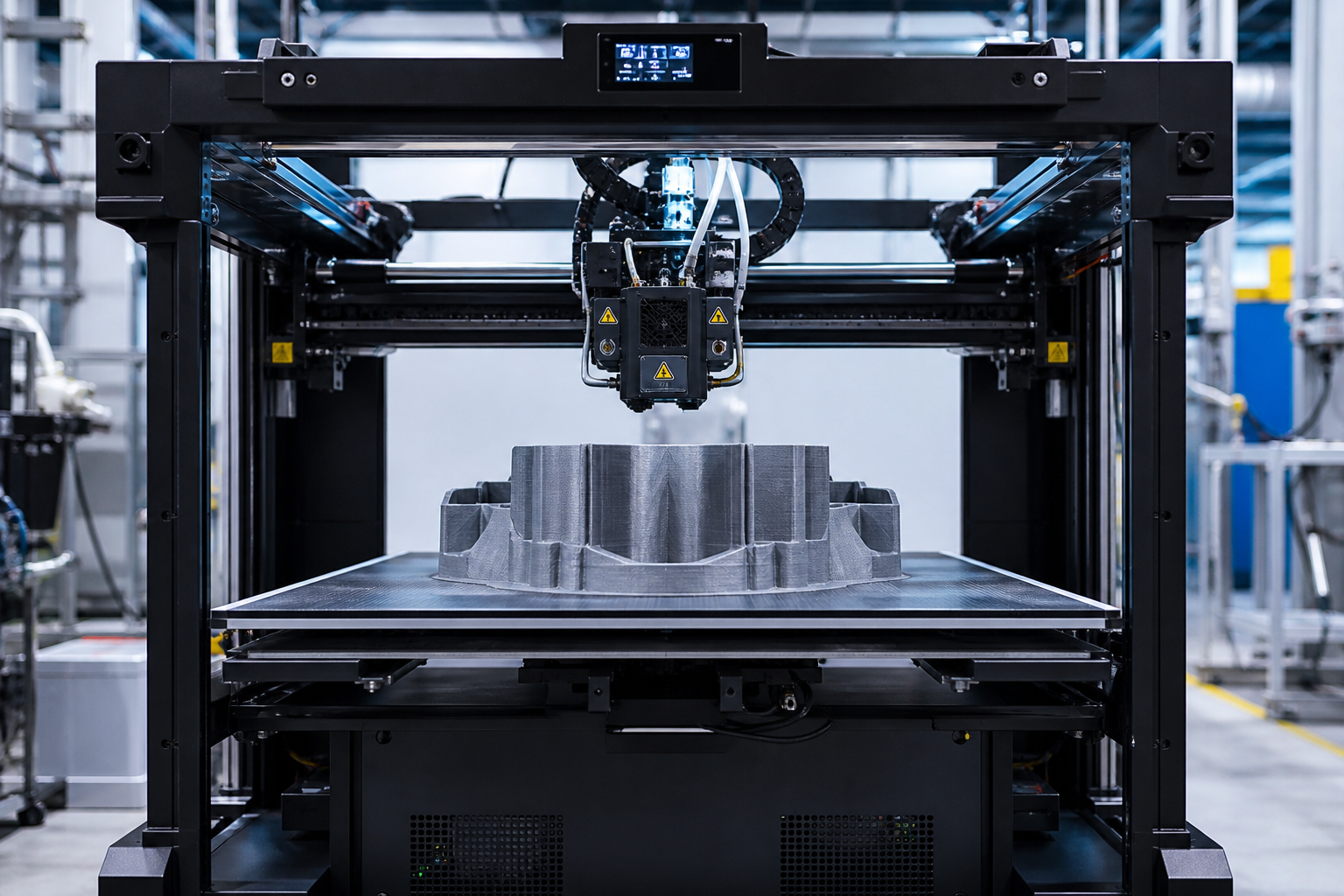
Wind turbine blades are critical components of wind power generation systems, and their design and manufacturing standards directly impact power generation efficiency and costs. Traditional blade manufacturing employs composite layup processes, which are characterized by long production cycles, high costs, and difficulty in achieving complex aerodynamic optimization designs. 3D printing technology has introduced new possibilities for blade manufacturing: manufacturing complex aerodynamic shapes (optimizing blade airfoils, edge structures, and surface textures to enhance aerodynamic efficiency); manufacturing lightweight structures (adopting lattice or hollow structures to reduce blade weight); manufacturing functionally integrated structures (integrating sensor mounting structures, cable routing channels, and lightning protection systems); and rapid prototyping (shortening the blade development cycle and accelerating the verification of new technologies). Although it is currently difficult for 3D printing to directly manufacture full-length blades (typically 60-80 meters), it is feasible to manufacture key blade components (such as blade tips, blade roots, and connectors) or scaled prototypes. In the future, with the development of large-scale 3D printing equipment, the direct printing of full-length blades will become possible. Key technologies for 3D printed blades include: large-scale printing equipment (gantry or robotic 3D printing systems); composite material printing (carbon fiber reinforced thermoplastic composites); online quality inspection (real-time monitoring of printing quality and automatic correction of deviations); and post-processing techniques (heat setting, surface coating, and balance correction).
Energy Storage Equipment Component Manufacturing
Energy storage is an integral component of the energy system and is critical for balancing supply and demand as well as enhancing the utilization rate of renewable energy. 3D printing technology offers unique advantages in the manufacturing of energy storage devices: battery structure optimization (fabricating complex electrode structures, porous current collectors, and three-dimensional battery structures to enhance energy density and power density); fuel cell component manufacturing (fabricating bipolar plates, gas diffusion layers, and membrane electrode assemblies to optimize fluid distribution and current collection); supercapacitor manufacturing (fabricating high specific surface area electrodes and porous current collectors to improve capacitive performance); and thermal management systems (fabricating battery pack cooling structures and phase change material radiators to improve thermal management efficiency). For instance, the use of 3D printing to fabricate electrodes for lithium-ion batteries, through the optimization of electrode microstructures, can increase energy density by 20-30% and charging speed by 50-100%. Key technologies for 3D printed energy storage devices include: electrochemical material printing (developing electrode and electrolyte materials suitable for 3D printing); structural design (optimizing electrode microstructures and battery macrostructures); interface engineering (improving electrode/electrolyte interfaces and reducing interfacial impedance); and safety design (preventing safety issues such as short circuits, overheating, and leakage). Energy storage devices demand extremely high levels of safety and reliability; therefore, 3D printed components must pass rigorous safety testing and certification.
Application of Petroleum Drilling and Production Equipment
Oil drilling and production equipment operates in harsh environments, imposing extremely high requirements for the corrosion resistance, wear resistance, and high-temperature resistance of components. 3D printing technology can provide high-performance parts for oil drilling and production equipment: downhole tools (manufacturing drilling tools, completion tools, and well logging tools with complex structures); valves and pump bodies (manufacturing corrosion-resistant and wear-resistant valve and pump body parts); pipeline connectors (manufacturing pipe joints, tees, and elbows with complex flow channels); and rapid supply of spare parts (rapidly printing urgently needed spare parts on-site to reduce downtime). For example, oil drill bits manufactured using 3D printing have achieved a 15-25% increase in drilling efficiency and a 30-40% extension in drill bit life through the optimization of cutting element layout and cooling channel design. Key technologies for 3D printing oil equipment include: corrosion-resistant alloy printing (Hastelloy, Inconel, duplex stainless steel); surface hardening treatments (carburizing, nitriding, laser cladding to improve surface hardness and wear resistance); quality inspection (non-destructive testing, performance testing to ensure component reliability); and certification systems (obtaining certifications from API, ISO, and other petroleum industry standards). The petroleum industry demands extremely high equipment reliability, requiring 3D printed parts to undergo sufficient verification and testing before being put into service.
Nuclear Power Plant Component Manufacturing
Nuclear power plants impose extremely strict requirements on equipment safety and reliability, as any failure could lead to severe consequences. The application of 3D printing technology in nuclear power plants primarily focuses on: spare parts manufacturing (producing spares for discontinued equipment to resolve supply chain issues); complex structural components (fabricating parts with complex structures that are difficult to machine using traditional processes); and rapid response (quickly manufacturing urgently needed parts during maintenance outages to minimize downtime losses). For instance, a nuclear power plant utilized 3D printing to manufacture steam generator plugs; while traditional manufacturing requires 3 months, 3D printing takes only 2 weeks, with quality fully meeting nuclear-grade requirements. Key technologies for 3D printing nuclear-grade components include: nuclear-grade material printing (using Stainless Steel 316L and Nickel-based alloys 600/690 to meet nuclear-grade material standards); quality control (full-process quality traceability, non-destructive testing, and performance testing); certification systems (obtaining nuclear safety equipment certification and nuclear-grade manufacturing qualifications); and radiation protection (considering performance variations of printed parts under radiation environments). The greatest challenge in applying 3D printing in nuclear power plants lies in certification and licensing, requiring close collaboration with nuclear safety regulatory authorities to establish a certification system for 3D printed nuclear-grade parts.
Material Selection and Performance Requirements
Energy equipment operates under harsh conditions, imposing extremely high requirements on material performance. The selection of 3D printing materials requires consideration of: high-temperature performance (creep strength, oxidation resistance, thermal fatigue resistance); corrosion resistance (acid resistance, alkali resistance, salt spray resistance, stress corrosion resistance); mechanical properties (strength, toughness, fatigue performance, fracture toughness); welding performance (weldability, welded joint properties); and long-term stability (long-term service performance, aging characteristics). Common 3D printing materials include: superalloys (Inconel 718, Hastelloy X, suitable for high-temperature environments); stainless steels (316L, 17-4PH, suitable for corrosive environments); titanium alloys (Ti-6Al-4V, suitable for lightweight requirements); and ceramic materials (alumina, silicon carbide, suitable for high-temperature and corrosion-resistant environments). Material performance must be verified through rigorous testing: room-temperature/high-temperature tensile testing, impact testing, fatigue testing, creep testing, corrosion testing, thermal cycling testing, etc. Only when material performance meets the requirements can 3D printed parts be safely used in energy equipment.
Quality Control and Certification System
Energy equipment concerns national energy security and the safety of people's lives and property, making quality control of paramount importance. 3D printed energy equipment parts require the establishment of a comprehensive quality control system: raw material control (powder composition, particle size distribution, oxygen content, sphericity); process control (printing parameter monitoring, layer thickness control, temperature control, atmosphere control); non-destructive testing (X-ray testing, ultrasonic testing, penetrant testing, magnetic particle testing); performance testing (mechanical property testing, metallographic analysis, dimensional accuracy inspection); certification systems (ISO 9001 quality management system, ASME nuclear certification, API petroleum certification, DNV GL offshore certification). The key to quality control lies in establishing a full-process traceability system, from raw materials to the final parts, with detailed records for every step to ensure that quality issues can be located, analyzed, and improved. At the same time, it is necessary to establish a performance database for 3D printed parts to accumulate long-term service experience, providing a basis for design optimization and quality control.
Future Development Trends
3D printing holds broad application prospects in energy equipment manufacturing. Future development trends include: scaling up (developing large-scale 3D printing equipment to directly manufacture large energy equipment parts); high performance (developing higher-performance materials and processes to meet more demanding working conditions); intelligentization (integrating sensors and intelligent control to achieve intelligent monitoring and optimized operation of equipment); green development (adopting eco-friendly materials and processes to reduce energy consumption and environmental pollution); and standardization (establishing design, process, inspection, and certification standards for 3D printed energy equipment). With the deepening advancement of the energy transition, 3D printing will play an increasingly important role in new energy equipment manufacturing (such as hydrogen energy equipment, energy storage equipment, and smart grid equipment). Meanwhile, the combination of 3D printing and traditional manufacturing (hybrid manufacturing) will also become an important development direction, fully leveraging the advantages of both processes to achieve quality improvement and efficiency enhancement in energy equipment manufacturing.
Conclusion
3D printing is bringing profound changes to energy equipment manufacturing. From burner optimization to wind turbine blade manufacturing, from heat exchangers to energy storage equipment components, 3D printing demonstrates immense application value across multiple energy equipment sectors. Although challenges such as material properties, quality control, and certification remain, these obstacles are being gradually overcome with continuous technological advancements and the accumulation of application experience. Energy equipment manufacturing enterprises should actively embrace 3D printing technology, explore application scenarios suitable for their own businesses, and enhance equipment performance and manufacturing efficiency. In the future, 3D printing is bound to become an indispensable and critical process in energy equipment manufacturing, making significant contributions to the energy transition and national energy security.
Submit a model, drawing, image or written notes. Engineers will review material, process, finishing and delivery based on actual use.