Introduction: Lightweight requirements and the value of topology optimization
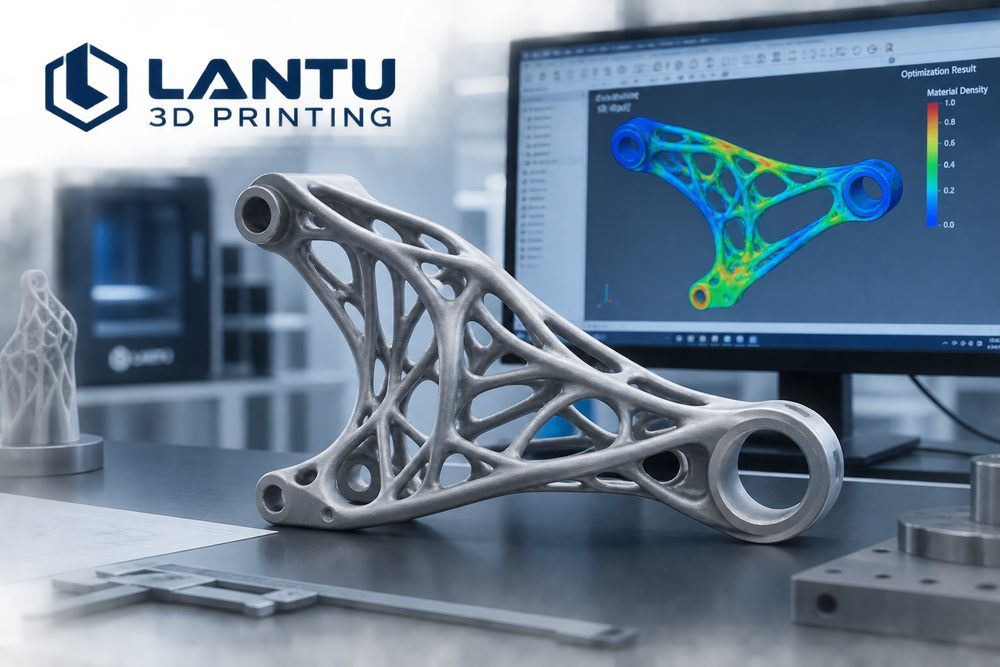
In aerospace, automobile manufacturing, medical equipment and other fields, weight reduction of parts directly affects product performance and cost. Traditional design relies on rules of thumb, and the material utilization rate is only 35%-45%. However, topology optimization based on force transmission paths can increase the material utilization rate to more than 85%. Data from an aviation company's turbine engine bracket project show that after topology optimization, the part mass was reduced from the original 2.8kg to 1.06kg, a weight reduction of 62%, while the fatigue life was increased by 40%. This achievement reveals the huge value of the combination of topology optimization and 3D printing technology - breaking through the limitations of traditional manufacturing processes and realizing true bionic structural design.
1. Basic principles of topology optimization
1. Core of SIMP density method algorithm
The most mainstream SIMP (Solid Isotropic Material with Penalization) density method in topology optimization discretizes the design domain into finite units, assigns the density variable ρ (0-1) to each unit, and establishes the interpolation relationship between material density and elastic modulus:
E(ρ) = E₀ × ρ^p
Where p is the penalty factor (usually 3.0), which promotes the unit density to converge to 0 (empty) or 1 (real). The objective function is to minimize the structural flexibility, and the constraint is the upper limit of the volume fraction.
2. Optimize the solution process
The complete optimization process includes four core steps: geometric discretization (meshing), sensitivity analysis, density update, and convergence determination. Sensitivity analysis uses the adjoint method to calculate the derivative of the objective function with respect to the density variable. The numerical formula is:
∂C/∂ρₑ = -p × ρₑ^(p-1) × uₑᵀ × K₀ × uₑ
Where uₑ is the unit displacement vector, and K₀ is the solid material stiffness matrix. Data from a certain automotive control arm project shows that Hexa-dominant meshing was used, with a unit size of 2.5mm, a total number of units of about 187,000, and 45 optimization iterations to reach the convergence standard (objective function change
Submit a model, drawing, image or written notes. Engineers will review material, process, finishing and delivery based on actual use.