Introduction: One Process Patent, and Three Departments All Believe They Should Be Named
An additive manufacturing team files an invention patent for a “titanium-alloy thin-wall part processing parameter set.” The process engineer adjusts laser power and scanning strategies; the structural engineer modifies supports and part orientation; the test technician runs twelve in-furnace coupon builds and issues a density report; and the project manager initiates the project and drafts the technical disclosure. Once the patent is granted and rewards are to be distributed, disputes arise: who qualifies as an inventor, what allocation weights apply, and whether an engineer who left six months earlier remains eligible. Such disputes are common in R&D-oriented 3D printing companies. Parameter sets, model files, and test records are stored across different systems, and teams often look for evidence only when inventorship must be determined, leaving little more than a verbal consensus that “everyone participated.” A lifecycle approach from design blueprint to physical delivery treats the entire process as manageable; ownership and rewards for R&D results should likewise form a verifiable segment of that lifecycle, rather than being left to personnel judgment. This article breaks down employee-invention classification, inventorship, contribution evidence chains, reward calculations, and dispute boundaries into implementable fields and criteria.
1. Start with Three Outcomes: Is the Result an Employee Invention?
The assessment should not begin with “who contributed effort,” but with legal ownership. The core rules under the Patent Law and its implementing regulations can be divided into three verifiable conditions. First, determine whether the invention was made in carrying out the tasks of the organization. This includes inventions made within the scope of the employee’s duties, while performing a specific R&D assignment separately assigned by the organization, or within one year after resignation, retirement, or transfer, where the invention relates to the employee’s former duties or assigned work at the original organization. The third category is the easiest to overlook. The register should retain three fields—job description, project assignment, and termination date—and automatically screen cases using “termination date + 365 days + task relevance.”
Second, determine whether the invention primarily used the organization’s material and technical resources. In 3D printing, these should be expressly listed: metal powder or resin batch numbers, LPBF machine time, non-public process parameter libraries, simulation software licenses, in-furnace test coupons and inspection reports, and customer-provided models and operating-condition data. If an employee merely uses company equipment for an incidental experiment unrelated to their duties, it does not automatically constitute an employee invention. However, where the parameter set, powder batch, and test data originate from the organization, it is difficult to claim the result as an individual achievement.
Third, define the boundary of agreement priority. An organization and an inventor may agree on ownership and rewards through employment contracts, project-specific agreements, or legally established internal rules. However, such agreements may not deprive inventors of their basic rights to be named and to receive rewards or remuneration, nor may they assign an employee invention to an individual without compensation in advance. The result should be recorded in one of three states: employee invention / non-employee invention / evidence pending. For evidence-pending items, the missing field, responsible person, and completion deadline must be logged. A case must not be closed based on an assumption that it “should be” resolved.
2. Inventorship: Participation Alone Does Not Merit Attribution; a Creative Contribution to Substantive Features Does
Ownership by the organization does not mean everyone within the organization may be named. An inventor is a person who makes a creative contribution to the substantive features of an invention. In practice, this can be assessed through three criteria: whether the person proposed or defined the technical problem to be solved; whether the person conceived a substantive technical feature that distinguishes the solution from prior art; and whether the person helped implement and verify the effectiveness of that feature. In 3D printing R&D, an engineer who proposes the combined feature of “zoned variable power plus interlayer direction changes” to suppress thin-wall warpage meets all three criteria. Personnel who operate the machine using established parameters, perform standard tensile tests, compile data reports, or manage schedules and purchasing generally provide routine labor or management and do not become inventors on that basis.
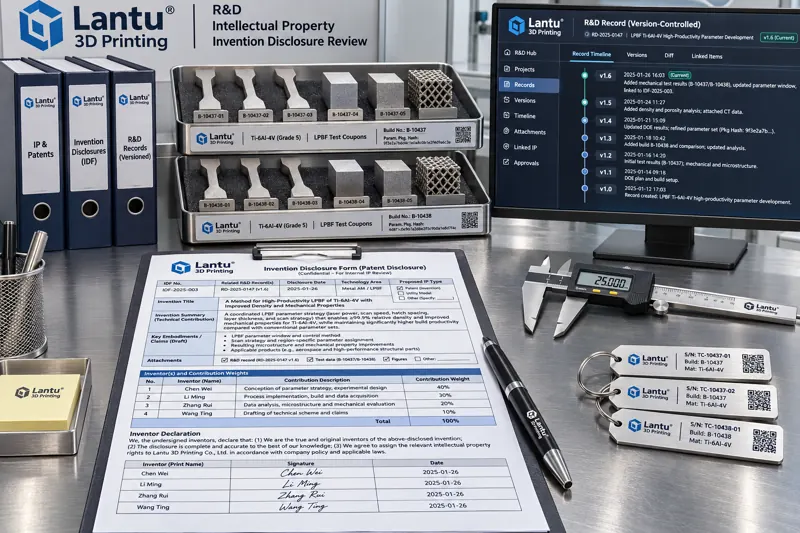
It is advisable to document these criteria in an invention disclosure form. Each technical feature should occupy one row, with columns for “feature description / contributor / proposal date / supporting record number / verification record number,” jointly signed by the technical lead and IP specialist. This ensures that the inventor list is no longer determined by seniority or departmental balance, but by documented proof of who proposed each technical feature. Where multiple people jointly complete the same feature, they should be jointly named based on their contribution records, without preset weighting. Weights are used only for subsequent reward allocation, not for inventorship attribution.
3. Contribution Evidence Chains: Making Attribution and Allocation Reviewable by Third Parties
The key to verifiability is to preserve records already generated during R&D, rather than reconstructing them afterward. The minimum evidence set includes five categories. First, project initiation and assignment documents: project number, R&D objective, participant roles, start and end dates, and change records. Second, design files: STEP/3MF model hashes, version numbers, revision notes, coordinate-system and unit declarations, preventing an untraceable “final version.” Third, process and trial-production records: parameter-set hashes, equipment IDs and build numbers, powder batch numbers, preheating curves, and layer-by-layer monitoring summaries. Fourth, verification data: in-furnace coupon location maps, sampling directions, density, mechanical-property, and CT report numbers, as well as raw data point sets. Fifth, invention disclosures and review minutes: when the technical problem was raised, solution comparisons, prior-art search conclusions, and the relationship between the application text and claims in the specification.
Records should follow the ALCOA+ principles: attributable, legible, contemporaneous, original, accurate, complete, consistent, enduring, and available. For 3D printing, particular emphasis should be placed on binding four keys: “build number – parameter-set version – powder batch number – coupon ID.” If any key is missing, the causal connection between test data and the technical solution is broken. All records should include retention periods and access permissions. Accounts of departing employees should be disabled rather than deleted so that log relationships are preserved. In this way, even if a dispute arises two years later, the same records can support the same conclusion.
4. Two Reward Routes and Practical Calculation Bases
Rewards and remuneration follow two routes: agreement priority and statutory fallback. The agreement route refers to rules lawfully established and published by the organization, or written agreements signed with inventors, that specify the method and amount of rewards and remuneration. Internal rules must follow democratic procedures and be published; standards unilaterally added afterward are generally unsuitable as a basis. Where there is no agreement or the agreement is unclear, current laws and regulations on minimum standards and calculations from implementation income apply. Specific amounts and percentages should be determined according to laws effective at the time of application and the organization’s rules; internal policies should not lock in a fixed figure for many years. Both routes must distinguish between a one-time reward upon patent grant and continuing remuneration after implementation or commercialization, the latter being the more frequent source of disputes.
The basis for commercialization income must be fixed before calculation and incorporated into a version-controlled accounting rule. For self-implementation, use the attributable operating profit of the product line covered by the patent as the base. For licensing, use net license income. For equity contribution, use the appraised contribution value and the amount actually paid in. Where multiple patents jointly cover the same product, income should be apportioned according to pre-agreed contribution coefficients to avoid duplicate accruals from the same revenue. For example, if a forming-parameter patent generates annual net licensing income of RMB 1.2 million, a contracted 5% accrual equals RMB 60,000. If three inventors share it at contribution weights of 5:3:2 according to the disclosure form, they receive RMB 30,000, RMB 18,000, and RMB 12,000 respectively. The payment date, tax withholding, objection and appeal window, and reviewer should all be recorded. These figures are illustrative only; actual outcomes depend on contracts and internal rules. The essential point is that the base definition, allocation rule, source of weights, and payment audit trail can all be retrieved and reviewed.
5. Five High-Dispute Boundaries: Put the Rules into Contracts in Advance
First, commissioned development and cooperative development: where ownership is not agreed in a contract, commissioned-development results generally belong to the developer, while cooperative-development results are jointly owned by the parties. External technical agreements must therefore clearly state ownership of the patent application right, rights of use, and subsequent improvements; simply stating that “intellectual property belongs to both parties” is insufficient. Second, customer-supplied models and outsourced trial production: customer-provided models, operating conditions, and materials are customer property. The use boundaries for resulting developments should be linked to the custody register for customer-supplied assets. Customer data must not be directly incorporated into an in-house parameter library and then used for patent applications. Third, open-source models and secondary development: for model files subject to open-source licenses, first review the license’s copyleft obligations and attribution requirements, then determine whether derivative elements are patentable. Fourth, public disclosure and novelty: papers, exhibition samples, bid proposals, and customer demonstrations may all constitute public disclosure. A pre-disclosure IP review gate should ensure that the technical disclosure precedes any external material. Fifth, resignation and role changes: the one-year rule, non-compete arrangements, invention-disclosure obligations during employment, and treatment of undisclosed results upon departure should all be addressed in both onboarding and offboarding checklists.
6. Implementation Checklist and Dashboard
Six minimum executable actions are recommended: establish an invention-disclosure register with ten fields—number, name, type, contributor, proposal date, technical-feature list, evidence number, review conclusion, application number, and ownership status; incorporate the four-key binding of “build number – parameter set – powder batch – coupon” into trial-production work orders; add a pre-disclosure review gate to R&D project templates; unify and version-control the reward accounting rules; review evidence-pending items and one-year post-departure screening quarterly; and establish a written appeal channel for inventorship and reward disputes. The dashboard should track five indicators: average time from disclosure to application, on-time reward payment rate, outstanding evidence-pending items, number of inventorship disputes, and pre-disclosure review coverage. These metrics are not intended for performance evaluation, but to ensure that the system continues to function for the next patent.
Conclusion
The challenge of employee-invention management has never been memorizing legal provisions. It is turning “who proposed which technical feature, based on which test record, and under which income basis the proceeds are allocated” into a retrievable and reviewable record chain. Once the three classification outcomes, three inventorship criteria, five evidence categories, two reward routes, and five boundary rules are embedded into operations, R&D teams can return their attention to the process itself. For an additive manufacturing platform positioned to manage the journey from design blueprint to physical delivery, this record chain is, like models, parameters, and inspection records, part of delivery credibility.
Invia un modello, un disegno, un'immagine o note scritte. Gli ingegneri valuteranno materiale, processo, finitura e consegna in base all'uso effettivo.