Process limitations of minimum wall thickness
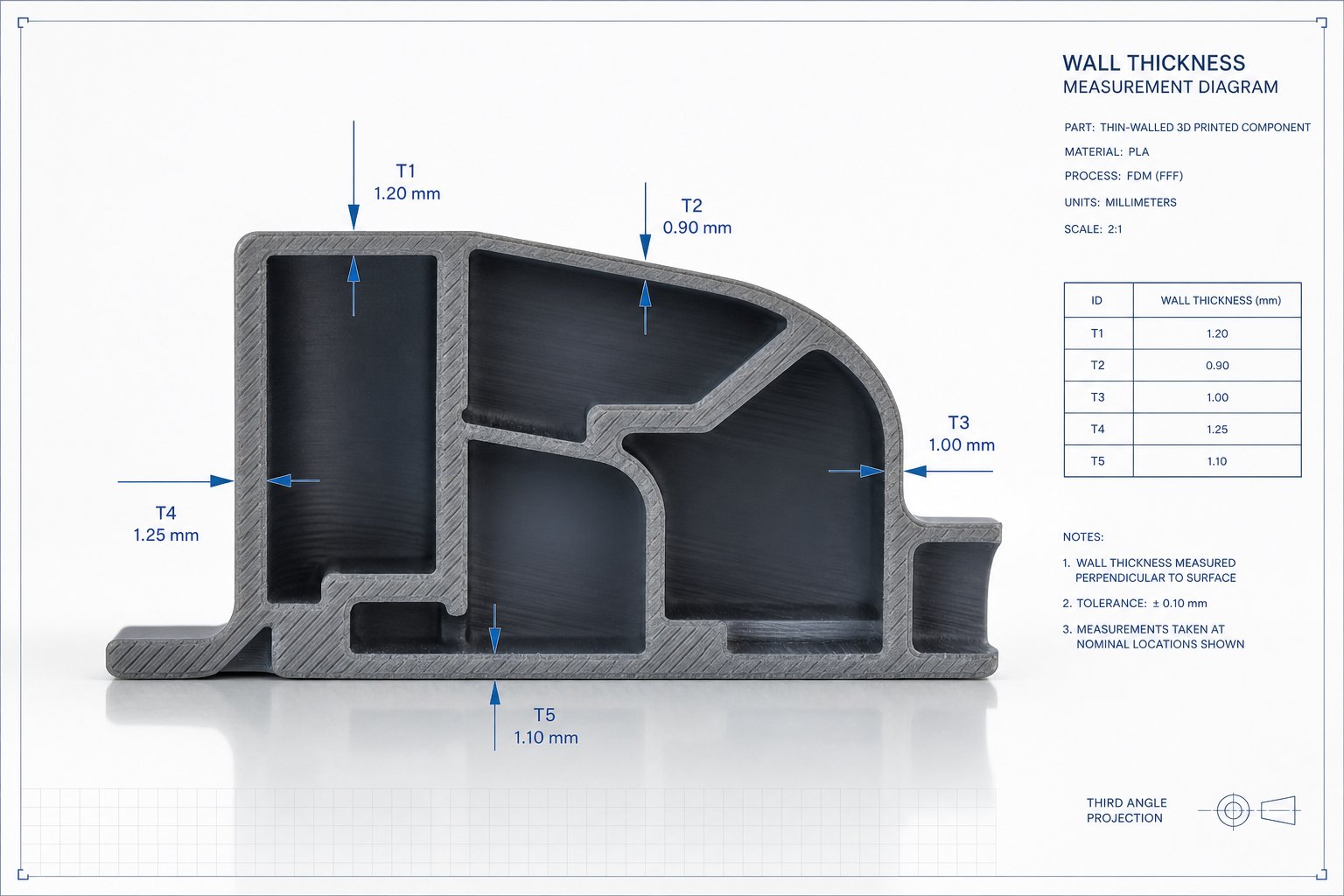
The wall thickness of the FDM process is directly related to the nozzle diameter. The minimum wall thickness is approximately 0.4 times the nozzle diameter. A commonly used 0.4mm nozzle corresponds to a minimum wall thickness of 0.16mm. It is recommended that the wall thickness be no less than 0.8mm to ensure that the interlayer superposition is roughly uniform. The SLA process is limited by resin fluidity and support capacity, and the minimum wall thickness can be more than 0.4mm. Since nylon parts in the SLS process do not require support, the minimum wall thickness can be reduced to 0.7mm, but warping is prone to occur if it is less than 1mm.
The relationship between wall thickness and structural strength
In plate and shell structures, the bending stiffness is proportional to the cube of wall thickness, and the strength gain brought by increasing wall thickness far exceeds the linear relationship. However, when the wall thickness exceeds a certain critical value, the probability of printing defects (bubbles, pores) increases, which in turn reduces the actual strength. For functional parts, adjusting the wall thickness within the range of 1.5mm to 3mm is the most cost-effective range. After exceeding 5mm, it should be changed to a reinforced rib structure to reduce weight and save materials.
Wall thickness uniformity and stress concentration
Sudden changes in wall thickness are the areas most prone to deformation and cracks in 3D printing. At joints where the difference in adjacent wall thickness exceeds 1.5mm, a transition bevel needs to be set to avoid warpage caused by differences in heat accumulation. Symmetrical wall thickness design can also effectively reduce uneven internal stress distribution, which is especially important for the shrinkage of crystalline materials such as nylon.
Submit a model, drawing, image or written notes. Engineers will review material, process, finishing and delivery based on actual use.