1. Selection Logic for SLS Nylon Powder Materials: Start with the Operating Conditions, Then Evaluate the Structure
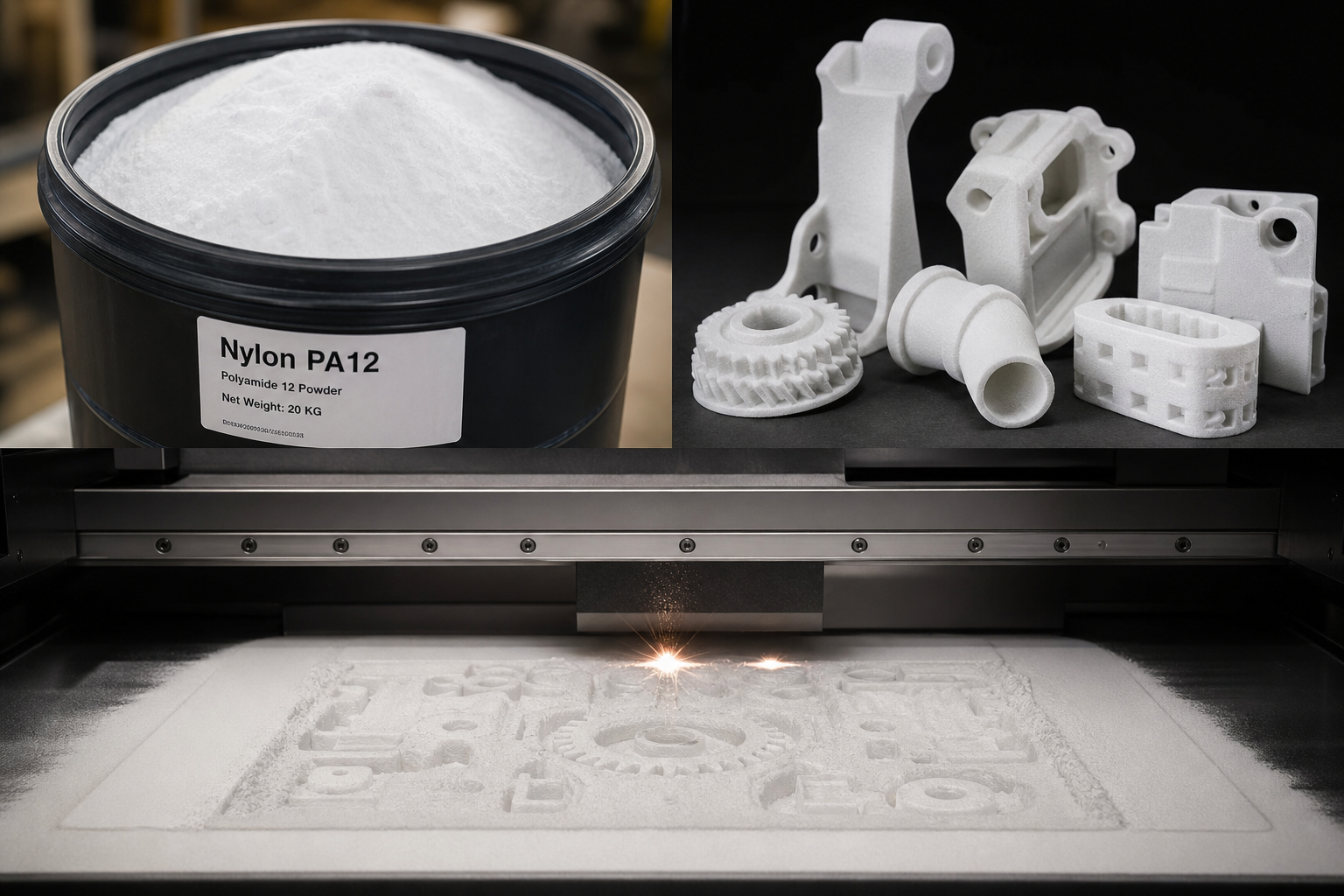
When selecting materials for SLS (selective laser sintering) nylon parts, you cannot look only at whether the strength is high; you need to break down the operating conditions first: load type, temperature range, hot and humid environment, whether fatigue cycling is involved, whether snap-fit toughness is required, and the limits of post-processing and cost. PA12, PA11, and glass-fiber/carbon-fiber reinforced nylons essentially correspond to three design goals: PA12 favors balanced overall performance and process stability; PA11 favors toughness, impact resistance, and low-temperature environments; reinforced nylon favors high stiffness, high dimensional stability, and load-bearing capability. A common mistake engineers make is treating PA12 as the default answer, but in scenarios involving long-term loading, elevated temperatures, or assembly accuracy sensitivity, reinforced nylon is often more cost-effective; in scenarios that require repeated snap-fits, hinges, clamping, and impact absorption, PA11 is often more stable than PA12.
- PA12: Balanced overall performance, suitable for general structural parts, housings, functional prototypes, and low-volume fixtures.
- PA11: Higher toughness, better impact resistance, and stronger fatigue performance; suitable for moving parts, snap-fit parts, and low-temperature service conditions.
- Glass-fiber/carbon-fiber reinforced nylon: High stiffness, low warpage, and strong load-bearing capability; suitable for jigs, fixtures, brackets, and replacements for certain metal parts.
2. Mechanical Property Comparison: Strength, Stiffness, and Elongation Determine How a Part Fails
From the typical properties of SLS-processed parts, PA12 usually has a tensile strength of 45–55 MPa, an elongation at break of about 15%–25%, and a flexural modulus of roughly 1.4–1.8 GPa. PA11 generally has a tensile strength of 40–50 MPa, with strength close to PA12, but its elongation at break can reach 30%–50%, making it less prone to brittle fracture under impact and repeated bending. Glass-fiber reinforced nylon commonly achieves a tensile strength of 60–80 MPa, and its flexural modulus can be increased to 3.5–6 GPa, offering significantly better dimensional rigidity than unfilled nylon. Carbon-fiber reinforced nylon can further push the modulus into the 5–10 GPa range, making it suitable for structural parts with tighter deformation control requirements. It should be noted that the strength of reinforced materials is mainly reflected in stiffness and load paths, not in improved toughness. In fact, many thin-walled parts may crack first at bosses, sharp corners, and hole edges when subjected to assembly impact.
- PA12: Balanced in strength, toughness, and processing stability; suitable for most functional parts.
- PA11: High elongation, with clear advantages in impact resistance and fatigue resistance; more suitable for moving structures and snap-fit designs.
- GF/CF nylon: Higher stiffness and load capacity, but stress concentration must be controlled to avoid brittle cracking in thin walls.
3. Temperature Resistance and Environmental Performance: Heat Deflection Temperature and Hygrothermal Stability Are the Dividing Line
In real-world applications, the thermal performance of SLS nylon is usually more important than the nominal material grade, because printed porosity, powder refresh cycles, and post-processing all affect heat deformation behavior. Typical PA12 has a heat deflection temperature (HDT) of around 95–110°C, and while it can withstand higher temperatures for short periods, dimensional changes become noticeable under long-term thermal loading. PA11 offers better toughness in the mid-temperature range; in many supply chains, its HDT can be close to or slightly lower than PA12, but it is more stable under low-temperature conditions, thermal cycling, and impact loading. The HDT of glass-fiber/carbon-fiber reinforced nylon often rises to 130–180°C, giving it a clear advantage in engine-bay accessories, brackets near heat sources, and fixtures. In terms of chemical resistance, nylon performs well against oils, lubricants, weak alkalis, and most industrial cleaners, but strong acids, strong oxidizers, and high-temperature steam environments still require careful evaluation. For parts that must remain in contact with coolant, cutting fluid, or humid air for long periods, the dimensional drift of reinforced nylon is usually easier to control.
- PA12: Stable in moderate-temperature service, suitable for general mechanical environments and indoor equipment structures.
- PA11: More reliable in impact, low-temperature, and thermal cycling conditions; suitable for outdoor or high-temperature-difference applications.
- GF/CF nylon: Better heat resistance and creep resistance; suitable for parts near heat sources or under long-term static loads.
4. Moisture Absorption and Dimensional Stability: Assembly Accuracy Depends on Ambient Moisture
Nylon materials naturally absorb moisture, and the dimensional accuracy and mechanical properties of SLS parts will fluctuate with changes in moisture content. Under typical conditions, the equilibrium water absorption of PA12 is around 1.5%–2.0%, PA11 is usually controlled within 1.0%–1.5%, and the overall moisture uptake of glass-fiber or carbon-fiber reinforced nylon can be further reduced to 0.6%–1.2% because of the lower resin content. The effects of moisture absorption are mainly reflected in two aspects: first, the part dimensions expand slightly, which is more obvious in long-span structures and thin-wall slots; second, the material becomes softer, with a drop in tensile strength but an increase in elongation at break. For assemblies requiring 0.1–0.2 mm-level fits, it is recommended to consider build orientation, post-processing condition, and service humidity during the design stage, and to leave tolerance compensation in advance. For instrument housings, locating fixtures, and flow-path parts, if long-term dimensional stability is required, reinforced nylon should be prioritized, or PA12/PA11 should be conditioned under controlled temperature and humidity before shipment.
- PA11 is usually more stable in hot and humid environments, making it suitable for outdoor use, transportation, and complex service conditions.
- PA12 has moderate sensitivity to ambient humidity and is suitable for general precision functional parts.
- Reinforced nylon has a lower moisture absorption rate and is suitable for assembly datums, locating holes, and dimension-sensitive structures.
5. Processability, Powder Reuse Rate, and Cost: True Cost in SLS Mass Production
In SLS, material price is only part of the total cost. Powder reuse rate, build window, aging rate of waste powder, and post-processing labor often have a greater impact on the final quote than the price difference per kilogram. PA12 is the most mature material in SLS systems: it has a wide sintering window, stable recoating performance, easy warpage control, and high overall yield, so many service providers use it as the baseline material. PA11 powder flow and thermal behavior are generally more suitable for flexible parts, but its cost is often about 20%–40% higher than PA12. Because reinforced nylon involves more complex powder morphology, machine wear, sintering parameters, and post-processing requirements, the overall cost is usually 1.5–2.5 times that of PA12, and some high-performance grades are even higher. For production parts, it is recommended to compare single-part material cost, build yield, nesting efficiency, scrap risk, and downstream assembly cost at the same time, rather than looking only at the powder price.
- PA12: Mature process and high yield; suitable for stable delivery from small batches to mid-volume production.
- PA11: Higher material cost, but in projects with high toughness requirements it can reduce breakage and rework.
- GF/CF nylon: Higher total cost, but it can replace some aluminum or sheet-metal parts and reduce assembly complexity.
6. Engineering Application Cases: The Differences in Suitable Part Types Are Very Clear
In engineering projects involving Blueprints 3D, PA12 is often used for equipment housings, air ducts, sensor brackets, light-load fixtures, and structural validation parts because it combines printing efficiency with dimensional stability. In one automation project, a customer used PA12 to print a batch of end-effectors protective covers for robotic arms. With a wall thickness of 2.0 mm and ribs of 1.2 mm, the weight per part was reduced by about 35% compared with the aluminum-sheet solution, and the assembly cycle was shortened by more than half. PA11 is more commonly used for snap-fits, hinges, flexible connectors, feet, cushioning parts, and fixtures that require frequent disassembly and reassembly. For example, in a logistics sorting project, the limit tabs printed in PA11 showed a much longer service life than the PA12 version after continuous fatigue testing, with crack initiation delayed by about 30%–40%. Reinforced nylon is often used for load-bearing brackets, grippers, locating bases, and functional parts that replace metal. For instance, a camera bracket printed in carbon-fiber reinforced nylon showed more than a 50% reduction in static deflection compared with the PA12 version under the same geometry, making it better suited to vibration environments and high-precision positioning.
- PA12: Housings, air ducts, validation parts, general-purpose fixtures, and low-to-medium load functional parts.
- PA11: Snap-fits, hinges, cushioning parts, repeatedly bent parts, and parts used in low-temperature or fatigue-prone conditions.
- GF/CF nylon: Fixtures, jigs, load-bearing brackets, locating bases, and replacements for certain metal structures.
7. Selection Recommendations: Match Material Properties to Part Failure Modes One by One
If the project goal is to get the part made first and deliver it stably, PA12 is usually the first choice because on most SLS machines it offers a wide process window, a high build success rate, and good compatibility with post-processing. If the main failure mode is impact cracking, repeated bending, or low-temperature embrittlement, PA11 is the better option. If the main failure mode is excessive deflection, loose screw bosses, creep under long-term loading, or thermal deformation, glass-fiber/carbon-fiber reinforced nylon should be evaluated directly. Design should also take wall thickness into account: for pure nylon parts, wall thickness is generally recommended to be no less than 1.2–1.5 mm, while load-bearing parts more commonly use 2.0–3.0 mm; reinforced nylon can be thinned somewhat while maintaining stiffness, but hole edges, corners, and rib roots still need fillet transitions. For batch orders, it is recommended to first run one round of material coupon testing, then proceed with a small pilot run, focusing on dimensional springback, fit changes after moisture absorption, and assembly fatigue life. This is closer to actual delivery results than relying on the material datasheet alone.
- Prioritize PA12: General structural parts, projects with tight lead times, and cost-controlled applications.
- Prioritize PA11: Projects with high requirements for toughness, impact resistance, fatigue resistance, and low-temperature performance.
- Prioritize GF/CF nylon: High-stiffness, high-temperature, low-creep structural parts and replacements for metal components.
Conclusion
PA12, PA11, and glass-fiber/carbon-fiber reinforced nylon do not have absolute advantages or disadvantages; the key is matching the operating conditions. PA12
Submit a model, drawing, image or written notes. Engineers will review material, process, finishing and delivery based on actual use.