Introduction: Material selection is shifting from “printable” to “verifiably deliverable”
In the past, many projects simplified 3D printing material selection into three categories: resin, nylon, or metal. In real engineering delivery, however, the focus is more on strength, heat resistance, dimensional stability, surface quality, and batch consistency. During project evaluation, Blueprint3D found that if material decisions rely only on the appearance of a single sample, rework often occurs later during assembly, tolerance verification, durability testing, or cost accounting. Therefore, the value of material innovation is not just launching new grades, but enabling a traceable closed loop among design, manufacturing, inspection, and delivery.
1. Metal powder materials: Focus on composition window, flowability, and heat-treatment response
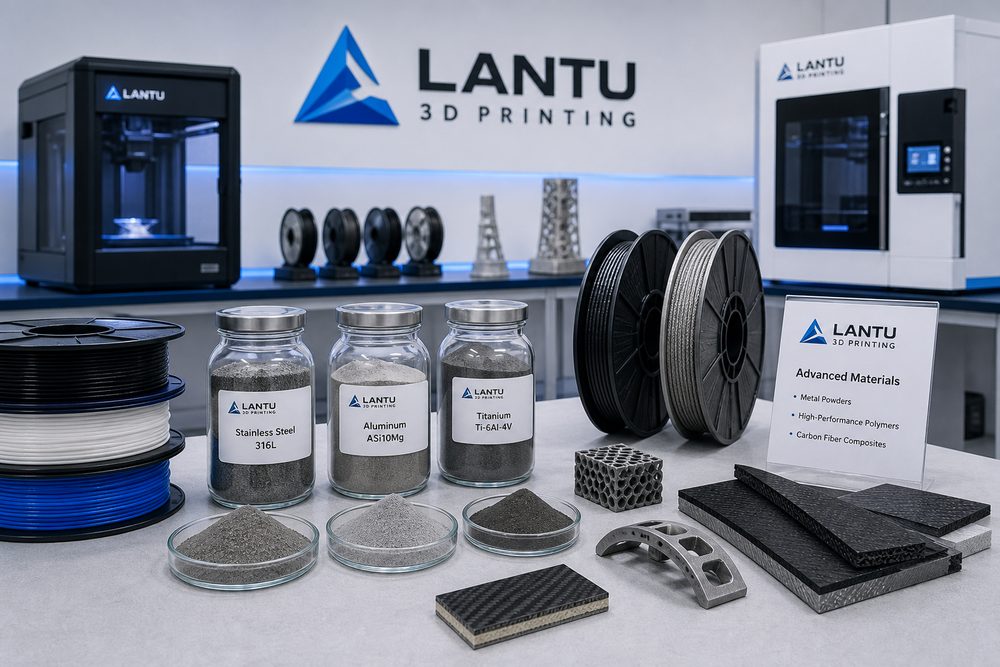
Common SLM metal printing materials include 316L stainless steel, AlSi10Mg aluminum alloy, TC4 titanium alloy, and tool steel. In engineering selection, attention should be paid to powder particle size distribution, typically in the 15–45 micron range; flowability, oxygen content, and the proportion of satellite powder directly affect powder spreading uniformity. Taking TC4 as an example, if the part is used as a lightweight bracket, yield strength, fatigue performance, and microstructural stability after heat treatment should be evaluated at the same time. It is recommended to retain coupons from the same batch during first-article validation for tensile, hardness, and metallographic inspection, rather than judging material qualification solely on successful printing.
2. High-performance polymers: Expanding from appearance parts to functional parts
SLS nylons such as PA12, PA11, TPU, and high-performance polymers such as PEEK and PEKK are taking on more demands for fixtures, piping, light-load structural parts, and heat-resistant components. PA12 is suitable for complex internal cavities and low-volume functional parts, with a typical layer thickness of 0.1–0.12 mm; TPU is suitable for cushioning and sealing applications, but balance is needed among resilience, tear strength, and dimensional shrinkage. For heat-resistant applications, it is not enough to look only at the material’s heat deflection temperature; actual stress conditions, operating time, and environmental media must also be verified.
3. Fiber-reinforced composites: Lightweight does not mean blind reinforcement
Carbon fiber, glass fiber, or chopped-fiber reinforced materials can improve stiffness and thermal stability, but they also introduce anisotropy, increased surface roughness, and greater post-processing difficulty. For drone brackets, automotive inspection fixtures, or robot end effectors, the proper approach is to first identify the main load-bearing direction, then design the fiber orientation, wall thickness, and stiffening ribs accordingly. If the part contains threads, snap-fit features, or thin-wall structures, interlayer bonding strength should be evaluated additionally to avoid local brittle failure.
4. Building a material database: Making quotations and quality management reusable
To make material innovation practical, sample testing, historical quotations, failure cases, and customer feedback must be accumulated into an enterprise database. For each material, at minimum, the recommended process, minimum wall thickness, typical accuracy, post-processing method, unit cost range, and delivery risks should be recorded. Blueprint3D recommends moving material selection to the front end of the requirements review stage, quickly screening through five dimensions—application, size, load, appearance, and budget—and then converging on a solution through sample validation.
Conclusion
Future competition in 3D printing materials will not be about the number of material grades alone, but about the comprehensive competition of material performance, process parameters, inspection standards, and supply chain stability. Only when companies build material databases and continuously update validation results can material innovation truly be transformed into repeatable delivery capability.
Submit a model, drawing, image or written notes. Engineers will review material, process, finishing and delivery based on actual use.